For many patients, Dysport is a strong choice for forehead lines: it tends to work faster than Botox and spreads a little more broadly, which smooths wider areas evenly. That said, the right product depends on your forehead width, how much movement you want to keep, and your injector’s technique. Effects typically last several months or more, and we only use products with Health Canada authorization.
TL;DR:
- Dysport tends to have an earlier onset and potentially longer duration of effect than Botox, especially when used at equivalent units in the forehead.
- Proper injection placement and technique are more crucial than brand choice, with experienced injectors ensuring natural results and avoiding heavy brow effects.
- Results typically appear within three to five days and last around three to four months, but individual factors like muscle strength and metabolism influence duration.
- Confirming that the product used is authorized with a valid Drug Identification Number is essential for safety, as unauthorized injectables pose serious health risks.
- The shape of the forehead and personal goals should guide treatment plans, with Dysport suitable for broader spread in wider foreheads and Botox preferred for more localized effects.
How Dysport and Botox differ for forehead lines
Dysport and Botox are both botulinum toxin type A, but they are not interchangeable. Each has its own formulation, its own unit measurement, and its own typical field of effect once injected, which is why a plan built for one product doesn’t simply transfer to the other.
A split-face randomized study comparing abobotulinumtoxinA (Dysport, often shortened to ABO) with onabotulinumtoxinA (Botox, or ONA) found that Dysport produced earlier onset and a longer duration of effect on frontalis muscle activity, using a 3:1 unit dosing model between the two products. Other comparative reviews of botulinum toxin preparations describe a wider field of effect for ABO formulations, which can suit broad treatment areas like the forehead but which calls for careful planning near the brows.
Here is what tends to separate the two products in practice:
- Dysport often shows visible improvement a day or two sooner than Botox in comparative studies.
- Botox is frequently selected when a clinician wants a narrower, more contained spread.
- Unit conversion between the two is not fixed; your injector tailors the dose to your anatomy and goals rather than applying a simple ratio.
- Some trials report longer median duration with Dysport at specific dosing levels, though results vary by study and by patient.
Neither product is universally “better.” The right one depends on your forehead shape and what your injector is trying to achieve.
What happens in your forehead muscle during treatment
Dysport works by temporarily reducing the release of acetylcholine at the nerve-muscle junction, which lessens contraction in the frontalis, the muscle that raises your eyebrows and creates horizontal forehead lines. With less contraction, the skin over that muscle stays smoother at rest and during expression.
Treatment patterns vary by forehead shape and the look you want:
- Narrow foreheads often need fewer injection points, placed centrally, to avoid pulling on the brows.
- Wider foreheads may need a broader distribution of smaller doses so the smoothing effect reads evenly across the whole area.
- A lighter “baby Botox” style approach uses fewer units and preserves more natural movement, while fuller smoothing uses more units concentrated on stronger muscle activity.
- Placement always respects the distance from the brow line, since injections placed too low or too lateral can affect brow position.
Lateral over-treatment near the outer brow is one of the more common avoidable mistakes, since it can drop the tail of the eyebrow and create an unnatural, heavy look.
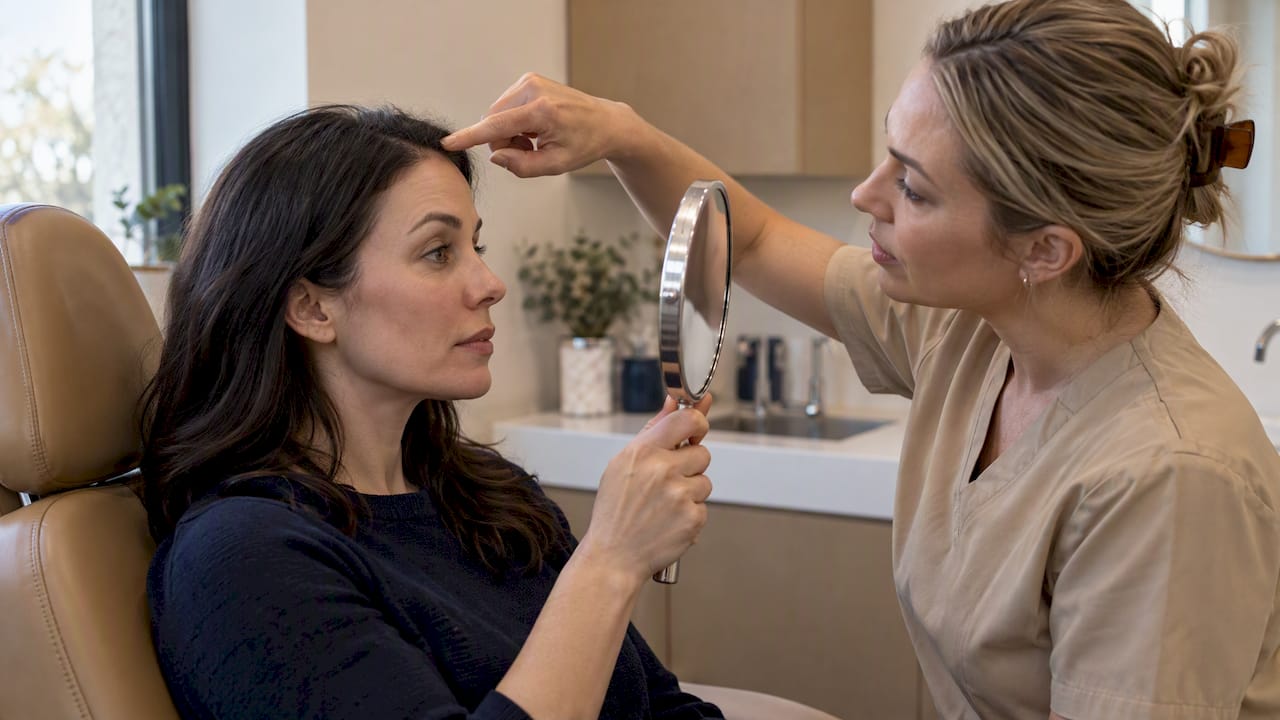
Pro Tip: Ask your injector to show you, on a mirror or photo, exactly where they plan to place each injection before starting, so you understand how the pattern relates to your own brow shape.
How soon Dysport works and how long results last
Most patients notice softening of forehead lines within two to five days of treatment, and many clinics report visible brow lift effects from Dysport specifically within three to five days, a timeline you can read more about on our Dysport brow lift page. Full results generally settle in over the following one to two weeks as the effect reaches its peak.
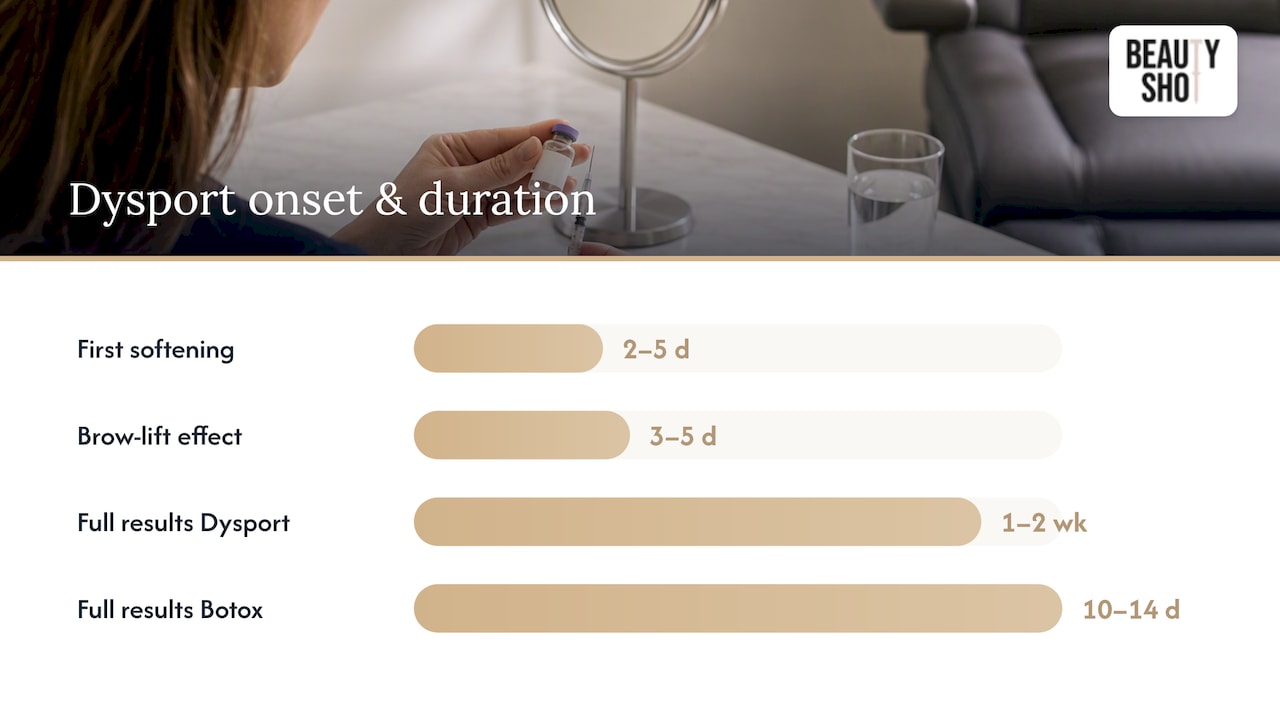
A split-face clinical study found statistically significant longer duration of effect for Dysport compared to Botox across multiple measured endpoints using a 3:1 dosing model, meaning some patients may stretch further past the three-month mark before lines start to return.
Several factors influence how long your results hold:
- The dose used relative to your muscle bulk and strength.
- Whether you have had prior toxin treatments, since response can shift with repeated exposure.
- Individual metabolic differences that affect how quickly the toxin’s effect wears off.
- How precisely the product was placed during injection.
Most patients return for a follow-up treatment around the three to four month mark, though we tailor maintenance scheduling to how your own forehead responds over time. For guidance on what to expect in the days right after treatment, our Dysport aftercare guide walks through the first 48 hours in detail.
Safety, side effects, and confirming an authorized product
Most side effects from Dysport are mild and short-lived: bruising or soreness at the injection site is common and usually resolves within days. Less common but more significant effects can include eyelid or brow droop, localized muscle weakness, and headache, all of which Health Canada’s cosmetic injection guidance lists among the recognized risks of botulinum toxin injectables.
Before any treatment, it is worth confirming that the product your injector is using is authorized for sale in Canada. Every authorized product carries an eight-digit Drug Identification Number (DIN), and you are entitled to ask your clinic to show it to you.
- Ask to see the product packaging and confirm its DIN before treatment begins.
- Avoid any clinic that will not disclose which product, brand, or lot is being used.
- Confirm your injector has a plan for managing complications, should they arise.
Canadian enforcement actions have seized unauthorized injectable products sold online, and health officials have warned that unauthorized injectables can carry serious health risks.
Confirming a product’s DIN before treatment is one of the simplest steps a patient can take to protect their own safety.
Who is a good candidate and how to pick the right injector
Dysport is generally well suited to adults who want to soften forehead lines without losing natural expression, but it is not right for everyone. Pregnancy, certain neuromuscular conditions, and some medications are reasons to avoid treatment or to discuss alternatives with a qualified provider first.
When you are evaluating where to book, prioritize training and documented experience over price or convenience:
- Confirm your injector is a registered nurse or physician with formal cosmetic injection training, not simply someone who has attended a weekend course.
- Ask directly which product they plan to use, its DIN, and how many units they recommend for your forehead.
- Ask what timeline you should expect to see results and how they handle touch-ups if the outcome needs adjustment.
- Ask what their plan is if you experience an unexpected reaction or complication.
Our consultation checklist walks through these questions in more detail. Be cautious of clinics offering steep discounts, skipping informed consent, or declining to show you product labelling: these are signs worth taking seriously.
Why injector experience often matters more than the brand you choose
In our experience, the skill of the person holding the needle shapes your outcome more than whether the product is Dysport or Botox. Placement, unit selection, and the judgement to adjust for your specific anatomy are what prevent a heavy brow or an uneven result.
Every injection is performed by an advanced cosmetic registered nurse, with a focus on subtle, natural-looking outcomes rather than dramatic change. Dysport brow lift effects often appear within three to five days, while forehead Botox commonly settles into its natural-looking result over ten to fourteen days; this pattern is discussed further on our forehead Botox page.
Our take on choosing between Dysport and Botox
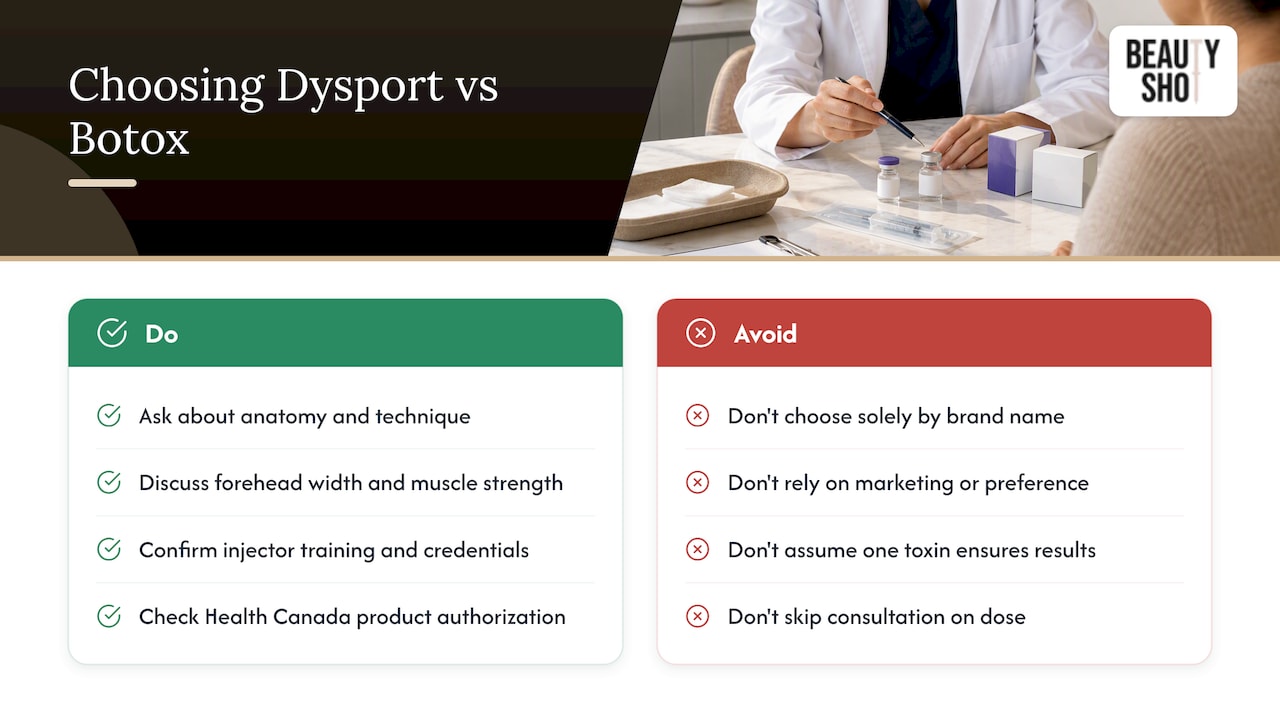
The research supports a simple conclusion: Dysport and Botox both work well for forehead lines, and the published differences in onset and duration, while real, are modest next to the effect of injector skill. Too much of the public conversation treats this as a brand decision, as though picking the “right” toxin guarantees a good result. It does not.
What gets underestimated is how much a forehead’s width, muscle strength, and brow position should drive the choice of product and dose, not personal preference or marketing. A wider forehead may benefit from Dysport’s broader spread; a narrower one may call for a more contained approach. We believe patients should walk into a consultation asking about anatomy and technique first, and worry about brand names second. Confirming your injector’s training and the product’s Health Canada authorization matters more than which toxin is on the label.
— Felix
How we approach Dysport treatment at Beauty Shot Medical Clinic
Every Botox and Dysport treatment at our clinic is performed by an advanced cosmetic registered nurse, with a personalized plan built around your forehead anatomy rather than a one-size-fits-all dose. We take the time to walk through your goals, confirm the product’s Drug Identification Number with you, and explain exactly what to expect before we inject anything.
- Review our full range of Botox and Dysport services to see what a consultation includes.
- Learn more about our Dysport and Botox offerings and what each appointment covers.
- Book a consultation to discuss your forehead, your goals, and which product fits your anatomy best.
FAQ
What are the downsides of Dysport?
The most common downsides are mild bruising or soreness at the injection site, which usually clear within a few days. Less often, patients experience eyelid droop, muscle weakness, or headache, which is why precise placement and an experienced injector matter.
Why do I still have wrinkles after Dysport?
Fine lines that were already deeply etched into the skin before treatment may not fully disappear, since Dysport relaxes the muscle but does not resurface skin. Under-dosing for your muscle strength or treating too lightly can also leave some movement and lines visible.
Which is better for forehead lines, Dysport or Botox?
Neither is categorically better: a split-face clinical study found Dysport had earlier onset and longer duration of effect at specific dosing levels, while Botox is often chosen for a more contained, targeted spread. The better fit depends on your forehead width and the judgement of your injector.
Why do I still have lines in my forehead after Botox?
This usually comes down to dosing that was conservative relative to your muscle strength, or treatment that focused on a different pattern than where your lines form. A follow-up appointment to adjust units and placement typically resolves this.
Sources
- Objective: To measure and compare the duration of action of abobotulinumtoxinA and onabotulinumtoxinA (split-face study) — PMC
- Unauthorized injectable health products sold online and seized … – Government of Canada