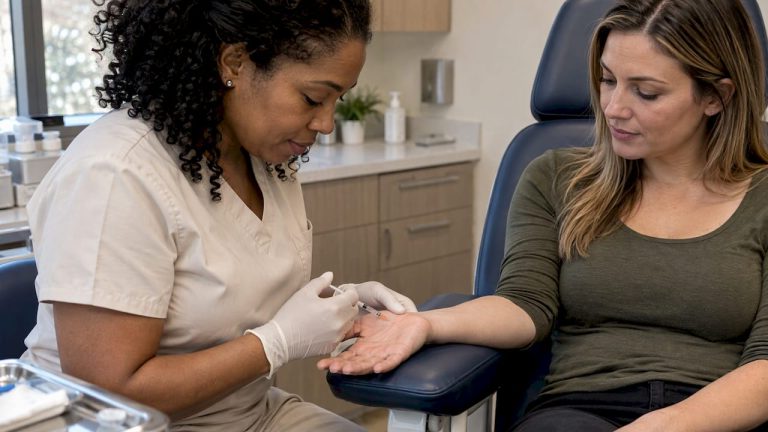
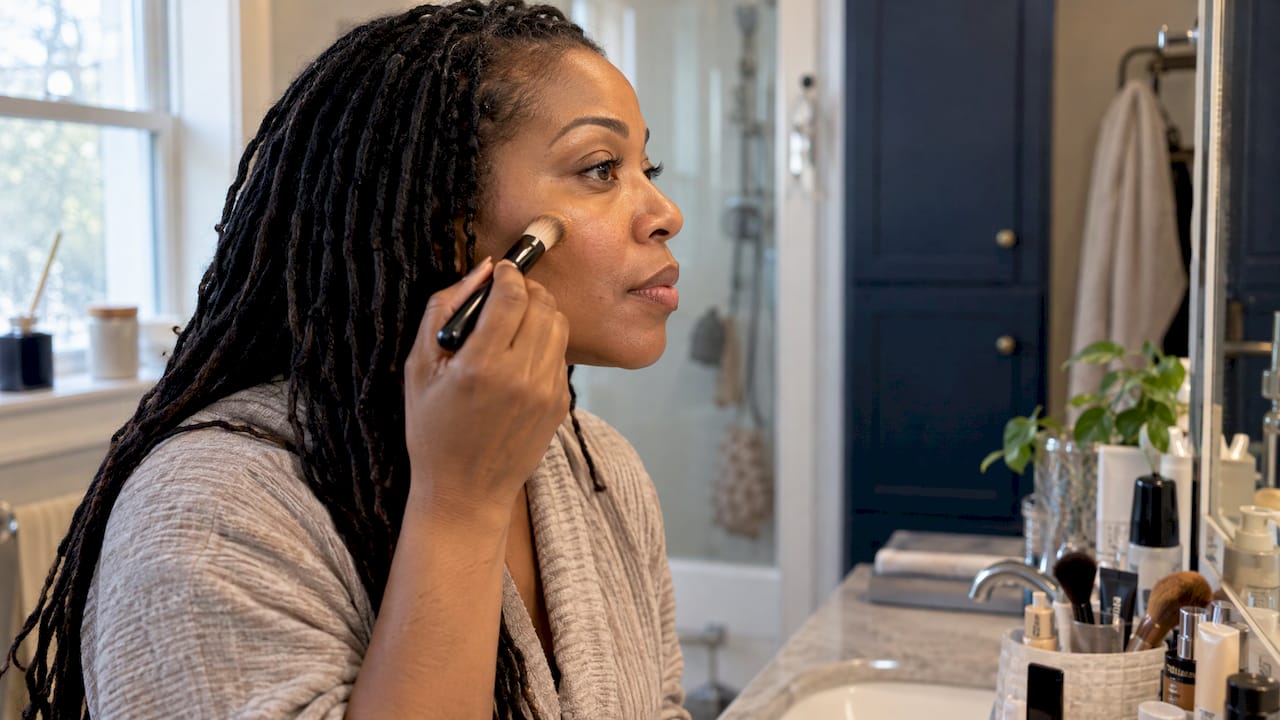
For most people, the safe answer is to wait until the next day. That means about 24 hours before you put makeup on or near the treated area. Lips need the most care, because lipstick, liner and gloss touch the injection sites directly and the area often swells more. If you have visible injection marks, bruising or noticeable swelling, wait a little longer. Your injector’s instructions come first, because they depend on the area treated and the product used.
This guide explains the timing for each area, why the wait matters, how to apply makeup gently once it is safe, and what to do if you wore it too early.
TL;DR
- Plan on about 24 hours with no makeup on the treated area. Some sources allow a shorter wait for non-lip areas, but 24 hours is the simplest rule to follow.
- Lipstick, liner and tinted balm should wait a full day, and longer if your lips are still swollen or have small injection marks.
- Once you start, use clean hands, clean brushes and fresh sponges, and pat the product on. Do not rub or press.
- Call your injector right away if you see blanching, a dark or mottled patch, or pain that is unusual.
- Wearing makeup too soon is common and usually fixable. Remove it gently and tell your injector.
How long to wait, by treatment area
The table below gives practical timing as we guide patients in our Woodbridge clinic. Healing differs from person to person, so treat it as a starting point and follow the instructions you were given at your appointment.
| Treated area | Skin makeup (foundation, concealer, powder) | Lip products (lipstick, liner, tinted balm) |
|---|---|---|
| Lips | Avoid near the lips for 24 hours | 24 hours at minimum, longer if swollen or marked |
| Under-eye hollows | 24 hours, then apply very gently | Not affected |
| Cheeks and temples | 24 hours | Not affected |
| Chin and jawline | 24 hours | Wait 24 hours if the chin product is near the lip line |
| Nasolabial folds and marionette lines | 24 hours | Wait 24 hours if products would touch the mouth area |
| Neck lines | 24 hours | Not affected |
These timings are cautious on purpose. Published guidance varies. Experts quoted by Byrdie suggest skipping makeup for at least 12 hours after lip injections, with lipstick or balm acceptable from about 24 hours if applied delicately. Elle quotes a physician who recommends pausing your makeup routine until the day after filler. Waiting a full day sits comfortably inside both.
Why the wait matters
Every filler injection is a tiny opening in the skin. In the first hours, those openings are still closing. Makeup is not sterile, and brushes, sponges and fingertips all carry bacteria. Pressing, buffing or dragging product across the area can also move filler that has only just been placed.
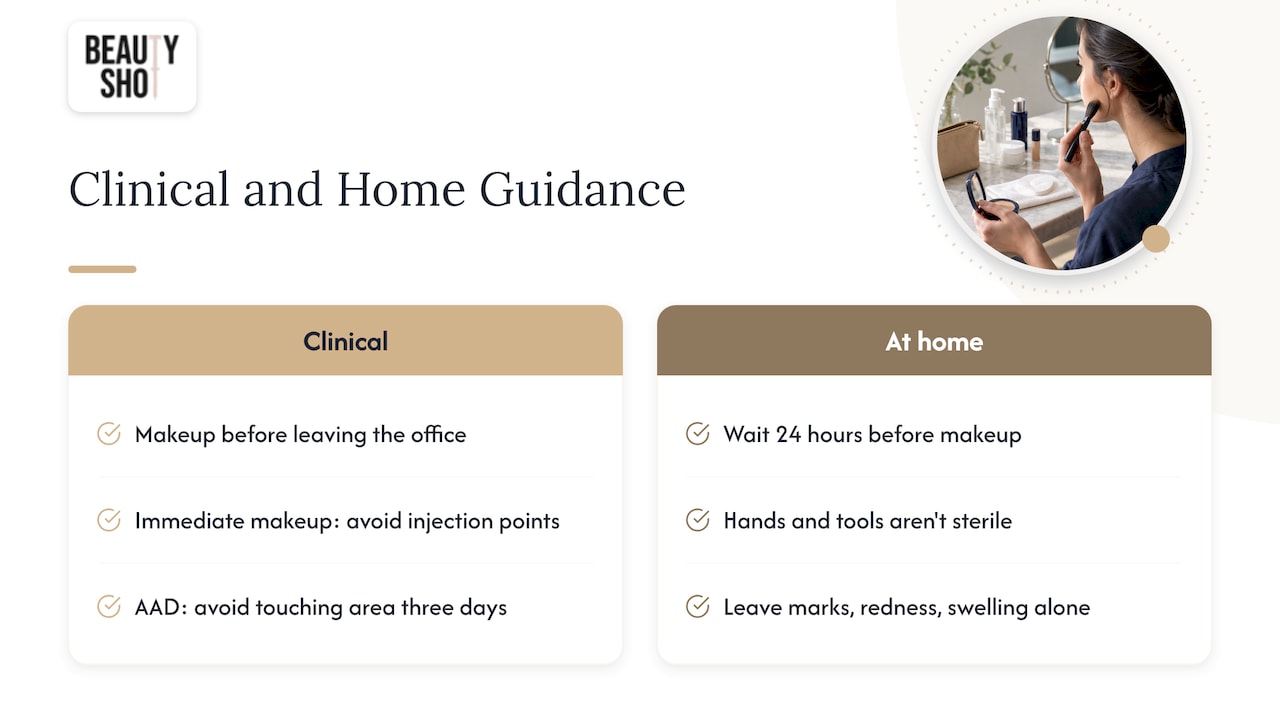
The research reflects that caution. A 2021 peer-reviewed review on corrective makeup notes that makeup should not be applied until the skin barrier has recovered, to prevent superinfection or contact dermatitis. The same review also says that after minimally invasive procedures such as hyaluronic acid fillers, cosmetics may be applied right away as long as the injection points are avoided, particularly after a cannula technique.
The American Academy of Dermatology says patients should be able to apply makeup before leaving the office after a filler injection, and should avoid touching the treated area for three days unless told to massage it.
How do we reconcile “immediately” with “wait a day”? Those sources describe what is medically possible, usually with sterile technique and a professional applying product away from injection points. What we ask of patients at home is more cautious. At home your hands, brushes and products are not clean-room clean, you may be tired and rushed, and the skin may show tiny marks, redness or swelling you want to leave alone. A full day costs you very little and removes most of the risk.
Lip filler: the area that needs the most patience
Lips are the most common reason people ask this question. They are also the area where makeup is most likely to cause trouble. Lipstick and liner sit directly on fresh injection points, and you tend to touch, press and lick your lips without thinking. They also swell easily after treatment, so a lip that feels fine in the morning may look different by evening.
Our guidance for lips:
- First 24 hours: no lipstick, liner, gloss or tinted balm. Use a plain, clean lip balm only if your injector says it is fine.
- After 24 hours: if the lips look calm and any tiny marks have closed, choose a fresh product and apply it lightly. Do not use an old lipstick that has been sitting in a bag for months.
- If swelling or bruising remains: wait longer. Covering a bruise with heavy product often means rubbing the area, which is exactly what you want to avoid.
- Skip sharing and testing: do not use shop testers or a friend’s lipstick during healing.
If you are comparing lip treatments, our guide to how soon you can wear makeup after lip fillers goes deeper on products and timing. For a fuller picture of the week ahead, see our lip filler aftercare step by step and essential dos and don’ts. If you are still deciding whether lip filler suits you, this overview of lip filler safety and expectations covers what to expect before you book.
Had a lip flip with Botox or Dysport instead? The healing is different, and we cover that in how soon you can wear lipstick after a lip flip.
Cheeks, under-eyes, jawline and other areas
Skin makeup over cheeks, temples, chin and jawline is usually less of a worry than lipstick, but the same 24-hour rule applies for the same reasons: open injection points and filler that has not yet settled.
Under-eye hollows deserve extra thought. The skin there is thin, and concealer is often pressed and blended with fingers or a sponge. After the first day, pat concealer on with a clean fingertip or a clean, soft brush. Do not drag or rub, and take off eye makeup with a gentle, non-tugging method at night.
Cheeks and temples often feel firm or slightly tender for a few days. Avoid contouring techniques that involve pressing a sponge hard into the cheekbone for the first several days. You are trying to avoid pressure on filler that is still settling.
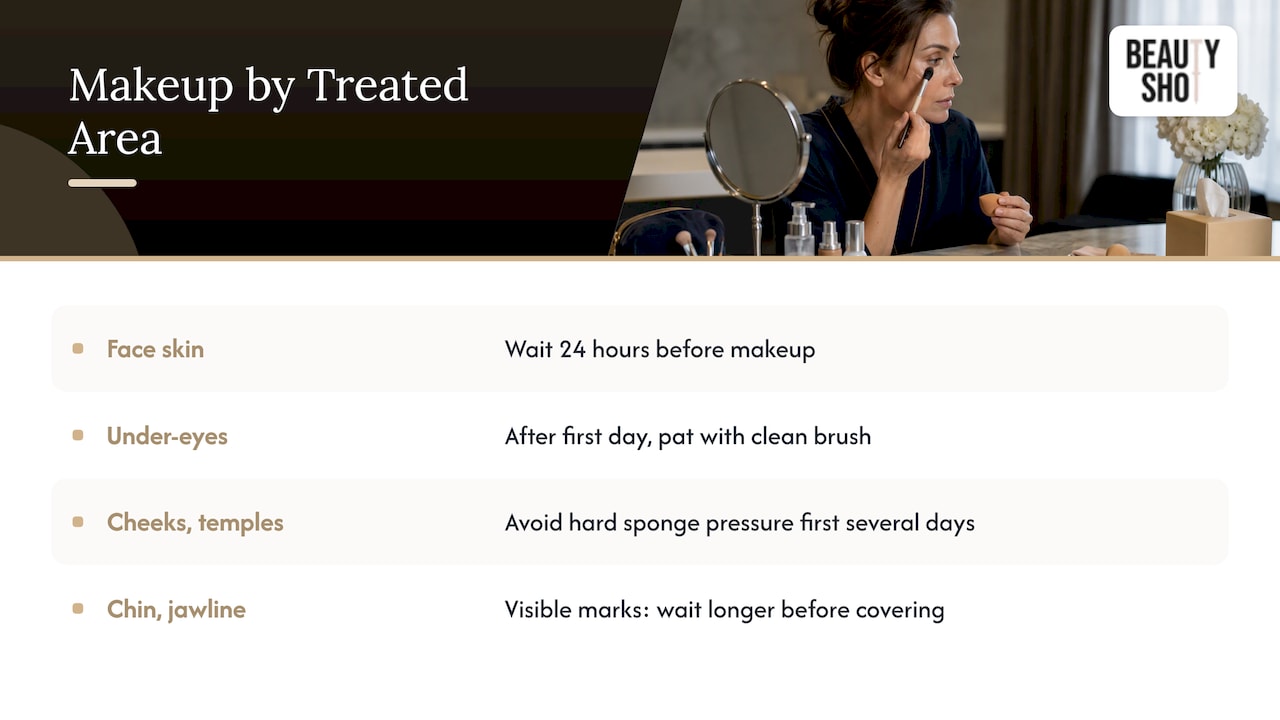
Chin and jawline treatments can show small marks or bruising. If you can see them, give them a bit longer to close before covering.
If bruising appears, resist the urge to cover it on day one. Let the skin settle, then use a light touch. Our guide to alcohol after fillers also explains why we ask patients to be careful in the first days, since alcohol can make bruising and swelling more noticeable.
How to apply makeup safely once the wait is over
When the first day has passed and the skin looks calm, you can return to your routine with a few habits that protect your results.
- Wash your hands first. This is the simplest and most useful step.
- Use clean tools. Wash brushes beforehand and use a new or freshly washed sponge. Old tools hold product and bacteria.
- Choose fresh products. Avoid anything old, shared or past its date, especially lip and eye products.
- Pat, do not rub. Use light tapping movements. Skip circular buffing over treated areas.
- Avoid pressure. Do not press hard on the lips, tear troughs or cheeks while blending.
- Consider cream formulas. The physician quoted by Elle suggests cream-based makeup after injectables, since powders can irritate if they work deeper into the skin.
- Remove gently at night. Use a mild cleanser and your fingertips, with no scrubbing or tugging.
Touching the area less is the theme running through all of this. Fewer fingers on the skin means fewer chances for irritation, and less pressure on fresh filler.
If you wore makeup too soon
It happens often: a work event, a photo, a habit. If you applied makeup within the first day, stay calm. One occasion of early makeup does not mean something has gone wrong.
Here is what we would tell you at a consultation:
- Remove it gently. Wash your hands, then use a mild cleanser or micellar water on a clean cotton pad. Lightly dab, do not scrub or press.
- Do not massage the area. Rubbing can move filler. Only massage if your injector has specifically told you to.
- Keep the area clean and untouched for the rest of the day.
- Watch for changes over the next few days: spreading redness, warmth, increasing swelling, pus, or a rash. These are reasons to contact your injector or a doctor.
- Tell your injector, even if everything looks fine. We would much rather hear about it than have you worry.
If you wore a lipstick that touched injection points and your lips become unusually sore, hot or swollen, call us or your treating injector the same day.
Warning signs: when to call your injector
Most post-filler changes are mild: some swelling, tenderness, small bumps and bruising that settle over days. A few signs are different and should never wait for your next appointment.
Contact your injector immediately if you notice:
- Skin that turns white or pale (blanching) near the treated area
- A mottled, dark or bluish patch
- Pain that is severe or out of proportion to what you expected
- Skin colour that is slow to return after light pressure
- Vision changes or pain around the eye. Treat these as an emergency and go to the nearest emergency department.
These can be signs of a vascular complication, where blood flow has been affected. A professional aesthetic nurse guide notes that serious filler problems tend to become worse when patients do not know when to reach out, so please call early rather than waiting to see. If you cannot reach your injector, go to urgent care or an emergency department.
Our perspective on makeup after filler
We hear this question at nearly every appointment, usually from busy professionals who have a meeting, a dinner or a family event soon after treatment. Our answer is the same: plan your filler around your calendar, not the other way around.
Every injection we do is performed by an advanced cosmetic Registered Nurse, and we treat the hours after the appointment as part of the treatment. Leaving the skin alone for a day is a small step that protects the result you came for. We prefer natural, refreshed, balanced results, and those are easier to see when the skin is not irritated.
At your appointment, we walk you through aftercare for the exact area we treated, because lips, under-eyes and cheeks do not all heal the same way. If you are nervous about swelling or bruising, tell us when your event is. We can help you choose a day that gives your skin time to settle.
If something does not look or feel right afterward, call us. That is not a bother. It is part of looking after you.
Felix
Planning your appointment around makeup
A little planning makes the first day easier.
- Arrive with a clean face if possible, or expect your injector to cleanse the area before treatment.
- Book ahead of events. Leave several days between treatment and a photo shoot, wedding or major event. Bruising and swelling are possible even with careful technique.
- Pack the right items. Bring a clean, plain lip balm only if your injector approves it, and a gentle cleanser for the evening.
- Prepare your skin. Our guide to preparing your skin before your first filler session explains what to do in the days beforehand.
- Stay low-key for the day. Our article on working out after lip fillers explains why we also ask you to take it easy.
Having Botox or Dysport as well? The rules differ somewhat, and we cover them in makeup after Botox.
Book a natural-looking filler consultation in Woodbridge
At Beauty Shot Medical Clinic in Woodbridge, Vaughan, your filler treatment is performed by an advanced cosmetic Registered Nurse with more than nine years of injection experience. We build an individualized plan around your anatomy and your goals, and we explain the aftercare for your treatment before you leave. Explore our dermal filler treatments for lips, cheeks, temples, chin, jawline, under-eye hollows and more, or see all of our services to book a consultation.
FAQ
Can I wear makeup right after fillers?
We recommend waiting about 24 hours before applying makeup to the treated area. Some medical sources say cosmetics can be used soon after injections if injection points are avoided, but that assumes clean technique and careful placement. At home, a full day is the safer choice.
When can I wear lipstick after lip filler?
Wait at least 24 hours, and longer if your lips are still swollen, bruised or have visible injection marks. When you start again, use a fresh product and apply it lightly without pressing. Follow your injector’s instructions if they differ.
Can I cover bruising with concealer?
Once the first day has passed and the skin is calm, you can lightly pat on concealer with a clean fingertip or brush. Do not rub or press. If the bruise is tender or you are not sure the skin has closed, wait another day.
Does makeup affect how long filler lasts?
We have no evidence that makeup applied after the healing window changes how long filler lasts. The concern is irritation, infection and pressure during the first day, which is why we ask you to wait and apply gently afterward.
What if I touched or rubbed the area with makeup on?
Cleanse the area gently, avoid any further pressing, and keep an eye on it for several days. Contact your injector if you see spreading redness, increasing swelling, warmth, pain, or any whitening or dark patches.
Sources
- Byrdie: lip filler aftercare tips from experts
- Elle: what you shouldn’t do before or after getting injectables
- PMC: recommendations for the use of corrective makeup (2021)
- American Academy of Dermatology: fillers FAQs
- Facial Esthetics: botox and filler aftercare guide