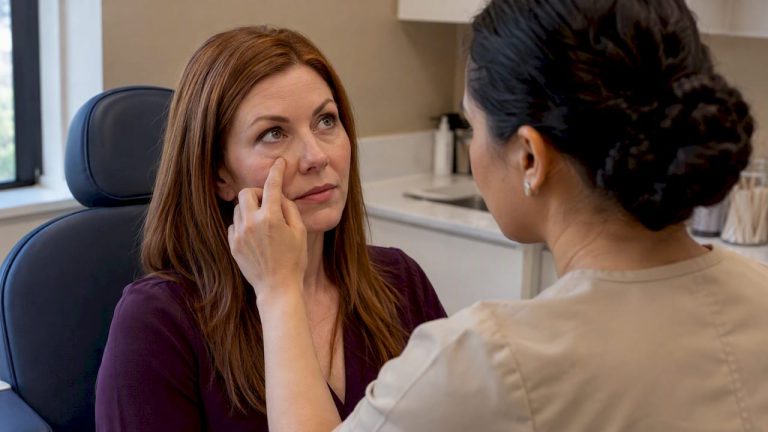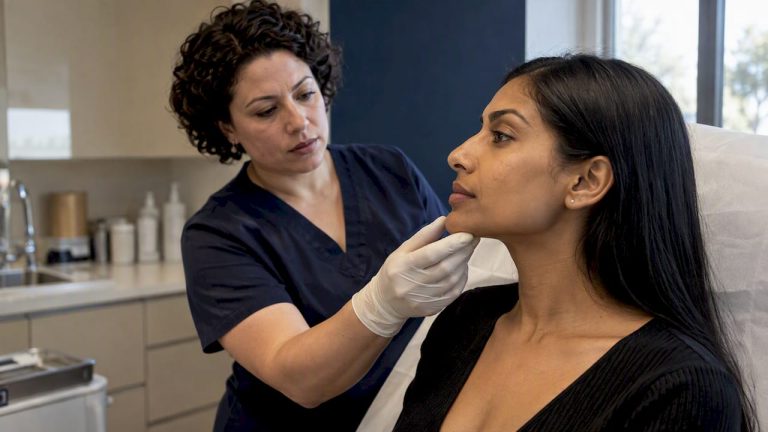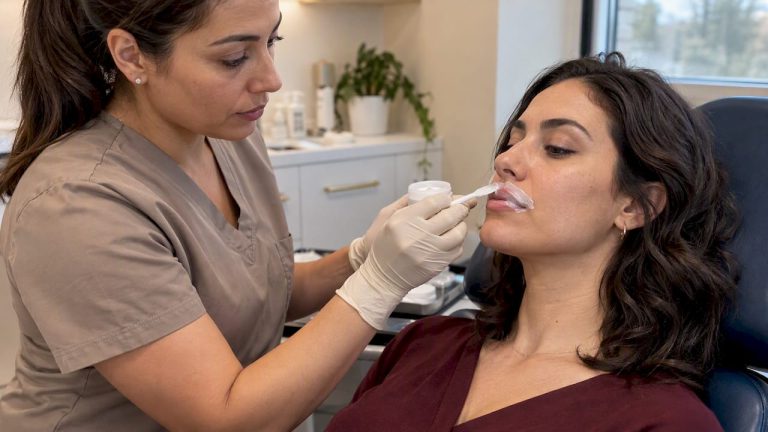
There is no single waiting time that every clinic agrees on, and the research is still small. Evidence suggests that many light-based and laser treatments can be done close to Botox without cutting its effect, while microneedling and radiofrequency need more thought. In my chair, I usually ask patients to keep a gap of about two weeks before any resurfacing or needling, and I plan the order of treatments so each one gets a clean start.
I’m Irene Soni, a registered nurse and cosmetic injector in Woodbridge. This is the answer I give patients in consultation, in plain language, with the research behind it.
TL;DR
- Botox needs several days to start working and about two weeks to show its full result, so give the area time to settle before aggressive treatments.
- A 2023 review found no loss of Botox effect when IPL and several non-ablative devices were used straight after injection. The evidence is limited, so your treating team’s judgment matters.
- Microneedling and radiofrequency needling are different. Studies suggest immediate needling or radiofrequency around the injection can affect how well the toxin works.
- Pause retinoids, acids and hydroquinone around any procedure that disrupts the skin barrier, then restart gently.
- Tell every provider about every treatment you have had in the last month, in either direction.
The short answer by treatment type
The word “laser” covers very different devices, so the answer depends on what is being used. Here is how I sort them for patients.
| Treatment | What it does to skin | My general approach after Botox |
|---|---|---|
| IPL (intense pulsed light) | Light-based, targets pigment and redness, little surface injury | Often compatible with a short gap; confirm with your provider |
| Non-ablative laser (for example vascular or toning devices) | Heats deeper tissue, leaves the surface mostly intact | Often compatible, and some studies used these straight after injection |
| Ablative or fractional resurfacing laser | Removes or perforates the surface layer, real downtime | Allow the Botox to settle first; some protocols wait one to six weeks |
| Microneedling | Creates many small channels in the skin | I prefer to wait about two weeks |
| Microneedling with radiofrequency | Needles plus heat | Wait, and have your provider plan the order |
These are my clinical habits and the patterns in the research, not a rule. Your skin, your treatment area and the device your provider uses all change the plan.
Why timing matters at all
Botox and Dysport work by blocking the signal from nerve to muscle in the spots where they are placed. That is why we place small, measured amounts in specific muscles. If you want a refresher on the mechanism, our guide to how Botox works covers it.
There are three practical reasons I ask patients to think about spacing:
- Placement. For the first hours after injection, the product sits where it was placed. Heavy pressure, heat or massage over the area is the thing I most want you to avoid early on.
- Swelling and bruising. A small bump or bruise at an injection site is common. Adding a second treatment on top of tender skin makes it harder to tell what is causing what.
- Clarity. If you have a reaction, I want to know which treatment caused it. Stacking several treatments in one week makes that difficult for you and for your providers.
If you are curious about how quickly results arrive, see why Botox takes time to work. It helps explain why I talk in weeks, not hours.
Laser after Botox: what the research says
A 2023 review in Aesthetic Surgery Journal looked at botulinum toxin and laser therapy together. It describes studies where ablative laser was done 2 to 6 weeks after Botox in one report and 1 week after in another, and the review’s authors often inject Botox first and treat with laser a week later, or immediately for regular toxin patients.
The same review also reports that a prospective study found no decrease in Botox efficacy when several devices were used straight after injection. Those devices included pulsed dye, IPL and radiofrequency-based systems.
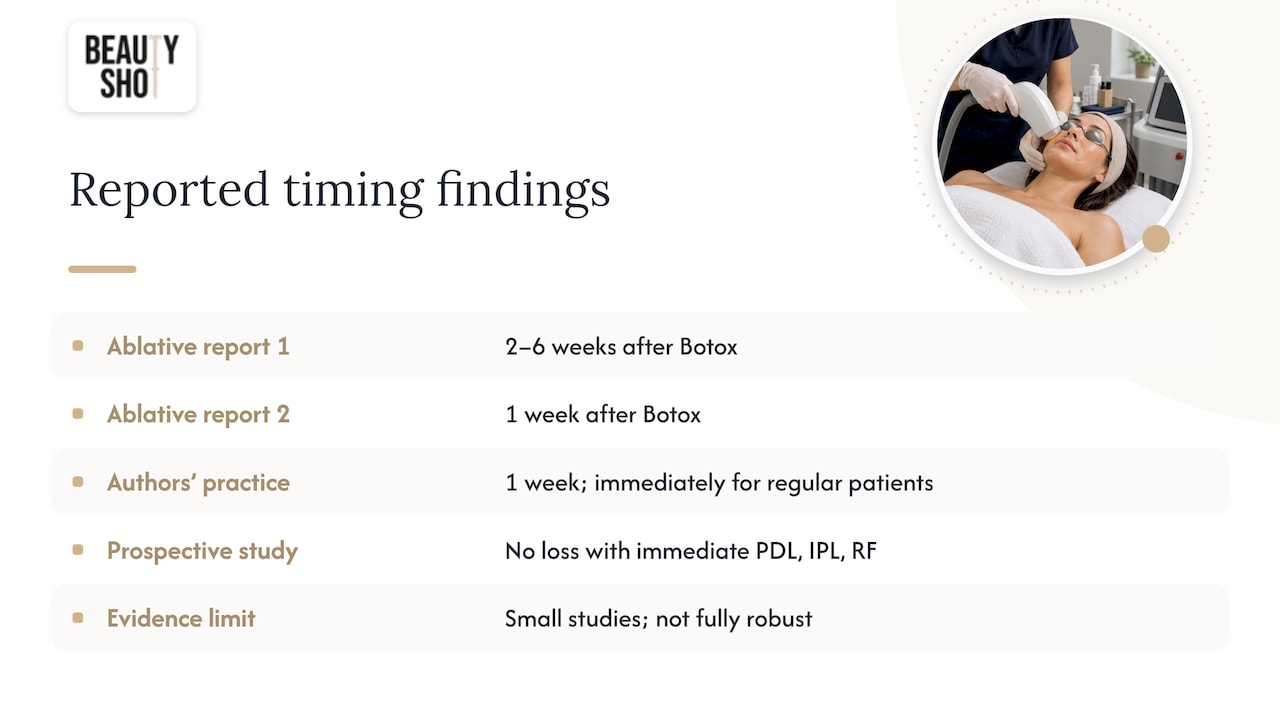
The review is also clear about its limits: the available studies are small, so the conclusions are not fully robust. I take that seriously. It means a confident, universal rule would go beyond the evidence, and it is why I treat the question as individual.
What this means for you
- If your laser is a gentle, non-ablative treatment, a short gap or even the same visit may be reasonable when your providers agree and coordinate.
- If your laser removes surface skin, I would let the Botox settle first and take your provider’s recovery plan seriously, since swollen, healing skin is a poor starting point for injections.
- If you are on a laser course with several sessions, tell your injector the schedule so we can place Botox between sessions rather than on top of one.
IPL after Botox
IPL is not technically a laser, but it is the next question patients ask. The research I reviewed gives no separate IPL waiting interval. What it does say is that in the prospective study above, a Quantum IPL device was among those used right after injection with no reduction in toxin efficacy. The reported IPL wavelength range there was 560 to 1200 nm.
In practice, I think about IPL this way:
- It usually leaves the skin surface intact, so downtime is modest.
- It makes skin more sensitive to sun and heat for days, so sun protection matters.
- Sessions are often spaced weeks apart, which fits easily around Botox every three to four months.
My advice is simple. If IPL is booked within a few days of your Botox, mention it when you book. If you can choose, I would rather you do IPL a couple of weeks after Botox or leave a gap before the next injection session, so your skin is calm for both.
Microneedling after Botox
Microneedling is where I am most careful, and it is also what most people ask about. It deliberately creates tiny channels in the skin. That is helpful for texture and scarring, but it is also a reason not to do it the same day as your injections.
Two studies are worth knowing about, and they point in different directions:
- A 2024 pilot study from Italy used a specialized protocol, with laser and microneedling to deliver botulinum toxin into the skin in 20 patients over three sessions, and reported improvements in wrinkles, pores and satisfaction. That is a different technique from an injector placing toxin in a muscle and a separate microneedling appointment, so it does not set a general waiting time.
- A 2023 study of microneedle fractional radiofrequency reported that botulinum toxin given immediately after the treatment was less effective than at other intervals, and animal findings suggested the radiofrequency reduced toxin activity for about 3 days.
Put together, the sensible reading is that needling or heat in the same area close to the injection may change how the toxin behaves, and that the order and spacing are not trivial. That is why I prefer to keep microneedling away from fresh Botox, and why I would not combine it with a radiofrequency device on the same day without a plan agreed between providers.
If you had microneedling first
People also ask the reverse: Botox after microneedling. My approach is to let the skin heal from needling before injecting. Red, tender, open skin is not where I want to place a needle. Give it enough days for the redness to settle and the skin to feel normal, and tell me what was done and when.
A practical timeline I use with patients
This is a planning guide, not a prescription. Your own plan should come from the providers who have examined you.
- Day of Botox. Keep your face clear of heat, pressure and procedures. Gentle cleansing is fine. Our notes on makeup after Botox and alcohol around Botox cover the everyday questions.
- Days 1 to 3. The product is still settling. No facials, no massage, no needling, no radiofrequency over the treated area.
- Days 4 to 7. Early effects begin, and for many people this is when the first change shows. Light, non-ablative treatments may be reasonable if your providers agree.
- Around two weeks. Botox has reached its full effect, and this is the point I use for a check-in. It is also my usual marker before microneedling or resurfacing.
- Weeks 3 to 6. A reasonable window for stronger resurfacing, based on the intervals described in the research above.
- Three to four months. Botox begins to fade for most people. Plan your next round so it does not land right after a major resurfacing procedure.
If you want a more detailed day-by-day view, our Botox aftercare guide goes through products and habits, and the Dysport aftercare page maps the first 48 hours.
Protecting your skin around any energy-based treatment
Botox is not the only thing to plan around. Lasers, IPL and needling all change how your skin tolerates your usual products.
A 2025 consensus on skincare around energy-based procedures advises that after treatments causing mild barrier disruption, you should avoid prescription retinoids, AHAs and hydroquinone for about 4 to 12 days. The authors’ reasoning is that irritation around these procedures can interfere with healing.
Here is how I translate that:
Do
- Use a gentle cleanser and a plain, fragrance-free moisturizer.
- Apply broad-spectrum sunscreen every morning, especially after IPL or laser.
- Follow your laser provider’s written aftercare first. It is specific to the device.
- Ask before restarting active products.
Don’t
- Use retinol, glycolic or other acids, or hydroquinone in the days around the procedure, unless your provider has said otherwise.
- Pick at flaking or scabbing skin.
- Book a sauna, hot yoga or a facial in the first days.
- Rub or massage the Botox area.
When you restart a strong active, ease in rather than going back to full strength. A retinol sandwich method layers moisturizer around the active to reduce irritation, which suits skin that is still settling. If you are restarting after injections, our note on retinol after fillers explains the clinical thinking for that case.
What to watch for before your next treatment
Before you book another procedure, check in with your own face. I would wait and call your injector or the treating provider if you notice any of the following:
- Swelling, tenderness or bruising that is not improving.
- A drooping eyelid or brow, or a change in your expression you did not expect.
- Redness that is spreading, heat, or worsening pain.
- Skin that is peeling, weeping or very sensitive from a previous treatment.
Most reactions after Botox are mild. For what is usual and when to call, read common Botox side effects. Anything severe, such as trouble breathing, swallowing or speaking, needs urgent medical care, not a booking call.
Combining treatments well
Many of my patients want a full plan: toxin for movement lines, filler for volume, and a skin treatment for tone and texture. That is a sensible goal. The key is order and spacing.
- Botox and filler can often be done in the same visit. We cover that in combining Botox and fillers safely.
- Botox with other treatments needs a plan around the device being used. Our guide on combining Botox with other treatments walks through the common pairings.
- Skin treatments are best placed between injection rounds, not on top of them.
Bring a list to your consultation: every injection, device treatment, peel and prescription product from the past month, with dates.
Our perspective
We see the same pattern often: a patient books a laser or microneedling session without telling anyone she had Botox last week, then wonders why her results look different or her skin is unusually irritated. The research is encouraging for some light-based treatments, yet it is small, and we do not think a confident universal rule serves you.
That is why every treatment we do starts with a conversation. Your injections are performed by an advanced cosmetic registered nurse with more than nine years of injection experience, not by an assistant or technician. We look at your anatomy, your goals and your calendar, and we space treatments so each one gets a fair chance to work.
Our aim is natural, refreshed results that still look like you. For us that means placing small amounts where they are needed, letting the product settle, and planning skin treatments around it. If another provider is doing your laser or needling, we are glad to coordinate the order so your results are not compromised.
Felix
Planning your Botox around skin treatments in Woodbridge
If you are in Woodbridge, Vaughan, Maple, Kleinburg or Concord and have a laser, IPL or microneedling course in mind, tell us before you book your injections. We offer Botox and Dysport, including a lip flip, and we can help you place them between your skin sessions. Pricing is discussed at your consultation. You can see our full range on our services page.
FAQ
Can I get a laser treatment right after Botox?
Sometimes. A 2023 review found no loss of Botox effect when several non-ablative devices were used straight after injection, but the studies were small. Resurfacing lasers are different, and many protocols leave a gap. Ask both providers and tell them the dates.
Can I do IPL after Botox?
Often yes, with a short gap. IPL usually leaves the skin surface intact and was among the devices used right after injection in the study reviewed above. Avoid heat and pressure over the injection sites in the first days, and use sunscreen.
How long should I wait for microneedling after Botox?
I usually suggest about two weeks, once Botox has reached its full effect. Research on needling and radiofrequency suggests the timing near injection can affect how well the toxin works, so do not combine them on the same day without a plan from your providers.
Do I need to stop my retinol around these treatments?
Usually, yes, for a few days. A 2025 consensus recommends avoiding prescription retinoids, AHAs and hydroquinone for about 4 to 12 days after procedures that cause mild barrier disruption. Your laser provider’s written instructions come first.
What if my face looks different after combining treatments?
Call the provider who treated you. Early swelling or bruising usually settles, but a drooping lid or brow, spreading redness, or worsening pain needs prompt attention. Bring your treatment dates to the visit.
Sources
- Botulinum A Toxin and Laser Therapy: Evidence and Recommendations, Aesthetic Surgery Journal (2023)
- Carbon-Assisted Q-Switched Nd:YAG Laser and Microneedling Delivery of Botulinum Toxin, Plastic and Reconstructive Surgery (2024)
- Does microneedle fractional radiofrequency system affect botulinum toxin efficacy? Journal of Cosmetic Dermatology (2023)
- Recommendations on Periprocedural Skincare for Energy-Based Devices (2025)