
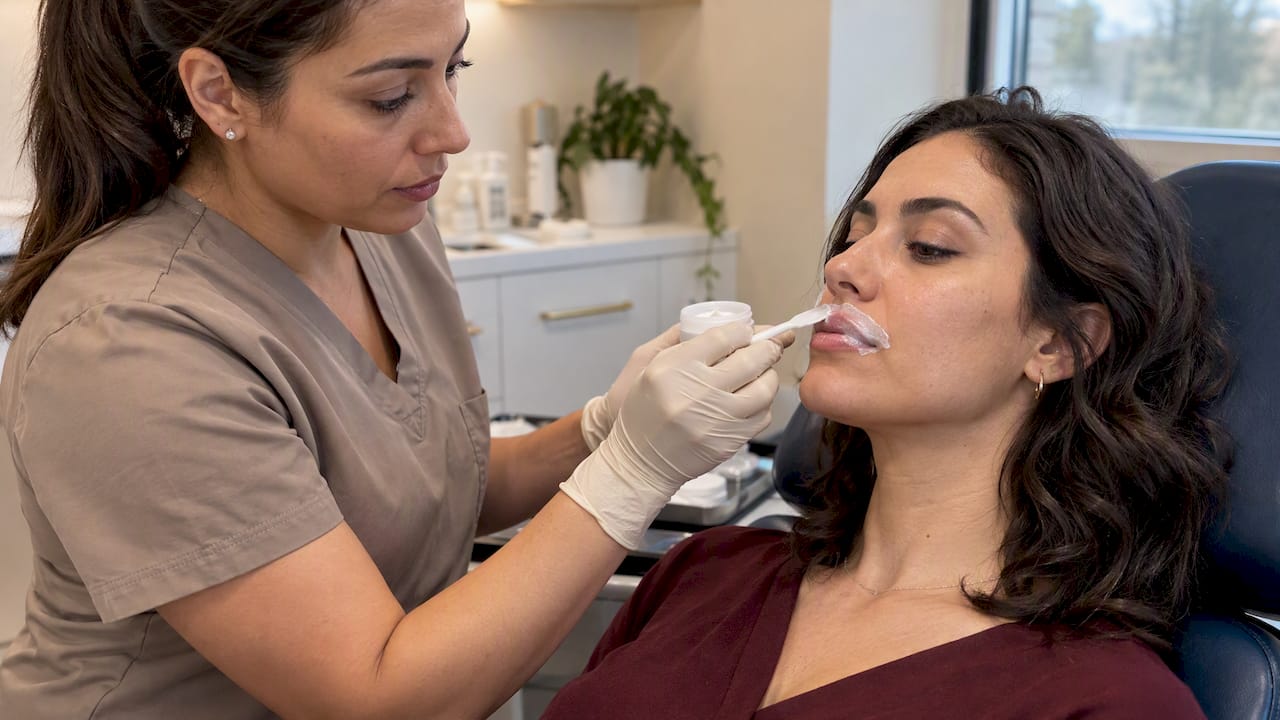
Yes, a topical numbing cream is commonly used before lip filler, and it can make the injections much more comfortable. It is not the only option, and it does not make every patient feel nothing. How well it works depends on the product, how long it sits on your skin, how your lips respond, and the technique of the person injecting.
This guide explains what the cream does, how long it is usually left on, where its limits are, and which questions to bring to your consultation. If you are nervous about needles or have had a sensitive experience before, read the section on other comfort options too.
TL;DR
- Numbing creams contain local anesthetics such as lidocaine and sometimes tetracaine. They dull surface sensation but do not remove all pressure or pinching.
- For filler, a numbing product is typically left on for about 20 to 30 minutes, then removed before injecting.
- Most fillers already contain lidocaine, so you often get comfort from two directions: the cream first, then the filler itself.
- Nerve blocks and vibration are other options. Ask your injector what they recommend for your lips and your pain tolerance.
- Tell your injector about any allergies and every product you use. Never apply numbing products to your lips yourself without guidance.
How numbing cream makes lip filler more comfortable
Lip tissue is rich in nerve endings, which is why lips feel sensitive. A topical anesthetic works on the surface. Lidocaine and tetracaine are local anesthetics applied to the skin to prevent pain before procedures such as dermal filler injection, briefly numbing the skin and the area around it. In simple terms, they block the signals that travel from the nerve endings to your brain. A review of local anesthetics in aesthetic practice describes the same mechanism: local anesthetics block the reception and transmission of pain stimuli, and cooling or topical products may be used before filler injections.
What you will usually feel with a good topical numbing is pressure, a sense of movement under the skin, and sometimes a short pinch. What you should feel much less of is the sharp sting of the needle entering. If you want a fuller picture of the sensations, our guide to whether lip fillers hurt walks through the appointment from start to finish.
How long numbing cream stays on before lip filler
This is the question most people ask, and the honest answer is that your injector decides, based on the product they use. Timing is not a guess. Prescription-strength products have a defined application window.
For example, the Canadian product monograph for a lidocaine and tetracaine peel-off product says it is applied 20 to 30 minutes before dermal filler injection and removed before the procedure. For superficial procedures like filler, it is applied to intact skin at a thickness of about 1 mm, and the peel must be removed afterwards. A 2005 study in Dermatologic Surgery used 5% lidocaine cream on the lips for a similar window: 20 to 30 minutes with a barrier over the area.
What this means for you in practice:
- Plan for the wait. Numbing takes time to work. Leaving early means you may be injected before it has taken full effect.
- More is not better. A thicker layer or a longer wait does not automatically mean deeper numbness, and it can increase irritation or absorption. Follow your injector’s timing.
- Expect cleaning. The cream is wiped or peeled off before injecting, and the area is cleansed.
- Arrive on time. A rushed appointment is usually a less comfortable one.
If you see a shorter or longer time on a tube you bought online, do not substitute it for your injector’s plan. Strengths and ingredients differ from product to product.
How well does numbing cream work on lips?
It can work well, but results vary between people. In the 2005 study above, 5% lidocaine cream applied to the lips produced profound anesthesia for filler injections, with no complications reported, and it was easier to perform and better tolerated than injectable anesthetics in that study.
The picture is more nuanced when topical numbing is compared with nerve blocks. In a randomized study of 48 facial filler patients in California, pain scores out of 10 were higher with topical anesthetic than with nerve blocks: about 3.67 versus 0.89 for the upper lip and 4.38 versus 1.47 for the lower lip. So a cream often brings the pain to a manageable level, but a block can numb more deeply.
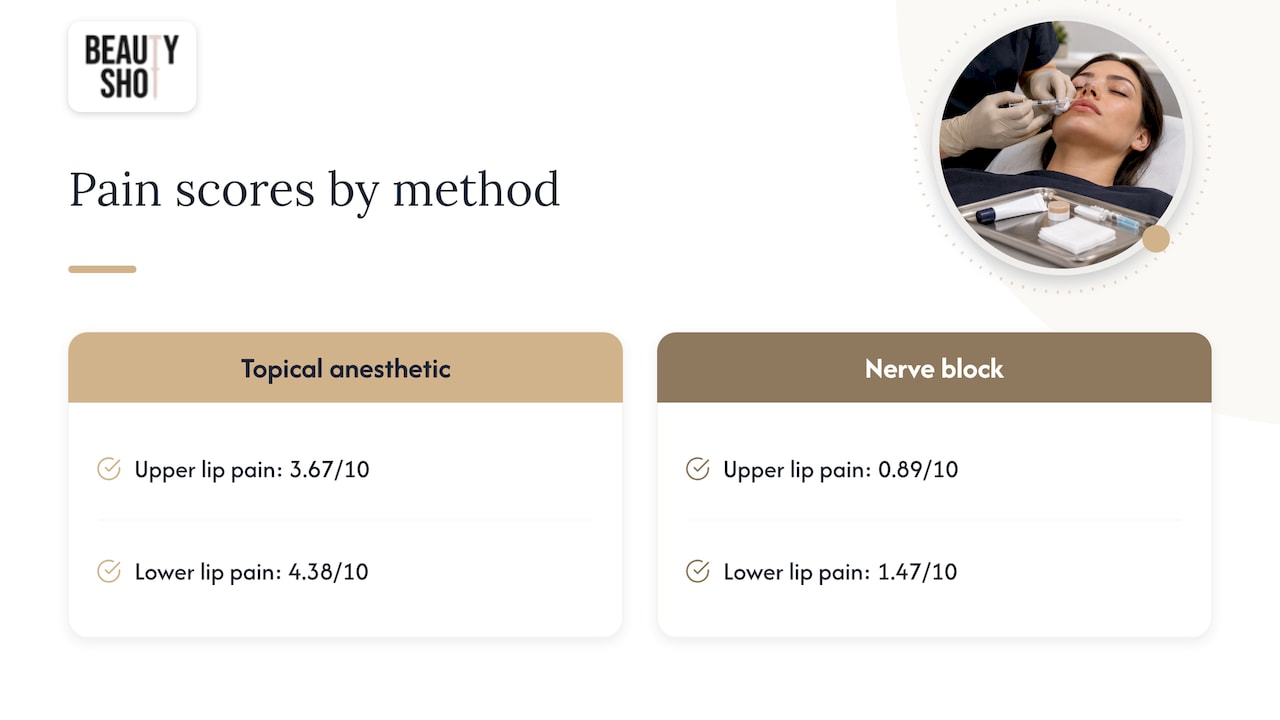
The same study adds a useful caution. The block itself caused discomfort, and some patients mentioned post-treatment numbness as a concern. A lower score on the day is not automatically the better choice for every person. Some prefer feeling more, and recovering faster, over a deeper numb lip that makes it hard to judge symmetry or to drink and speak normally afterwards.
A topical anesthetic, in other words, is a comfort tool and not a promise of a painless appointment. Your pain threshold, hormonal cycle, stress, sleep, caffeine and the exact lip area treated all play a part. Lower lips and the central upper lip tend to be more sensitive for many patients.
A caution about numbing products and the lips themselves
Here is where the details matter, and where self-treatment can go wrong. The lips include mucous membrane, which absorbs medication much more readily than the skin on your cheek. That is why labelling for many numbing products draws a line.
The Canadian monograph for the peel-off lidocaine and tetracaine product states it is not indicated for mucous membranes, which includes the lips, mouth and nose. Health Canada’s labelling standard for non-prescription topical anesthetics likewise says it does not apply to products used on mucous membranes or surrounding areas, including lips.
In plain language: a numbing cream bought off the shelf for tattoos or waxing is not labelled for use on your lips, and you should not apply it there on your own. How and where a topical product is used on the lip area is a clinical decision that belongs to your injector, who knows the product’s strength, the area to be covered and how much is safe.
There is also a cosmetic consideration. A review of local anesthetics in aesthetic medicine notes that for lip augmentation, EMLA cream may cause vasoconstriction and transient blurring of the vermilion border. The vermilion border is the edge of the lip, and your injector uses it as a landmark. Part of careful, natural-looking work is choosing how to numb without hiding the anatomy we are trying to respect.
Lidocaine already inside the filler
Many people are surprised to learn that the filler syringe often helps numb the lip as it goes in. Most fillers contain lidocaine, and studies show it reduces pain, with a good safety profile and no effect on filler longevity.
An Austrian prospective lip augmentation study of a lidocaine-containing filler measured mean pain of 3.3 immediately after treatment and 0.5 at 15 minutes, a statistically significant drop. That tells you two things. First, there is real discomfort in the moment for many patients. Second, it settles quickly.
This is why the cream is best thought of as the first layer of comfort. It softens the entry of the needle. The lidocaine in the filler then helps as the product is placed. If you want to understand the product side better, our guides on how dermal fillers work and the different types of lip filler explain what is in the syringe and why it matters.
Other ways to make lip filler more comfortable
Numbing cream is one tool among several. Here is how the common approaches compare.
| Approach | How it works | What to expect |
|---|---|---|
| Topical numbing | Anesthetic on the surface, left on for a set time | Dulls the needle entry; you may still feel pressure |
| Nerve block | Local anesthetic injected near the infraorbital nerve (upper lip) or mental nerve (lower lip) | Deeper numbness, but the block itself can sting and numbness may linger |
| Vibration | A device placed near the injection site distracts the nerves | Works well as an add-on to cream, not instead of it |
| Cooling | Ice or cold air before injecting | Brief, mild relief at the surface |
| Lidocaine in the filler | Anesthetic mixed into the product | Comfort builds as the filler is placed |
A mini review of pain reduction in aesthetic procedures notes that vibration, local anesthesia and vapocoolant are common methods, and combinations can reduce injection pain. On vibration specifically, a lip augmentation study summarized in a 2024 meta-analysis gave every patient topical anesthetic and added vibration on one side. Mean pain was 3.82 with vibration and 5.60 without it, and 23 of 25 patients preferred vibration at future visits. Because the cream was on both sides, this supports vibration as an add-on.
The idea behind a nerve block is familiar from other settings. Dental teams use local anesthetic so that a procedure feels manageable, and local anesthesia in dental care follows the same principle of blocking the signal before the work begins. For lip filler, the question is whether the added depth is worth an extra injection and a few hours of numbness. For many first-time patients, the answer is no. For someone with a very sensitive lip or a history of needle anxiety, it can be the right call.
Safety: what to tell your injector first
Topical anesthetics are generally well tolerated, but they are medications. Lidocaine and tetracaine products can cause temporary redness, stinging, skin-colour changes or swelling. They should not go on broken or irritated skin, over large areas or on mucous membranes.
Before your treatment, tell your injector about:
- Any allergy to lidocaine, tetracaine or other amide-type anesthetics, including past reactions at the dentist
- Heart, liver, blood or breathing conditions
- Every prescription, over-the-counter and herbal product you use
- Cold sores, which can flare with lip injections, and any active irritation, cuts or rashes around the mouth
- Pregnancy or breastfeeding, so your injector can decide whether to treat at all
If you develop spreading redness, hives, a rash, trouble breathing, dizziness or a racing heart after a numbing product, that is urgent: seek emergency care. For mild stinging or redness that settles within a day, mention it at your follow-up so your injector can adjust next time.
Safety goes beyond the cream. Health Canada warns that unauthorized injectable products, including dermal fillers, have not been assessed for safety, effectiveness or quality and may pose serious health risks, and every injectable product in Canada must be authorized for sale. Ask what product is being used and who is injecting. Our overview of whether lip fillers are safe covers the wider risks.
Our perspective on comfort and lip filler
We believe comfort is part of good care, not a luxury. A patient who is tense tends to move, tighten the lips and rush the appointment, and that makes careful, symmetrical work harder. When you are calm and comfortable, we can take the time to place small amounts, check your facial balance and stop when the result looks right.
We also believe in honesty. No numbing method removes every sensation, and we will not promise you a pain-free appointment. What we can do is talk through your options at the consultation, explain what each one adds, and choose a plan around your lips, your history and your preferences. Some patients want the deepest numbness available. Others prefer to feel a little more and leave without a heavy, numb mouth.
Our treatments are performed by an advanced cosmetic Registered Nurse with more than nine years of injection experience and a Sunnybrook Hospital medical and ICU nursing background. That background shapes how we think: assess first, explain clearly, and never rush. Our aim is for you to look refreshed and still like yourself, with lips that suit your face rather than lips that announce themselves.
— Felix
Before your appointment: simple do’s and don’ts
Do:
- Eat a normal meal and drink water beforehand
- Arrive a few minutes early so the numbing time is never rushed
- Tell your injector if you bruise easily or take blood thinners or supplements
- Ask what your options are if you feel the numbing is not enough on the day
- Bring a list of your medications
Don’t:
- Apply a store-bought numbing product to your lips before you arrive, unless your injector has told you to
- Book right before an event: swelling is normal, and you will want time to settle. Our guide on reducing swelling after lip fillers explains what to expect
- Massage or press on your lips afterwards unless your injector tells you to
- Judge the result on day one, since lumps and asymmetry from swelling often settle, as we explain in our note on lip filler lumps
If you are worried about the process itself, read what to expect during a lip filler procedure. Knowing each step usually reduces anxiety, and anxiety is a big part of how much a procedure hurts.
Lip filler with Beauty Shot in Woodbridge
If you are comparing options, we offer dermal fillers for the lips and surrounding areas at our boutique clinic in Woodbridge, Vaughan, with a consultation-first approach and individualized treatment plans. We also offer a lip flip with Botox or Dysport for patients who want a subtle change without filler. Pricing is discussed at your consultation. You can see everything we treat on our services page, and you are welcome to ask us about comfort options when you book.
FAQ
How long should you have numbing cream on for lip fillers?
It depends on the product your injector uses. A common window for filler is about 20 to 30 minutes, after which the product is removed before injecting. Do not extend the time on your own, as a longer wait can increase irritation without making you more numb.
Is numbing cream safe?
When used as directed on intact skin, topical anesthetics are generally well tolerated, but they can cause temporary redness, stinging or swelling. They are not labelled for use on mucous membranes such as the lips, so the way they are used around the lips should be decided by your injector. Tell them about any allergy to lidocaine or similar anesthetics.
Can I use numbing cream at home before my appointment?
We suggest you do not, unless your injector has specifically told you to. Over-the-counter products differ in strength and ingredients, and many are not intended for the lips. Your injector will apply the right product for the right time at the clinic.
Will lip filler still hurt with numbing cream?
Most patients feel less, but you may still notice pressure, a pinch or a stretching sensation. Many fillers also contain lidocaine, which helps as the product is placed. If you are very sensitive, ask about adding vibration or discussing other options at your consultation.
Sources
- Lidocaine/Tetracaine, topical (MyHealth Alberta)
- The use of local anaesthetics in dermatology and aesthetic medicine
- Pliaglis product monograph (Health Canada)
- Five percent lidocaine cream applied to the lips (Dermatologic Surgery, 2005)
- Patient preference for preprocedural anesthetic prior to filler injection
- Health Canada topical anaesthetic labelling standard
- Lip augmentation with Saypha LIPS Lidocaine
- A mini review on common methods of pain reduction
- Vibration anesthesia during invasive procedures
- Health Canada: unauthorized injectable drugs and medical devices
- Local anesthesia in dental care