

Natural lip filler is not a smaller syringe. It is a result where your lips suit your face, move when you talk and smile, and look like yours on a good day. That outcome depends on three things: the right hyaluronic acid (HA) product, careful placement, and a plan that respects your anatomy and does not rush to a bigger look.
This guide explains what “subtle” means in practice, how much filler is a reasonable amount, what to expect on the day and afterwards, and how to choose a qualified injector.
TL;DR
- A natural result comes from proportion between your lips and the rest of your face, not only from using a small amount of product.
- In a published clinical technique, no more than 1 to 1.5 mL of HA is placed in both lips per session. Gradual, staged treatment is the safer way to build more.
- Soft HA fillers last roughly six to 12 months depending on the product, your lips and technique, and they can be dissolved if needed.
- Health Canada advises seeing a medical professional experienced in injectables. Ask who will inject, what training they have and what they will use.
What “natural” lip filler actually means
When patients ask for natural lips, they usually describe the same few things. They want a softer shape, a little more hydration and definition, and no one asking what they had done. They do not want lips that look stiff, pushed forward or out of balance with their nose and chin.
A 2025 paper on anatomical-based filler techniques makes the point clearly: a natural lip is defined by proportion with the rest of the face, and filler that is placed badly can look artificial even in small amounts. So “a little” is not the same as “natural”. Placement and planning decide the outcome.
In my consultations I look at several things before I think about product:
- Ratio of upper to lower lip. Many natural lips have a slightly fuller lower lip. Matching that ratio usually looks more believable than building the upper lip.
- Lip shape at rest and in motion. Your lips move constantly. A result that looks good only when you are still is not natural.
- Skin quality and hydration. Dry, fine-lined lips often need softness and hydration more than volume.
- Your facial profile. The lips sit between the nose and chin. If the chin is recessed, for example, lip volume alone may not give the balance you want.
- Your own style. Some patients love a defined Cupid’s bow. Others want almost no visible change. Both are valid.
If you want a longer read on this, our patient guide explains why lip filler can look natural, and our expert tips for natural-looking lips cover more of the detail.
How much lip filler is a natural amount?
There is no single number that suits everyone, because lips differ in size, tissue and how much you want to change. Research gives useful guardrails, though.
The step-by-step technique in the 2025 anatomical study limits treatment to no more than 1 to 1.5 mL of HA in both lips per session. Many subtle treatments use well under that. A common approach for a first appointment is to start conservatively and see how your lips settle.
A 2021 Greek clinical study describes why. Its “step-by-step” method avoids overfilling in a single session, which respects delicate lip tissue, reduces complication risk and keeps natural lip movement. The same research notes that spacing sessions 15 to 30 days apart lets the tissue adjust and helps achieve natural proportions when more volume is wanted.
In practice, that means:
- Start small. Add a little, let swelling settle and then assess.
- Review at about two to four weeks. Swelling hides the true result for a while, so judging on day one is misleading.
- Add only if it serves your goal. If you are happy, you stop. There is no obligation to top up.
If you have a smaller area to refine, such as the peak of the upper lip, a very small volume can be enough. See our page on Cupid’s bow filler for how that works.
What makes lip filler look overdone
Overfilled lips rarely come from one cause. These are the patterns I see most often when patients ask me to correct earlier work:
- Too much product in one session, especially in the upper lip.
- Filler placed too superficially, which can look lumpy or leave a visible shadow.
- A product that is too firm for a mobile area like the lips.
- Ignoring the border and the surrounding area, so the lips look stuck on rather than part of the face.
- Stacking treatments before earlier filler has settled or dissolved.
Correcting these problems is possible, but it takes patience. We assess what is there before deciding whether to dissolve, wait or refine.
Product and technique: what a conservative result uses
Hyaluronic acid is the standard material for subtle lip work. HA is a gel that holds water, and products differ in how soft, flexible and cohesive they are. For lips, softer and more flexible products usually give a more natural feel and movement. Harder gels belong in structural areas such as the chin or jawline.
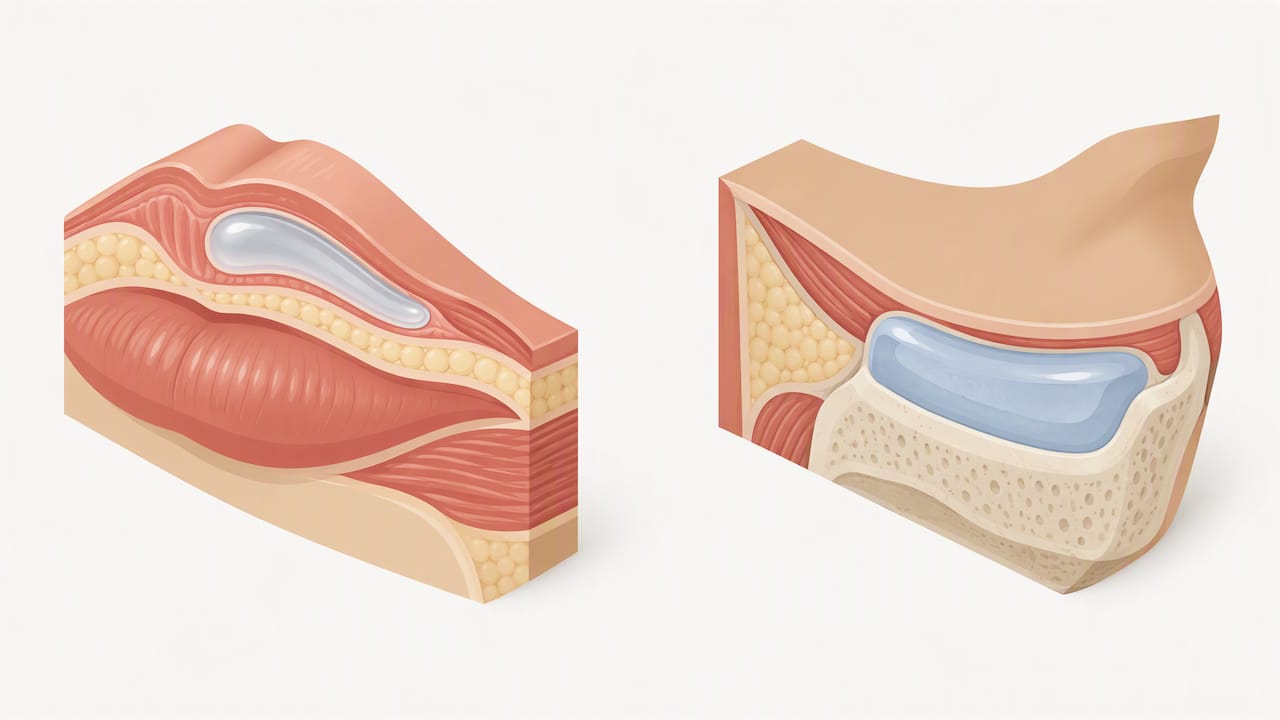
An academic framework on lip integrity, proportion and structure describes the approach: HA fillers chosen for their properties and intended depth, with techniques like retrograde threading and microdroplets matched to the patient’s anatomy and goals. The same framework describes linear threading and microdroplet injections for the lip contour and Cupid’s bow.
In plain terms:
- Threading places a fine line of filler as the needle or cannula is withdrawn. It is useful for defining the border or adding soft support.
- Microdroplets place tiny amounts at precise points. This gives control for shape refinement and subtle hydration.
- Depth matters. Placing the product at the right layer is what keeps the lip soft and mobile.
If you want to compare product types in more detail, see our guide to different types of lip fillers.
Perspective: how we approach subtle lips
We do not start with a syringe. We start with a conversation and a look at your face from the front and the side, at rest and while you smile. All injectables at Beauty Shot are performed by an advanced cosmetic Registered Nurse, with more than nine years of injection experience and a background in hospital nursing. That background shapes how we work: safety first, anatomy first, and honest advice, including when we tell you that you do not need as much as you expected.
Our plans are individual. One patient needs a gentle border and a little hydration. Another wants the lower lip balanced. Another is not a filler candidate at all, and a different treatment suits her better. Whatever the plan, our aim is that you look refreshed, confident and still like yourself. We also see patients who want earlier work softened or corrected, and we approach those visits without judgment.
— Felix
What happens at a lip filler appointment
A qualified professional will assess your anatomy, discuss your goals and perform the injections, often using a local anesthetic. Here is how that typically unfolds:
- Consultation. We review your health history, medications, allergies and what you want to change. Bring photos of lips you like, and photos of your own lips you liked in the past.
- Assessment and plan. We discuss proportions and agree on an amount and approach. Nothing is injected until you are comfortable.
- Preparation. The area is cleansed and numbing is applied.
- Injection. The treatment itself is usually short, and we check symmetry and feel as we go.
- Aftercare. You leave with written instructions and a way to reach us if you have questions.
For a fuller walkthrough, read what to expect during a lip filler procedure.
Recovery and aftercare
Expect temporary swelling and bruising. These typically resolve within a few days to weeks, and ice packs can help with the early symptoms. Lips can look larger and feel firm in the first days, and that is not the final result.
Do:
- Apply a cold pack gently, with a cloth barrier, for short periods.
- Sleep with your head slightly raised the first night.
- Keep lips moisturized.
- Plan the appointment well before a major event, so swelling and any bruising have time to settle.
Don’t:
- Press, massage or test the lips unless we have told you to.
- Skip our advice on alcohol. See our 24 to 72 hour guidance on alcohol after fillers.
- Judge the result on day one.
Everyone heals differently. If something feels wrong, contact us rather than wait.
Risks and when to get help
Lip filler is a medical procedure and it has risks. The FDA lists bruising, redness, swelling, pain and tenderness as common, and it warns that accidental injection into a blood vessel can cause skin necrosis, stroke or blindness. These are rare, but they are why training and anatomical knowledge matter.
Contact your injector or seek urgent medical care straight away if, after treatment, you notice any of the following:
- Severe or increasing pain.
- Skin that turns pale, white, dusky or blotchy.
- Changes in vision.
- Signs of infection such as spreading redness, heat or fever.
If you have vision changes or other serious symptoms, go to the nearest emergency department and tell staff you had filler.
Health Canada advises postponing or avoiding treatment in some situations, including severe allergies, allergies to collagen, eggs or lidocaine, inflamed or infected skin, bleeding disorders, active pimples, rashes or hives, or a tendency to excessive scarring. If you have an active cold sore history, are pregnant or breastfeeding, or take blood thinners, tell your injector at the consultation so they can advise you.
HA also has a safety advantage. A review of filler complications notes that high-quality hyaluronic acid preparations are preferred because their complication rate is much lower than permanent options. For more on what to expect, see our guide to the side effects of lip fillers.
How to choose a safe injector in Ontario
Health Canada advises that anyone considering an injectable cosmetic procedure should consult a medical professional with experience in such procedures. Its device guidance also says dermal fillers should be injected only by a qualified medical practitioner with sufficient training.
Before you book, ask:
- Who will inject me, and what are their credentials? You should know their name and professional designation.
- How many lip treatments have you done? Experience with lips specifically matters.
- Which product will you use, and why? The answer should reference your goals and your anatomy.
- How much will you use today? A cautious answer is a good sign.
- What is the plan if I am not happy or if there is a complication?
- Will you tell me when I should not have treatment? A good injector sometimes says no.
Be cautious about discounted products or social-media sellers. Health Canada has reported that unauthorized injectable products seized in Canada have lacked active ingredients, contained contaminants or varied in concentration, which poses serious health risks.
How long natural lip filler lasts
Soft HA lip fillers are temporary. For one product used in lips, a dermatologist quoted in a trade publication said results last about six to 12 months. Longevity depends on the product, how mobile the area is, the individual and the technique.
Why such a range? Lips move constantly, and some people metabolize filler faster than others. Any cosmetic result is shaped by wear and care, which is also true elsewhere, as the composite bonding lifespan shows for dental work. For lips, the practical advice is simple: protect your lips from sun, stay hydrated and book a review rather than a top-up by default.
For a detailed look at timelines and upkeep, see our guide on how long lip fillers last and how to maintain them.
One more benefit of HA is that it can be dissolved if you are not happy. That is a major reason we favour it for first-time patients.
Alternatives and related concerns
Filler is not the only way to change how your lips look, and sometimes it is not the best one.
- Lip flip with Botox or Dysport. A small amount of neuromuscular relaxer in the muscle around the upper lip lets the top lip gently roll outward. It adds no volume, so it suits someone who wants a subtle change in the upper lip or who dislikes how much gum shows when she smiles. Read about our lip flip.
- Hydration and skin care. If your lips are dry and lined, regular moisturizing and sun protection can improve how they look and feel.
- Perioral treatments. Lines around the mouth and a downturned look may respond better to treating the surrounding skin than adding lip volume.
- Facial balancing. If the chin or cheeks are the real issue, treating those areas can make lips look better without touching them.
About a gummy smile: if the upper lip lifts high when you smile, relaxing that muscle is usually the approach discussed, rather than adding filler, which can make a short, thin lip look heavier. The cause of a gummy smile varies, and some cases involve the jaw or teeth and need a dentist’s opinion. We will tell you honestly whether an injectable approach makes sense for you.
Book a consultation in Woodbridge
If you are in Woodbridge, Vaughan, Maple, Kleinburg, Concord or elsewhere in the GTA, we offer individualized lip and facial treatment plans with an advanced cosmetic Registered Nurse. You can see our dermal filler treatments, browse our before and after gallery, or visit our services page to book. Pricing is discussed at your consultation, after we have seen what you need.
FAQ
What is a natural amount of lip filler?
There is no universal amount, but conservative technique matters more than a number. One published technique limits treatment to 1 to 1.5 mL in both lips per session, and many subtle plans use less. We usually start small and review after the swelling settles.
Can I get natural lip filler as a first-time patient?
Yes, and starting conservatively is often the best choice. We assess your lips, talk through your goals and agree on a small first treatment. You can add later if you want more, and HA can be dissolved if you are not happy.
Will people be able to tell I had lip filler?
When the amount is modest and the placement suits your anatomy, most people notice that you look well rested, not that you had treatment. Swelling in the first days can make lips look larger, so avoid judging early. Natural results depend on proportion, not just volume.
Can lip filler fix thin lips or a gummy smile?
Filler can add softness and shape to thin lips, though staged treatment is the more natural route if you want more volume. For a gummy smile, filler is usually not the main tool, and a lip flip or a dental opinion may fit better. A consultation will clarify which applies to you.
How do I know if my injector is qualified?
Ask for their name, professional designation, training in lip anatomy and the product they will use. Health Canada advises choosing a medical professional with experience in injectables. If the answers are vague, look elsewhere.
Sources
- Anatomical-Based Diagnosis and Filler Injection Techniques (PMC, 2025)
- A Safe and Effective Lip Augmentation Method (PMC, 2021)
- Universal Lip Integrity, Proportion, and Structure (PMC, 2025)
- Dermal Filler Do’s and Don’ts for Wrinkles, Lips and More (FDA)
- Cosmetic injections (Health Canada)
- Guidance Document: Preparation of Premarket Medical Device Licence Amendment (Health Canada)
- Unauthorized injectable health products sold online and seized (Health Canada)
- Managing Complications of Fillers: Rare and Not-So-Rare (PMC, 2015)
- Getting to Know Juvéderm Volbella XC (Practical Dermatology)
- Composite bonding lifespan