
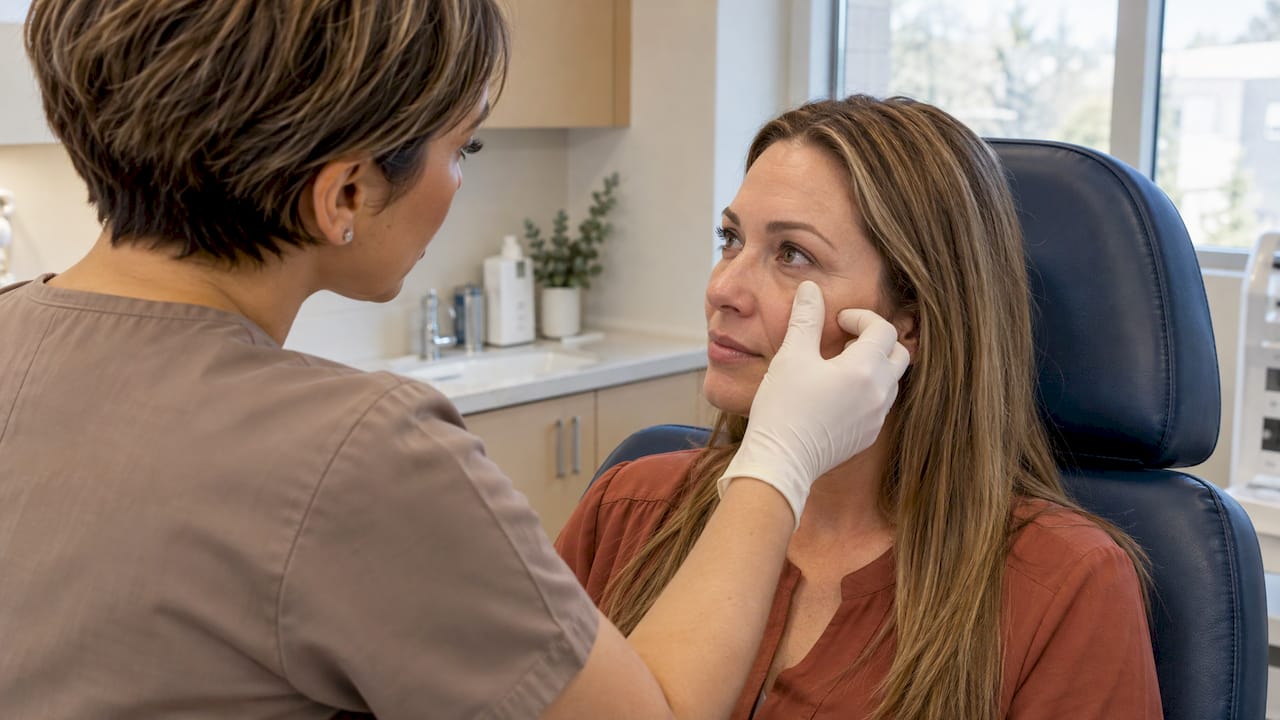
Under-eye (tear trough) filler is a delicate treatment, and it is safest when you understand the risks before you sit in the chair. Most side effects are mild and temporary: swelling, bruising and tenderness. A small number of complications are serious, and they are largely about where the product goes and who places it. At Beauty Shot Medical Clinic in Woodbridge, every injectable treatment is performed by an advanced cosmetic Registered Nurse, and this guide explains what that means for your safety in plain terms.
TL;DR
- Swelling, bruising and redness are the most common effects after under-eye filler, and they usually settle within days to weeks.
- Less common issues include lumps, uneven contour, delayed swelling and a blue-grey tint (the Tyndall effect). Most can be corrected.
- The rare serious risk is filler entering a blood vessel. Sudden vision changes, severe pain or pale, grey or blue skin after treatment need emergency care immediately.
- Some health conditions, such as recurrent eye-area swelling or active infection, make under-eye filler unsuitable. A proper consultation screens for them.
- In Ontario, nurses need an authorizing order to inject fillers, and the products used must be Health Canada-approved.
Is under-eye filler safe?
Health Canada states that all medical procedures carry risks, and that only you can decide what level of risk is acceptable. It advises anyone considering an injectable cosmetic procedure to see a medical professional experienced in that procedure and to know the potential risks and benefits first. That is a sound way to think about under-eye filler: it can be done safely, and safety depends on anatomy, product choice, technique and your own health.
The lower eyelid is a demanding area. The skin is thin, almost translucent, and sits close to small blood vessels and the eye socket. That is why a conservative plan matters more here than almost anywhere else on the face. We would always rather build gently than correct later.
If you want to understand the treatment itself first, our page on treating under-eye hollows with filler walks through what to expect.
Common side effects: what is normal
Health Canada lists the reported reactions to dermal fillers as pain, bruising, redness, swelling, nodules, infection, skin discoloration, allergic reaction and improper placement. Many are temporary, though some can last several months and need further treatment.
For the under-eye area specifically, you can expect:
- Swelling (edema). Early swelling is very common. A 2025 review of periocular hyaluronic acid complications found early swelling and bruising rates ranging widely between studies, from 0% to 100%, which tells you how much technique, product and patient factors matter. Persistent swelling was reported in 0 to 15% of cases.
- Bruising. The same review reported that a cannula of 22 gauge or thinner was associated with lower bruising than a needle. Eyewiki, an ophthalmology resource, notes that bruising and swelling around the eyes last about a week in typical cases.
- Redness and tenderness at the injection points, which settle quickly.
Swelling that lingers can feel alarming, especially in the morning. Our guide to managing under-eye filler swelling explains what is typical and how a conservative approach keeps it down.
Less common complications you should know about
These are the issues a thorough consent conversation should cover. A 2026 evidence-based review recommends that delayed edema, contour irregularity, the Tyndall effect, nodules and rare vascular occlusion all be part of consent for periorbital filler.
Lumps and uneven contour
Too much product, or product placed too superficially, can show as lumps or ripples under thin skin. EyeWiki lists undercorrection, overcorrection, contour irregularity and persistent swelling among the possible complications. Small amounts placed in stages are the main way to avoid this. If you have been treated before and are unhappy with the result, we assess it and discuss correction options, which can include filler dissolving.
Blue-grey discoloration (Tyndall effect)
Because tear-trough skin is so thin, hyaluronic acid placed too close to the surface can show through as a blue-grey tint. A 2020 ophthalmology review explains that it can appear weeks to months after injection and may persist. The same paper notes that placing the product deeper, on the bone layer, lowers the risk, and that hyaluronidase, the enzyme that breaks down hyaluronic acid filler, can treat it.
Delayed swelling
Some people develop swelling weeks or months after treatment. The 2025 review reports that late swelling may occur in up to 5% of cases within the first 12 months. If you notice new puffiness long after treatment, tell your injector rather than waiting it out.
Filler moving from where it was placed
EyeWiki also lists migration of filler, including posterior migration into the orbit, as a possible complication. Conservative volumes and correct depth are the main safeguards.
Infection and allergic reaction
Any injection carries a small infection risk, and allergic reactions are possible. The College of Nurses of Ontario notes that aesthetic services carry the same kinds of risks as other medical procedures, including infection and pain. This is why a medical history and a clean, controlled setting are part of safe care.
The rare serious risk: filler in a blood vessel
This is the part people fear most, so here it is clearly. The FDA identifies unintended injection into a blood vessel as the most concerning risk of dermal fillers. It can cause tissue death (necrosis), vision problems including blindness, and stroke.
Put in proportion:
- A 2020 review reports that skin necrosis after filler around the eye occurs in less than 0.001% to 0.5% of patients.
- An ophthalmology review reports vascular occlusion in the eye area at up to 3 in every 1,000 injections in reported data.
- Among 60 documented cases of filler-related vision loss reviewed in the 2025 paper, the tear trough was the injection site in only 1 case (1.7%).
The same 2025 review describes a danger zone in the inner tear trough, between a line down from the centre of the pupil and the side of the nose, because of connecting arteries there. Knowing this anatomy, and working slowly with small amounts, is the core of safe technique. This is why we focus on anatomy and facial balance, and why Irene Soni, R.N., BScN, brings 9+ years of injection experience and a Sunnybrook Medical/ICU nursing background to every treatment plan.
Warning signs that need emergency care
This is a safety instruction, not a reason for alarm. During or after any filler treatment, call 911 or go to the nearest emergency department straight away if you notice:
- Sudden vision loss or changes in vision
- Severe or unusual pain
- Skin that turns white, grey, blue or mottled near the injection
- Drooping eyelid, trouble moving the eye, headache, nausea
- Weakness, speech difficulty or any stroke-like symptom
The FDA advises patients to seek immediate medical attention for unusual pain, vision changes, or a white, gray or blue appearance of the skin. A 2026 review adds that these events call for stopping the procedure, activating emergency services and transfer to a centre with emergency ophthalmology and stroke capability. The 2025 review notes that vision loss usually appears immediately and up to a day afterwards, so do not wait to see whether it passes.
The same literature is clear that there is no proven, consistent way to reverse vision loss once it happens, which is why prevention through slow injection, aspiration and appropriate device choice is the priority. Careful technique is the part you can look for in a provider.
Who should not have under-eye filler
Not everyone is a candidate, and a good consultation says so. The 2024 Canadian guideline for aesthetic nurses states that patients with lower eyelid festoons, a history of malar edema, or allergies that cause recurrent eye swelling are not suitable for under-eye filler. It also lists contraindications including active infection, autoimmune conditions, confirmed hypersensitivity to hyaluronic acid filler or lidocaine, and immunotherapy medications.
Health Canada adds a history of severe allergies with anaphylactic shock, a bleeding disorder, inflamed or infected skin, active cysts, rashes or hives, and a tendency toward excessive scarring such as keloids. A tear-trough treatment paper also lists permanent fillers already present in the area as an exclusion.
If any of this applies to you, tell us at your consultation. It lets us build a plan around your health, and sometimes a different treatment suits your goals better.
How to lower your risk, step by step
Before your appointment
- Share your full medical history, including allergies, medications, supplements and any past filler.
- Avoid alcohol for 12 to 24 hours before. The 2025 review recommends this, and also avoiding supplements that raise bleeding risk, such as St. John’s wort, for 2 weeks beforehand.
- Tell us if you take blood thinners. The review advises a consultation with your cardiologist or prescribing doctor first.
- Have a plan for downtime. Our filler appointment preparation guide lists what to arrange and what to skip.
During treatment
This is the part where an experienced injector earns your trust. The 2025 review describes blunt cannulas or small-bore needles, small syringes, withdrawing before injecting, and slow, gentle injection of small amounts, with a stop if pain or vision changes occur. The 2026 review notes that deep placement on the bone layer, low water-binding products and small aliquots are the consensus strategies in the thin lower eyelid, with initial amounts of 0.1 to 0.7 mL per side described as experienced practice rather than a fixed maximum.

That same review points out that no single tool is universally safer: cannulas may cause less bruising in some settings, and needles may offer more precise placement. What counts is the injector’s judgment and anatomical knowledge. Our approach is individualized: a treatment plan for your face, and subtle results rather than a set number of syringes.
After treatment
- Use ice gently, as advised, and keep your head elevated for the first night.
- Avoid alcohol for 12 to 24 hours after, as the 2025 review recommends. Our nurse injector’s guide to alcohol after fillers covers the timing in more detail.
- Do not massage or press the area unless you were told to.
- Know the emergency signs above, and call 911 for any of them.
- Mention anything that worries you, such as uneven areas, new swelling or a blue tint, so it can be assessed early.
How long results last is a separate question, and our page on tear trough filler longevity answers it. EyeWiki reports that hyaluronic acid effects in this area last more than a year on average.
What Ontario requires of the people injecting you
It helps to know the rules that protect you here.
- An authorizing order. In Ontario, injecting dermal fillers involves controlled acts. The College of Nurses of Ontario says nurses need an authorizing mechanism such as a directive from an authorized provider. The 2024 Canadian guideline adds that the authorizer must review your medical history for contraindications before recurrent treatment.
- Health Canada-approved products. The CNO requires that drugs, products and equipment used in aesthetic nursing practice be Health Canada-approved, and notes that US FDA approval does not extend to Ontario. In Canada, fillers are regulated as medical devices and should be sourced from a licensed medical device vendor.
- Emergency readiness. The CNO expects policies that include resources to manage adverse outcomes, including emergencies.
These standards are part of why a Registered Nurse working within a regulated framework is a sound choice for a delicate area like the tear trough.
Perspective
When patients ask me about under-eye filler risks, I want them to leave the consultation more informed, not more nervous. The tear trough is one of the most precise areas I treat. The skin is thin, the anatomy is close to the eye, and there is very little room for hurry.
That is why we keep treatment plans individualized and conservative. The goal is to look refreshed and still like yourself, never overdone. Every injectable at our Woodbridge clinic is performed by an advanced cosmetic Registered Nurse, not an assistant or a technician, and that is a commitment we take seriously.
Good care also means being honest at the consultation. If your health history or your anatomy points to a different plan, we will say so and build one around you. And if you have had a result elsewhere that does not look right, we are glad to assess it and talk through your options.
Felix
Booking an under-eye consultation in Woodbridge
If you live in Woodbridge, Vaughan, Maple, Kleinburg or Concord and are weighing under-eye hollows, a consultation is the right first step. We review your history, look at your facial balance and explain what is and is not suitable for you. You can see the full range of treatments on our dermal fillers page, which includes under-eye hollows, or read about how tear trough filler works and what patients can expect.
FAQ
Is under-eye filler safe?
It can be, when it is performed by a trained injector on a suitable patient with an anatomy-led plan. Health Canada notes that all medical procedures carry risks and that you should consult an experienced medical professional first. Most side effects are temporary, such as swelling and bruising.
What are the most common complications of tear trough filler?
Swelling, bruising, redness and tenderness are the most common. Less often, people see lumps, uneven contour, delayed swelling or a blue-grey tint under the skin. These can usually be assessed and managed, including with hyaluronidase when the filler is hyaluronic acid.
What symptoms after under-eye filler are an emergency?
Sudden vision changes, severe or unusual pain, skin turning white, grey, blue or mottled, a drooping eyelid, trouble moving the eye, or any stroke-like symptoms. Call 911 or go to the nearest emergency department immediately and do not wait for it to pass.
Who should avoid under-eye filler?
Canadian nursing guidance lists lower eyelid festoons, a history of malar edema, allergies causing recurrent eye swelling, active infection, autoimmune conditions and allergy to hyaluronic acid or lidocaine. Health Canada also lists bleeding disorders and keloid scarring. A consultation screens for these.
How long does swelling last after tear trough filler?
Bruising and swelling around the eyes typically last about a week, according to EyeWiki, though it varies between people. If swelling persists or returns weeks later, let your injector know so it can be assessed.
Sources
- Cosmetic injections, Health Canada
- Complications of Periorbital Cosmetic Hyaluronic Acid Filler, 2025 review
- Complications after cosmetic periocular filler: prevention and management, 2020
- Periocular rejuvenation using hyaluronic acid fillers, 2020
- Eyelid Filler Injection, EyeWiki
- Periocular rejuvenation: current concepts, 2026 review
- Dermal Fillers (Soft Tissue Fillers), FDA
- Canadian Practice Standards and Guidelines for Nurses, 2024
- Recommendations for the treatment of tear trough deformity, 2021
- Aesthetic Services practice guideline, College of Nurses of Ontario
- Injectable Cosmetic Therapies: practice advice for RNs, 2025