Most people notice the first softening of their lines two to three days after Dysport. Full effect usually settles in by about two weeks, and results then fade gradually over roughly three to six months. That is the pattern in the clinical data, and it is the pattern we explain to every patient at Beauty Shot Medical Clinic in Woodbridge before treatment. Your own timeline depends on the muscle treated, your anatomy and the plan your injector builds for you.
Below is the timeline in plain language: what is normal on day one, what you may see by day three, when to judge the result, and what shapes the speed.
TL;DR
- Day 1 to 3: the first change is often subtle. In the Canadian product monograph, onset was reported as soon as 24 hours, with a median of three days.
- Day 7 to 14: the effect builds. Judge your result at the two-week mark, not at day three.
- Months 3 to 6: movement returns gradually. Most people respond through about three months, and some a little longer.
- Your timing varies with the muscle treated, your muscle strength, your history with neurotoxins and the dose.
The Dysport timeline at a glance
Dysport is a neuromuscular blocker: it relaxes the small muscles that fold your skin into frown lines, forehead lines and crow’s feet. If you want the mechanism, we explain it in how Botox and Dysport work. Because the effect builds as the muscle signal fades, results arrive in stages rather than all at once.
| When | What most people notice |
|---|---|
| Day of treatment | Tiny injection marks. No change in your lines yet. |
| Day 1 | Possibly nothing, possibly a very slight heaviness or less pull in the treated area. |
| Days 2 to 3 | First visible softening for many people, especially between the brows. |
| Days 4 to 7 | Movement keeps reducing. Lines look smoother at rest and in expression. |
| Days 10 to 14 | Full effect for most people. This is the point to assess the result. |
| Weeks 6 to 12 | Results hold, then movement slowly returns. |
| Months 3 to 6 | Gradual fade. Timing varies from person to person. |
This is a general guide, not a promise. The sections below show what the research says behind each stage.
When does Dysport kick in?
The Canadian Dysport Aesthetic product monograph (the official prescribing document, revised September 2023) reports onset as soon as 24 hours in the pivotal frown-line studies, with a median time to onset of treatment response of three days. The manufacturer’s own FAQ adds that, in its studies, more than half of people saw improvement in moderate-to-severe frown lines within two to three days, based on their own assessment.
An independent systematic review of 42 studies found the same range. Onset was most often reported at two to three days, and as early as 24 hours in a few studies. That review also notes that the studies assessing efficacy within a week all showed some response at their first check, with most reporting a median onset on day two or day three.
In practice, that means:
- Seeing nothing at 24 hours is normal. A fast onset is possible, but it is not the rule.
- Day three is a reasonable first checkpoint. Compare your face in expression (frowning, raising your brows) with your before photo, not just at rest.
- A slow start is not a poor result. Some people simply take closer to a week to see movement change.
Day by day: the first two weeks
Day 0 and day 1
You may have small raised bumps or a pinprick of redness where the product was placed. These typically settle within hours. Your lines will look the same, because the product has only just begun to work. Your injector will give you aftercare instructions for the first hours, and we have mapped them out in our Dysport aftercare guide.
Days 2 and 3
This is when many people first notice that a frown feels “lighter” or takes more effort. The monograph’s median onset of three days sits right here. If you were treated between the brows, this is often where you see it first.
Days 4 to 7
The effect keeps building. Lines that were deep in expression start to look shallower, and your face may feel less tense. Forehead movement may feel different from the frown area, which is normal and explained below.
Days 10 to 14
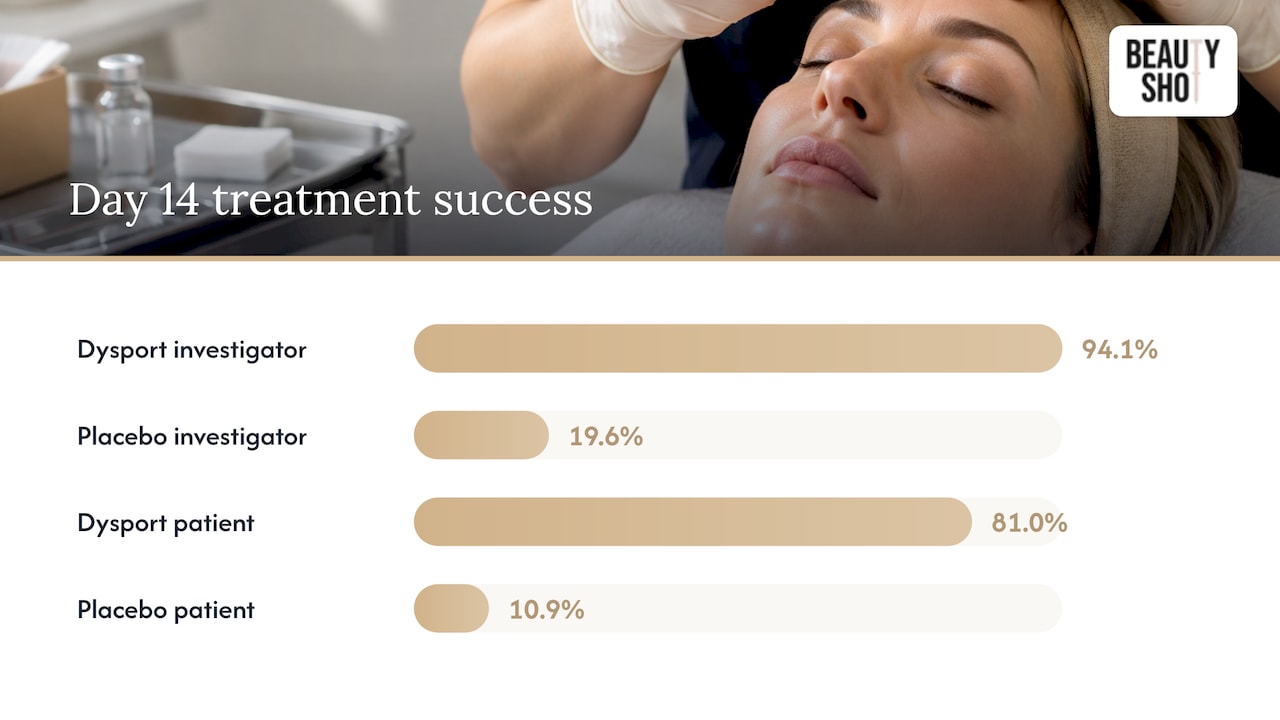
This is when we like to judge the result. In the Canadian monograph’s main study, 94.1% of Dysport-treated people (95 of 101) met the investigator’s definition of treatment success at day 14, compared with 19.6% on placebo. By the patient’s own assessment, 81.0% (81 of 100) met success versus 10.9% on placebo. At day 30, the figures were 89.3% by investigator and 75.7% by patient assessment. Those are results from a controlled study of a standard frown-line dose, so your own result may differ.
If you feel something is off at two weeks, such as one brow moving more than the other, that is the time to be seen. Fine adjustments are best made once the full effect has appeared, which is why a review visit is part of good care.
Why different areas soften at different speeds
It is common to feel your forehead change before your frown area, or the reverse. A 2017 review of abobotulinumtoxinA found the forehead muscle (frontalis) responded fastest, with median onset of 12 to 18 hours and some effect at six hours. The frown muscles between the brows took two to four days. Crow’s feet fell in between in the studies it reviewed.
So if you are treated in more than one area at the same visit, your face will not soften in unison. Wait for the full two weeks before drawing conclusions. If your goal is smoother forehead lines or a subtle lift, our guides to Dysport for forehead lines and the Dysport brow lift cover what that timeline looks like for those areas.
What affects how fast your results appear
Two people treated on the same day with the same product can have different timelines. The research points to several reasons.
- The muscle treated. Larger or more active muscles can behave differently from small ones, as shown above.
- Muscle mass and strength. The systematic review notes that variation in muscle mass between patients, influenced by age and sex, affects response.
- Technique and preparation. The same review lists injection technique, how the product is reconstituted and stored, and post-injection procedure as factors.
- Skin laxity. Looser skin in older patients can change how effective treatment looks over time.
- Your history. Prior neurotoxin treatment and dose can influence the speed and degree of response, according to the physician quoted in the review.
The common thread is that precision matters. Placement, dose and your facial anatomy all shape the outcome, which is why we map each plan to the individual face instead of using a fixed pattern.
If you are curious how timing plays out in a smaller area, the same logic applies to targeted treatments. Botox for a gummy smile is one example where a small, precise dose changes how the upper lip moves.
How long Dysport lasts
The 2020 JCAD review found duration was most often reported at four months, with some studies showing five months and a few at six months or beyond. The Canadian monograph’s main study shows the gradual decline: investigator-rated success was 66.3% at day 60, 46.4% at day 90, 24.2% at day 120, 9.5% at day 150 and 6.3% at day 180.
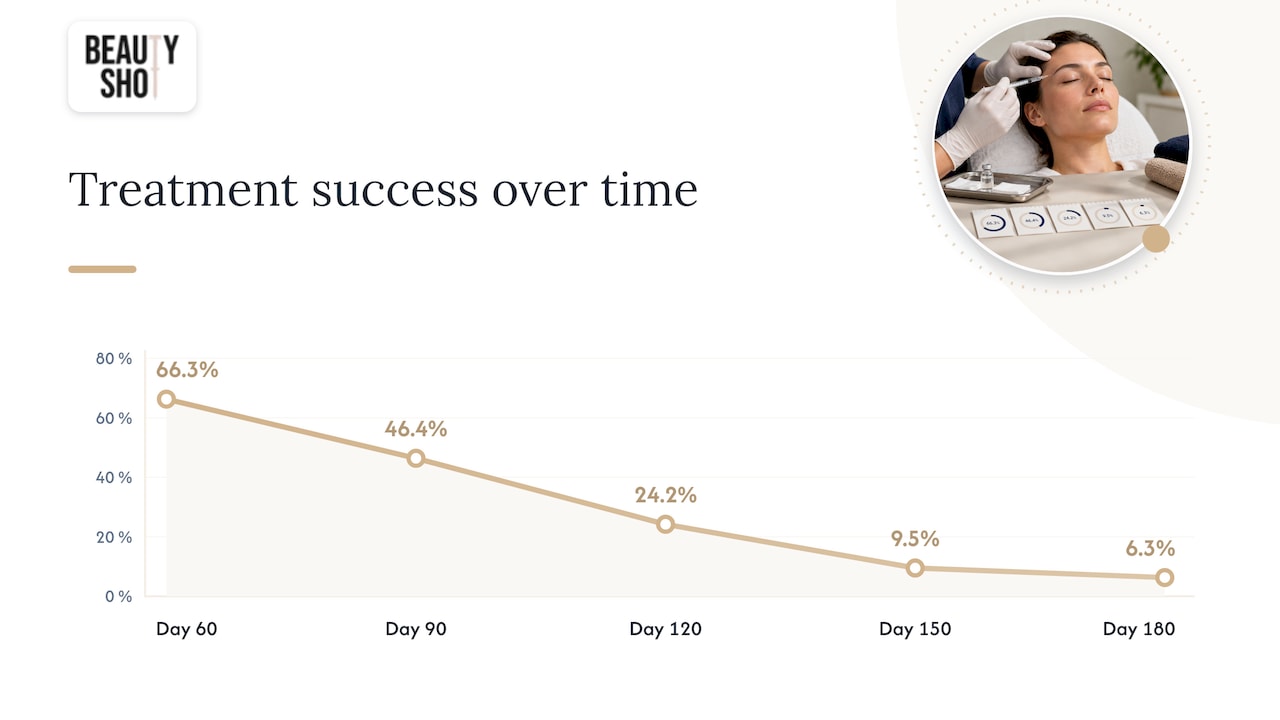
In other words, results do not switch off on one day. Movement returns slowly, often first in the strongest muscle, and lines gradually reappear. Most people are treated again somewhere in the three-to-six-month range. Waiting until the effect has clearly worn off, rather than booking by the calendar alone, lets us see how your muscles are behaving and adjust your plan.
Dysport and Botox: does timing differ?
Both are botulinum toxin type A products approved in Canada for frown lines, and both follow the same staged pattern: first change in a few days, full effect around two weeks. Head-to-head onset studies exist, such as a crow’s feet trial comparing the two with daily assessments in the week after injection. In everyday practice, the difference between the two for most patients is small compared with the differences between individuals and treatment areas.
One practical point: the units are not interchangeable. The same trial record notes that Dysport-to-Botox dosing is generally a 2.5:1 or 3:1 conversion, so a higher Dysport unit number does not mean a stronger treatment. If you are weighing the two, our guides to how soon you will see Botox results and why Botox takes time to work show the Botox side. Your injector can recommend which fits the look you want.
Making the most of your first two weeks
Do:
- Take a clear before photo, in rest and in expression, so you can compare fairly.
- Follow your injector’s aftercare instructions for the first hours and days.
- Judge your result at 14 days, then book your review if anything looks uneven.
- Keep notes on when you first noticed change. They help us plan your next visit.
Avoid:
- Judging your result on day one or two.
- Pressing or rubbing the treated area, unless your injector has told you otherwise.
- Adding more product on your own timeline. Adjustments are best done at your review.
If you notice anything unexpected, such as drooping of a brow or eyelid, difficulty breathing or swallowing, or a spreading rash, contact your injector right away, and seek urgent care if symptoms are severe. These are uncommon, but they are worth knowing.
Our perspective
Most worry about Dysport comes from one thing: patients expect a result on day one, see nothing, and assume it did not work. I tell every first-time patient the same story. Day one is quiet, day three is the first hint, and two weeks is when we decide whether the plan is right.
What matters more than speed is how the result looks. I would rather you look rested and still like yourself at two weeks than see a dramatic change at day three. That means placing small amounts in the right spots, based on how your face moves, not on a template.
Because every injection here is done by an advanced cosmetic Registered Nurse with more than nine years of injecting experience, you have one person who knows your anatomy at the first visit, the review and the next appointment. That continuity is how we keep your results natural from one treatment to the next.
Felix
Book a consultation in Woodbridge
If you are in Woodbridge, Vaughan, Maple, Kleinburg or Concord and want to know what a Dysport plan would look like for your face, our Botox and Dysport services page is the place to start. All injectable treatments at Beauty Shot are performed by an advanced cosmetic Registered Nurse, and your consultation is where timing, dose and expectations are set before anything is injected.
FAQ
When does Dysport start working?
Some people notice a change within 24 hours, but the median onset in the Canadian monograph’s studies was three days. Many first see softening between days two and four. It is normal to see little on day one.
How long until I see full Dysport results?
Most people see the full effect around one to two weeks after treatment. We recommend judging the result at about 14 days, because that is when touch-ups can be assessed fairly.
Can Dysport take longer than a week to work?
Yes, in some people. Muscle strength, the area treated, dose and your history with neurotoxins all affect speed. If you see no change at two weeks, contact your injector to review it.
How long do Dysport results last?
Studies most often report around four months, with some people reaching five or six. Results fade gradually, so you will notice movement returning slowly rather than all at once.
Sources
- Dysport Aesthetic product monograph, Canada (Sep 2023)
- Dysport injectable aesthetic treatment FAQs
- Onset and duration of abobotulinumtoxinA for aesthetic use, JCAD (2020)
- Key parameters for the use of abobotulinumtoxinA, PMC (2017)
- Dysport vs Botox crow’s feet onset study, ClinicalTrials.gov