

Hyaluronic acid (HA) chin filler typically lasts somewhere between 9 and 18 months, and many people sit near the one-year mark. Health Canada says HA filler effects can last six months to a year or more, depending on your skin, the size of the area and the product. The chin tends to be on the longer side of that range because it moves less than the lips or the smile lines. Below, we explain why the numbers vary so much, what you can and can’t control, and how to plan follow-up visits so your profile stays balanced and still looks like you.
TL;DR
- Most HA chin filler lasts about 9 to 18 months. A 2023 review found a mean of 13 months, with a wide spread from patient to patient.
- Depth, product choice and your own metabolism and anatomy matter more than any aftercare trick.
- Filler fades gradually. You usually notice your profile softening before the chin looks “gone”.
- Touch-ups often need less product than the first session, so waiting for a full reset is rarely necessary.
- The right plan starts with a consultation about your proportions, not a syringe count.
How long chin filler lasts: the realistic range
If you read five clinic pages, you will see five different answers: “6 to 12 months”, “12 to 18 months”, “up to 24 months”. They are not contradicting each other as much as they appear to. Each one describes a different product, a different injection depth, and a different kind of patient.
Here is what the better evidence says:
| Source | What it reports |
|---|---|
| Health Canada | HA filler effects can last six months to a year or more, depending on skin age, size of the area and filler type |
| A 2023 review of HA filler for chin retrusion | Durations from one month to more than 18 months, with a mean of 13 months |
| A systematic review and meta-analysis | Pooled mean effective duration of 13.0 months for the chin and 11.7 months for the jawline |
| Juvéderm’s chin page | Results with Voluma XC can last up to one year with optimal treatment |
| Alberta’s health information service | HA fillers about 9 to 12 months, calcium hydroxylapatite about 12 months, Sculptra up to 2 years |
Read together, a sensible expectation for a well-placed HA chin filler is roughly a year, with some patients getting noticeably less and some noticeably more. We would never promise you a specific number of months, because no one can know that before treating you.
Notice the wording in the research: “effective duration” is not the same as “the product is gone”. That distinction matters, and we come back to it below.
Why the chin usually outlasts other areas
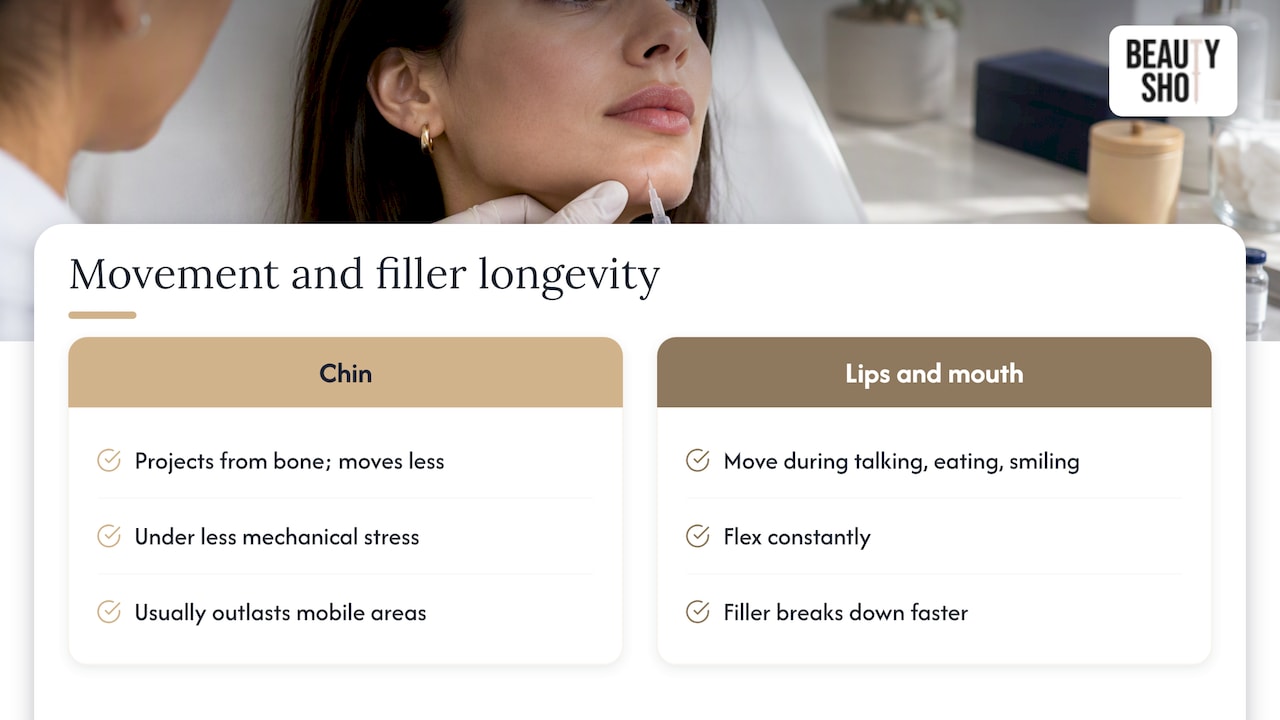
Filler breaks down faster where there is more movement. Your lips are in motion all day: talking, eating, smiling. The nasolabial folds and the area around the mouth flex constantly. The chin projects forward from bone and moves much less, so filler placed there is under less mechanical stress.
One 2024 academic paper on structural treatment of the chin raises a related point: muscle activity and mechanical stress may shorten chin-filler duration, and relaxing the chin muscles with botulinum toxin may help results last longer. That is a perspective, not a guarantee, but it reflects something we see in practice. A strongly active mentalis muscle (the one that makes your chin dimple or pebble when you talk) can work against the filler.
If you want to compare timelines in a more mobile area, we have written about how long lip fillers last and how to maintain them. The difference is real.
What changes how long your chin filler lasts
The meta-analysis cited above groups the influences into four buckets: filler composition, injection technique and depth, anatomy, and patient-specific factors such as age, sex, skin elasticity and lifestyle. Here is how each plays out in a real appointment.
The product you choose
HA fillers come in different consistencies. Firmer, more cohesive gels hold their shape under pressure, which is why they are often chosen for the chin, where you are building projection rather than softening a fine line. Softer gels suit superficial lines but would not give structural support in the chin.
The type of material matters too. HA fillers are the most common and are reversible. Biostimulating products work differently, encouraging your own tissue to build support, and the Alberta source above reports longer timelines for some of them. We discuss with you which category fits your goal, rather than choosing by the longest advertised number. A longer-lasting product is not automatically a better one if you are not sure about the shape you want.
Depth and placement
Placement is the factor patients underestimate. According to the meta-analysis, deep placement on the bone with high-cohesivity or high-viscosity HA yields the longest-lasting outcomes, typically 12 to 14 months. Place the same product more superficially and you can expect a different result, and often a different look.
This is why we put anatomy before product. Where the filler goes depends on whether your chin is short, retruded (set back), or simply out of balance with your nose and jawline.
Your own body
Some people metabolize filler faster. Age, skin quality and how much the area moves all play a part, and no test tells us in advance. Younger patients with active metabolisms and strong facial expressions sometimes see results fade a little sooner. You will learn your own pattern after the first round, which is one reason we like to review the result with you rather than guess.
Lifestyle: what helps and what is just a myth
Here we want to be honest, because many articles overpromise. Smoking and UV exposure damage collagen and speed visible skin aging, so protecting your skin is worthwhile for the whole face. But there is no strong evidence that drinking more water or avoiding exercise materially slows filler breakdown. You will see lists of “tips to make filler last” online. Most of them are noise.
What is genuinely sensible:
- Follow your aftercare instructions for the first days (we cover them below).
- Wear sunscreen daily.
- Don’t smoke.
- Come back for review rather than waiting until the result is fully gone.
Durability depends on wear and care in any cosmetic work, from injectables to something as different as composite bonding lifespan. The pattern is the same: good placement, sensible habits and regular check-ins beat trying to hack the timeline.
What “wearing off” actually looks like
Chin filler does not switch off. It softens gradually. In the first months the chin looks defined and your profile sits where we planned it. Over time the projection eases, and you may notice that your profile looks a bit flatter in photos or that your chin looks slightly smaller than you remember.
There is also a nuance in the literature. A 2025 review on managing fillers over the long term notes that HA fillers are generally reabsorbed within 6 to 24 months, yet histology reports have found filler material persisting for years. The visible aesthetic effect may fade well before the material is entirely gone. In plain words: your chin may look like the filler has worn off while a small amount remains in the tissue. That is one reason repeat treatments are planned carefully, and why we keep records of what was used and where.
When to book a touch-up
There is no universal date. Here are the signs we suggest you watch for.
- Your profile photos look different. Compare a side photo from week two with one today.
- The chin looks less projected or less defined. Often you feel it before others see it.
- Your original reason for treatment has returned, such as a recessed look next to your nose or jawline.
- It has been about 9 to 12 months. This is a good time to review, not a deadline to retreat.
The 2023 review puts the mean at 13 months, so many people choose to check in around the one-year mark. The meta-analysis also advises that chin-filler counselling should set site-specific expectations, with deeper, more stable placement informing touch-up timing.
A useful finding from the 2024 chin study: when patients return for re-injection of the studied product, they often need smaller volumes to get a result similar to their first treatment. Topping up before the filler fully disappears is often gentler and can be more economical than starting from zero. We can’t promise that for every patient, but it is a good reason not to wait until you feel you have “lost everything”.
Why records matter
Repeated treatments can leave residual material that affects where new filler should go. That is why we document the product, the lot number, the injection plane and the volume on each side. If you see a provider elsewhere in future, ask for a copy of your treatment record.
Can chin filler make your face look longer?
It can, and this is worth discussing before treatment. Filler placed to add height or to push the chin forward changes the proportions of the lower third of the face. Depending on where the product goes and how much is used, the chin can appear a little longer, more pointed or more projected. For someone with a short or recessed chin, that is often exactly the goal. For someone who already has a long lower face, adding vertical volume could work against balance.
This is why we assess your face from the front and in profile, not just the chin in isolation. Sometimes the answer is to add projection forward rather than length, to treat the jawline too, or to leave the chin alone and look elsewhere. Our guide to chin filler for a balanced facial profile goes into this further. If you have a chin crease or a pebbled look when you speak, chin crease filler is a separate conversation.
Our perspective on chin filler and longevity
We get asked “how long will it last?” at almost every chin consultation, and we understand why. It is a real investment. But we think it is the second question. The first is: what do you want your profile to look like, and is the chin actually the right place to start?
When treatments are performed by an advanced cosmetic Registered Nurse with more than nine years of injection experience, much of the longevity conversation comes down to planning. We look at your bone structure, your lower face proportions and how your chin moves when you speak. Then we choose a product and a depth that serve your goal, not the biggest number on a brochure.
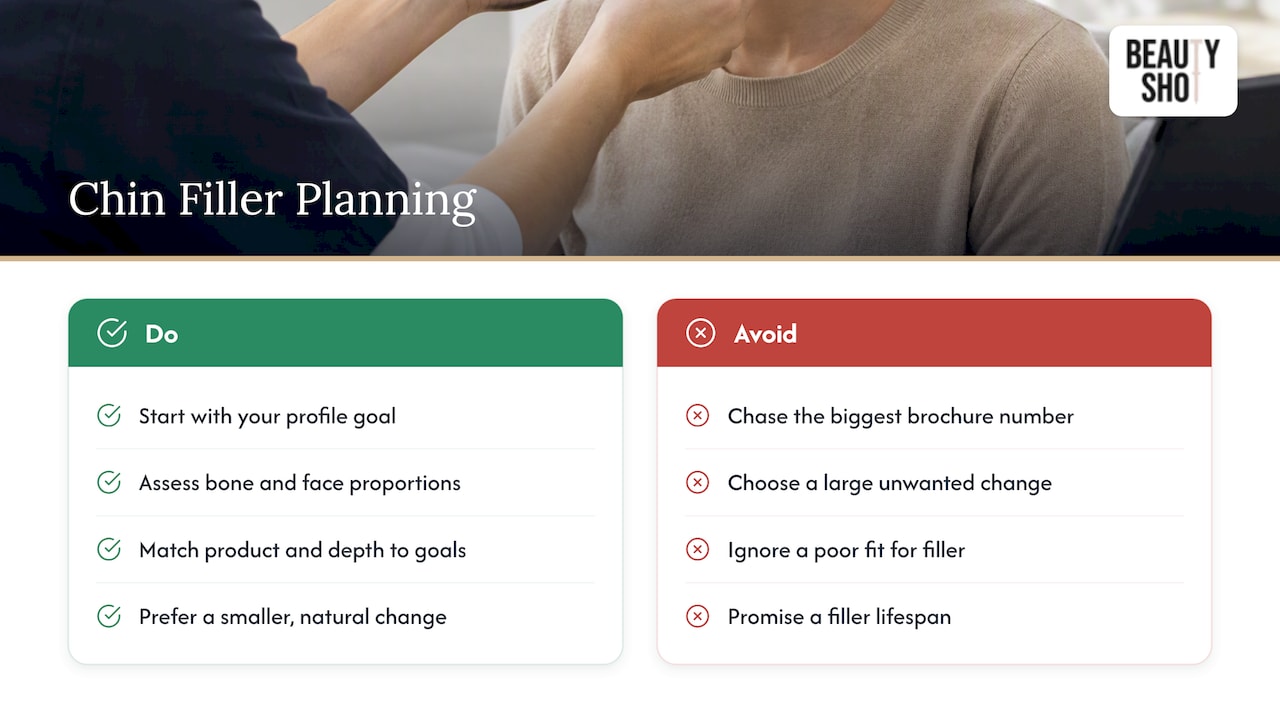
We would rather you have a smaller, natural change that you top up thoughtfully than a large one you did not quite want and have to wait out. Hyaluronic acid can be dissolved if needed, and we also see patients who want a past result corrected. Honest advice includes telling you when filler is not the best fit, or when a different treatment, such as masseter Botox for the jawline, could better balance the lower face.
No one can guarantee how long filler will last in your body. What we can promise is a plan that is clear, unhurried and built around you.
— Felix
What to do in the first days to protect your result
Aftercare will not double the life of your filler, but it protects the placement while the product settles. In general, we suggest:
Do:
- Sleep with your head slightly elevated the first night.
- Apply a cold compress gently if you are swollen, as advised at your visit.
- Use sunscreen as the area heals.
- Contact us if something feels wrong.
Don’t:
- Massage or press on the chin unless you were told to.
- Book facials with heavy pressure or heat on the lower face in the first days.
- Skip a review appointment because the chin looks good.
Swelling or bruising in the first days is common. If you notice severe pain, skin that turns pale or dusky, or vision changes, seek urgent medical care right away and tell the clinician you had filler. Health Canada’s cosmetic injections page is a good place to read about safe use of these products and why you should choose a qualified provider.
Chin filler at Beauty Shot in Woodbridge
At Beauty Shot Medical Clinic in Woodbridge, Vaughan, chin filler is part of our dermal filler services, alongside cheeks, temples and jawline. Every treatment is performed by an advanced cosmetic Registered Nurse, and each plan begins with a consultation about your proportions and your goals. If you are coming from Maple, Kleinburg, Concord or elsewhere in the GTA, you can see all our services or reach us through our main site to arrange a visit. Pricing is discussed at your consultation.
FAQ
How long does chin filler last?
Most HA chin filler lasts around 9 to 18 months, and the 2023 review found a mean of 13 months. Some people see results fade closer to 6 months, and some keep them for longer. Your anatomy, the product and the injection depth all play a role.
Does chin filler last longer than lip filler?
Usually, yes. The chin moves less than the lips, so the filler tends to break down more slowly. Health Canada gives a general range of six months to a year or more for HA fillers, and the chin generally sits toward the upper end of it.
Can I make chin filler last longer?
The biggest levers are choosing an appropriate product and having it placed at the right depth by an experienced injector. Sun protection and not smoking help your skin overall. Evidence that extra water or avoiding exercise slows breakdown is weak, so we would not rely on those.
Will I need a full amount again at my touch-up?
Not necessarily. Research on one chin filler found patients often needed smaller volumes when they returned for re-injection. We assess your chin at each visit and only add what is needed.
Can chin filler make my face look longer?
It can add length or projection depending on where the product is placed and how much is used. We check your facial proportions before treatment to make sure the change helps your balance.
Sources
- Cosmetic injections, Health Canada
- Juvéderm for chin
- The application and efficacy of hyaluronic acid fillers for chin retrusion
- Evaluating the duration of effectiveness of hyaluronic acid fillers
- Structural aesthetic treatment with hyaluronic acid filler
- Managing injectable fillers in the long term
- Filler injections, Alberta health information