
Most smile changes after cosmetic Botox are temporary and improve as the toxin naturally wears off, usually within weeks. The most common causes are technique-related, such as the product spreading slightly beyond the target muscle, rather than anything neurological. If you notice trouble breathing, swallowing, or speaking, that is not a cosmetic issue: seek medical attention right away.
TL;DR:
- Less than half of Botox-related smile asymmetries stem from the muscle effects, with most resolving naturally within four months.
- Injection placement near the mouth or diffusion from nearby areas most commonly cause unintended muscle weakening that affects the smile’s symmetry.
- A staged, conservative correction using targeted injections or neuromuscular retraining typically restores balance without risking overcorrection.
- Immediate signs of toxin spread requiring urgent care include difficulty breathing, trouble swallowing, slurred speech, or widespread muscle weakness.
- Choosing an experienced injector, verifying proper product approval, and following post-treatment rules significantly reduce the risk of lasting or serious complications.
Why Botox can make your smile look or feel different
A crooked or uneven smile after Botox almost always comes down to muscle mechanics. Botox works by reducing the ability of a targeted muscle to contract, and your smile depends on a coordinated pull between several small muscles around your mouth. When the product affects a muscle you did not intend to treat, even slightly, the balance shifts and one side may lift less than the other.
The lower face is unusually easy to overtreat because its muscles overlap and interdigitate rather than sitting in neat, separate layers, which is why precise assessment at rest and during movement matters so much when planning injection points. A few specific technical issues explain most cases:
- Injection placed too medially near the mouth can reach the depressor anguli oris, a muscle that pulls the corner of the mouth down, throwing off the smile’s symmetry.
- Product migration or diffusion from a nearby injection site, such as one intended for masseter slimming or jawline treatment, can spread into muscles that control lip movement.
- Slightly higher dosing than the area needed can overcorrect a muscle instead of softening it, leaving it too weak to contribute to a natural smile.
It is worth ruling out causes unrelated to the injection itself. Facial nerve palsy, a dental or jaw issue, an old facial injury, or a condition called synkinesis, where nerve signals cross and cause unrelated muscles to fire together, can all mimic a Botox-related smile change. If your smile felt off before treatment or the change does not track with your injection timeline, mention that at your follow-up so your injector can rule out something unrelated to the toxin. Our page on common Botox side effects walks through what is typical and what deserves a second look.
Typical timeline: when you’ll notice change and when movement usually returns
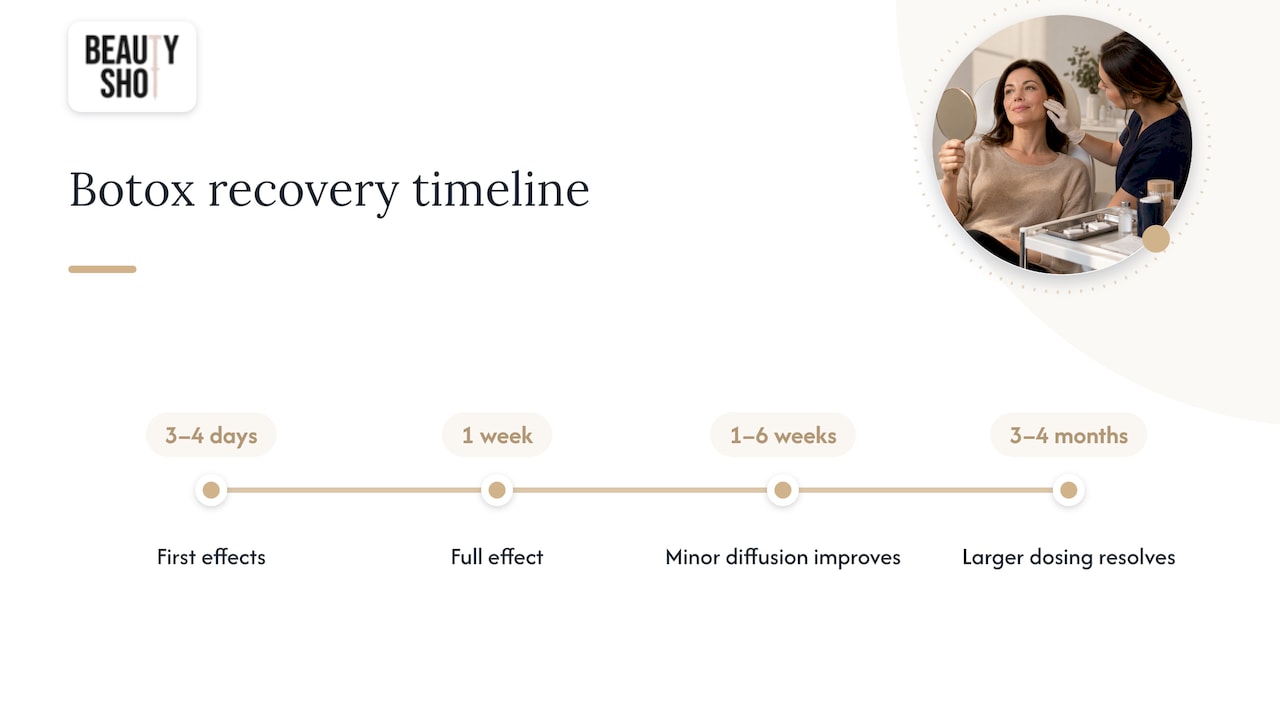
Botox does not act immediately. Most people notice the first effects within three to four days, with the full effect settling in by about one week, according to HealthLinkBC’s patient guidance. If a smile change appears, it usually shows up in that same window, once the product has taken full effect.
Botox results, including any unwanted effect on a nearby muscle, typically last a few months before the muscle regains its normal movement, per HealthLinkBC. Minor diffusion cases, where only a small amount of product reached an unintended muscle, often improve within one to six weeks as the effect there fades faster than at the primary injection site. Larger dosing issues, or cases where a fuller dose landed in the wrong spot, tend to follow the longer curve and may take the full three to four months to resolve completely.
Your own timeline depends on your anatomy, the dose used, the specific product, and how your body metabolizes the toxin. Two patients treated the same day can recover at noticeably different speeds, which is exactly why a follow-up appointment matters more than a fixed calendar date.
What to do now: self-care, clinical correction options and realistic expectations
The first few hours after any Botox treatment matter, whether or not you notice a problem. For the initial four hours, avoid rubbing or massaging the treated area, skip strenuous exercise, and stay away from saunas or hot showers, since heat and pressure can encourage the product to spread beyond its target. Our aftercare guide covers this in more detail, and a partner resource on post-treatment maintenance offers a useful outside perspective on staged aftercare habits.
If you do notice a change, document it. Take photos and a short video of your smile at rest and in motion, noting the date, so your injector can compare it against your baseline at follow-up.
From there, correction generally follows a staged approach:
- Wait and reassess if the change is mild, since many minor asymmetries improve on their own within the first couple of weeks.
- Targeted contralateral injections on the unaffected side can rebalance the smile: a documented case report found that this approach restored commissure symmetry within two weeks with no adverse events observed at follow-up.
- Small corrective doses to an overactive muscle elsewhere in the same area can fine-tune the result once the injector has assessed the pattern of movement.
- Neuromuscular retraining, such as guided facial exercises, is sometimes added when a muscle needs help relearning its normal pattern.
Most injectors reassess around 10 to 14 days after the original treatment, once the full effect has settled in and the pattern of any asymmetry is clear. Staged, conservative corrections carry less risk than jumping straight to a larger dose, because it is far easier to add a small amount of product later than to undo an overcorrection.
Pro Tip: Bring your timed photos and video to any follow-up appointment: seeing your smile in motion tells your injector far more than a description ever could.
Simple corrective injections are not suitable for everyone. Severe or widespread muscle weakness, or complex synkinesis involving multiple facial nerves, usually needs a more thorough medical assessment rather than a quick touch-up.
Warning signs: what needs urgent medical attention
A cosmetic smile change and a medical emergency look nothing alike once you know what to check. Health Canada is clear that common Botox reactions, including mild eyelid drooping, headache, and bruising, are usually temporary, but certain signs mean the toxin may have spread beyond the injection site and require immediate care.
Seek emergency attention if you experience:
- Difficulty breathing or a feeling of tightness in your throat or chest.
- Trouble swallowing, including pain or a sense that food or liquid is not going down normally.
- Slurred or noticeably changed speech that develops after treatment.
- Rapid spread of muscle weakness to areas far from where you were injected, such as your neck or limbs.
Serious systemic signs after Botox, though uncommon, indicate the toxin may have spread beyond the treated muscle and warrant urgent evaluation, per Health Canada. If you go to urgent care, tell the clinician exactly what was injected, when, and where on your face, so they can assess the situation quickly and accurately.
How to reduce risk next time: provider checks and procedural safeguards
Choosing carefully before your next treatment does more to protect your smile than anything you can do afterward. Health Canada has previously flagged unauthorized injectable products circulating outside legitimate clinical channels, which makes a few simple checks worth doing every time.
- Ask to see the vial or product label before treatment and confirm it carries a Drug Identification Number, which shows Health Canada has authorized the product.
- Confirm your injector’s training and experience, particularly with lower-face anatomy, since that is where smile-related complications are most likely to start.
- Ask about the planned dose and technique for the area being treated, and expect a conservative, staged plan rather than an aggressive one.
- Request clear documentation, including your treatment record and a plan for follow-up, so any adjustment later is based on what was actually done.
After treatment, follow the same four-hour rule every time: no rubbing, no strenuous exercise, and no heat exposure on the treated area, since all three can encourage unwanted spread. Our page on Botox safety research covers more of what the evidence says about provider practices and product handling.
Pro Tip: A confident, qualified injector will always show you the product vial without hesitation: treat any reluctance as a reason to ask more questions.
How we handle assessment and correction at this clinic
At this clinic, an altered smile after Botox receives a careful assessment process: static and dynamic photos, a review of functional movements like smiling and puckering, and a plan built around specific facial anatomy rather than a standard formula. Corrections are staged and conservative, starting with the smallest amount needed to rebalance movement and preserving as much of your natural expression as possible.
Follow-up typically happens around 10 to 14 days after the original treatment, once the effect has fully settled and any asymmetry is clear to assess. From there, most patients need only a small, targeted adjustment rather than a full re-treatment. Every injection at the clinic is performed by an advanced cosmetic Registered Nurse with years of injection experience and training across multiple recognized techniques, which shapes how carefully lower-face treatments are planned.
A nurse injector’s reassurance for anyone worried about their smile
It can feel unsettling when your smile does not look like your own right after treatment. In most cases, such changes are temporary and respond well to a small, well-planned adjustment rather than anything drastic. At your follow-up, I will ask for timed photos, a short video of your smile in motion, and a quick check of your lip seal, because those details tell me far more than a description alone. Reaching out early, and choosing an authorized product with a qualified injector from the start, makes correction faster and simpler.
— Felix
How the clinic can help with assessment and conservative correction
If your smile has changed after a Botox treatment elsewhere and you want an honest assessment, some clinics offer careful evaluation, staged corrective options, and a plan built around your anatomy rather than a one-size approach. Treatments performed by experienced cosmetic Registered Nurses typically take a conservative, anatomy-first approach to correcting past results, not just adding more product.
- Bring timed photos and video of your smile at rest and in motion so we can assess the pattern of movement.
- Bring the product vial or label if you have access to it, so we know exactly what was used.
- Expect a staged plan, starting small and reassessing before adding anything further.
You can book a consultation through our services page or learn more about our approach to Botox and Dysport treatments on our dedicated service page.
Primary sources and guidance referenced in this article
- Health Canada cosmetic injections guidance
- Contralateral correction case report
- Facial asymmetry and synkinesis literature review
- HealthLinkBC Botox timeline
- Health Canada unauthorized product alert
This article is general information, not a substitute for advice from a qualified doctor. Consult a qualified healthcare professional about your own circumstances before acting on anything here.
Sources
- Cosmetic injections – Health Canada
- Correction of iatrogenic facial asymmetry caused by botulinum toxin using contralateral injection: a case report
- The use of botulinum toxin to improve cosmesis in patients with facial asymmetry following facial palsy/synkinesis: a literature review
- Botulinum toxin (Botox) — HealthLink BC
- Unauthorized injectable drugs and medical devices seized – Health Canada recall
FAQ
What is the Joker smile after Botox?
This describes an uneven smile where one corner of the mouth pulls down or sideways more than the other, usually because the depressor anguli oris muscle was affected by the injection. It typically resolves as the effect on that muscle wears off, and a conservative corrective injection can often improve it sooner.
Why does my smile look weird after Botox?
An unusual-looking smile is most often caused by the product affecting a muscle near your intended treatment area, throwing off the natural balance between the muscles that lift and lower your mouth. It is rarely a sign of anything serious and typically improves on its own or with a small corrective adjustment.
What are the red flags after Botox?
Difficulty breathing, trouble swallowing, slurred speech, and muscle weakness spreading beyond the treated area are signs that need immediate medical attention rather than a wait-and-see approach, according to Health Canada. Ordinary cosmetic effects, like mild asymmetry or eyelid heaviness, do not come with these systemic symptoms.
What is the 4-hour rule for Botox?
The four-hour rule refers to avoiding rubbing or massaging the treated area, skipping strenuous exercise, and staying away from heat sources like saunas or hot showers for the first four hours after treatment. Following it helps keep the product at the injection site and reduces the chance of it spreading into nearby muscles.
How long does a Botox smile change usually last?
Most smile changes follow the same timeline as Botox itself, resolving within three to four months as the muscle regains its normal movement, per HealthLinkBC. Minor cases often improve much sooner, sometimes within a few weeks, especially with a targeted corrective adjustment.