
Most people who have hyaluronic acid (HA) filler placed under the eyes can expect results to last somewhere between about 9 and 18 months. Some see less, and some see more. The range is wide because this area is small, delicate and different on every face. Below, we explain what the research says, what changes your timeline, and how we plan treatment so the result stays soft and natural for as long as possible.
TL;DR
- Health Canada says licensed HA fillers typically last six months to a year or more. Studies of the tear trough specifically report ranges up to two years.
- Your skin, the size of the area, and the filler chosen all affect how long results last.
- Final results settle over about a month, so judge longevity from that point, not from day one.
- HA filler can be dissolved if needed, and a conservative, well-placed amount is the best protection for both look and lifespan.
- Book a review if swelling returns weeks or months after treatment.
How long does tear trough filler last?
The honest answer is a range, not a single number. Here is what the evidence shows:
- Health Canada notes that the effects of licensed HA dermal fillers typically last from six months to a year or more.
- A 2024 review reports that HA results for tear trough correction have been described as lasting from 6 months to 2 years.
- A 2021 clinical study of the HA filler VYC-15L found it was effective for infraorbital hollowing, with results lasting through 1 year.
- A 2025 systematic review of facial HA fillers found that ultrasound studies indicated persistence of 12 to 36 months.
Why do these numbers differ? Studies measure different things. Some track how the area looks to the eye, others track how much product is still present on ultrasound. Product still being present is not always the same as a visible improvement. That is why we talk with patients about what they see in the mirror, not only a calendar.
In our clinic, we describe a realistic expectation of roughly 9 to 18 months for under-eye filler. You can read more on our tear trough filler page. That is our clinical experience and our own guidance, not a promise. Your result may sit above or below that range.
Why the under-eye area often lasts longer than other areas
The tear trough does not move much. Lips and the area around the mouth are in constant motion when you talk, eat and smile, and many people find filler there softens sooner. Under the eye, the filler sits deep and still. We cover the lip side of this in our guide to how long lip fillers last, and the comparison shows how much placement and movement matter.
This is a general pattern, not a rule. A small amount placed in a very thin area can still fade sooner than you expect, which is why we plan the amount carefully rather than adding more to chase longevity.
What affects how long under-eye filler lasts
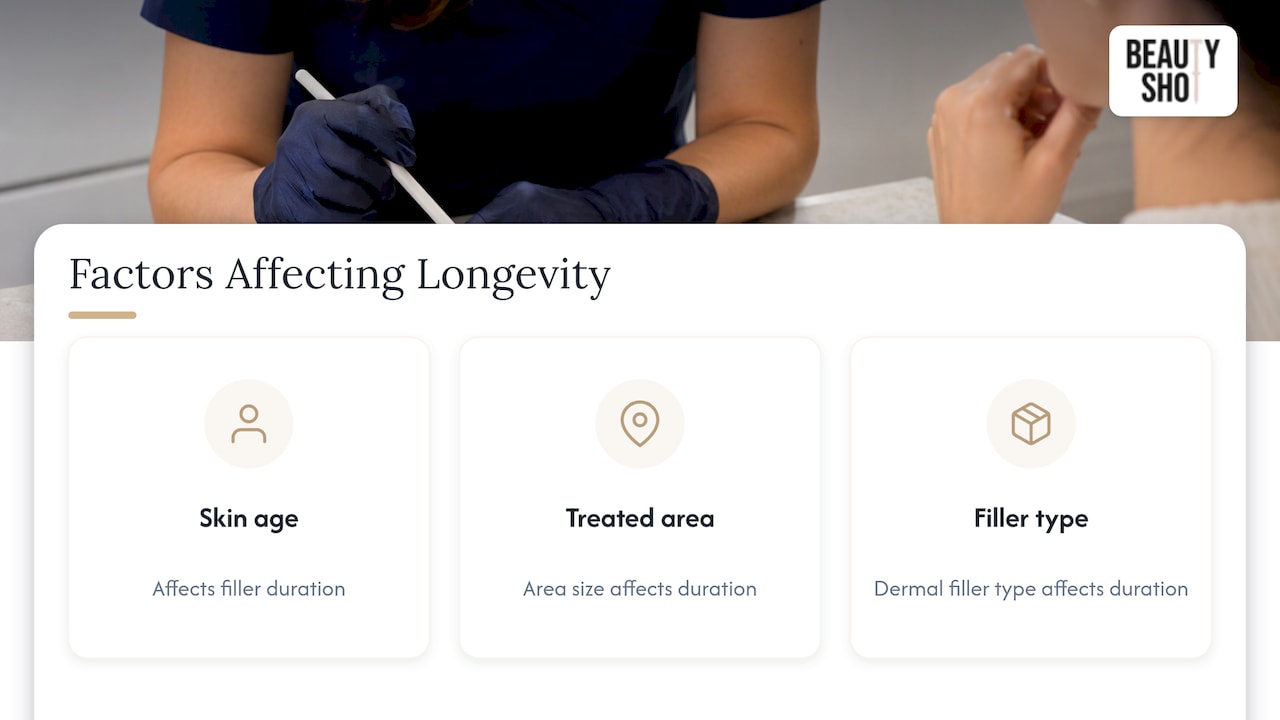
Health Canada states that duration depends on factors including skin age, the size of the area being treated, and the type of dermal filler used. In practice, we look at these things at your consultation.
The product
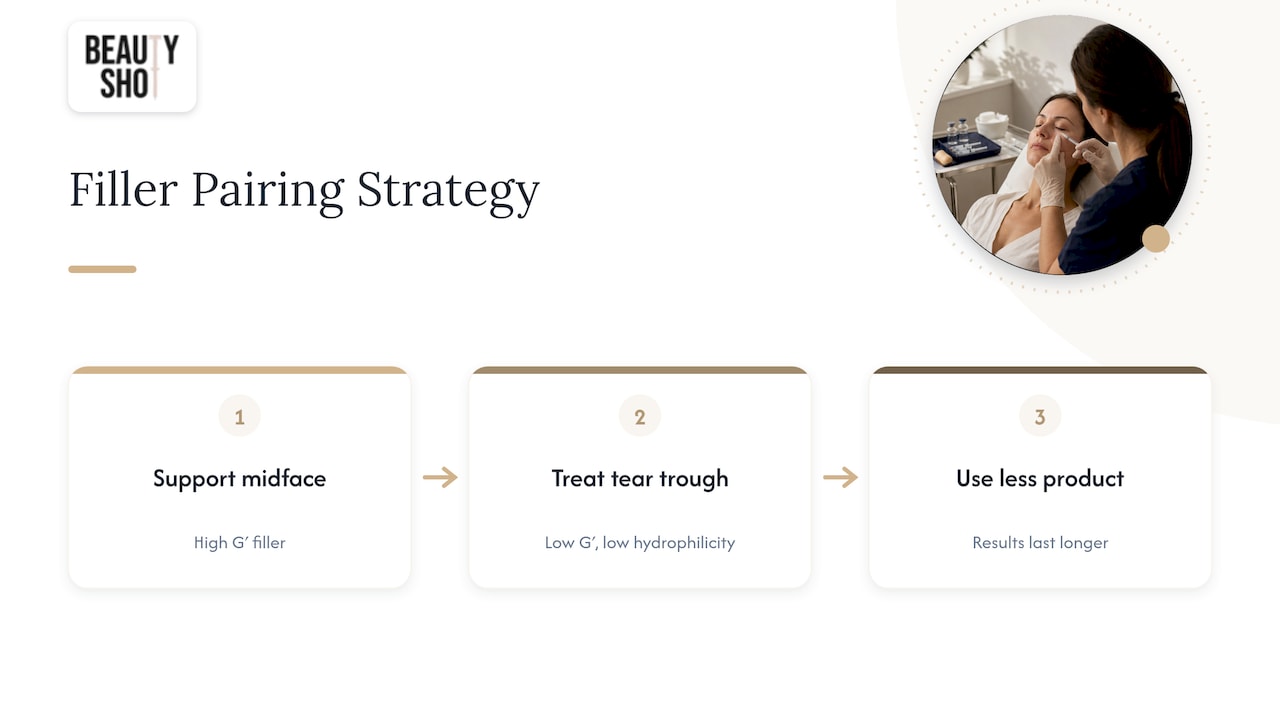
Not every HA filler behaves the same way. Fillers differ in how firm they are (often described as G′) and how much water they attract. A 2024 review explains that pairing a high G′ filler for the midface with a low G′, low-hydrophilicity filler for the tear trough reduces the amount needed and prolongs results. In plain words: when the cheek is supported properly, the delicate under-eye area needs less product and holds its result better.
This is why we often assess the cheek before we touch the tear trough. Sometimes a gentle bit of support in the midface softens the hollow so much that very little is needed under the eye. Our page on cheek filler explains how that works.
Your anatomy
The infraorbital area is complex. A 2022 paper by Robyn D. Siperstein and colleagues points out that thin skin, minimal fat and delicate lymphatic drainage raise the risk of visible irregularities and call for deep, periosteal placement. Two people who both say they have “hollow” eyes can need completely different plans, depending on bone structure, skin thickness, and how much volume has been lost.
Your skin and your body
Skin age matters, as Health Canada notes. Your metabolism, activity level and how your body handles HA may also play a role, though we cannot predict that precisely for any one person. What we can do is track your own pattern and adjust at follow-up visits.
The amount used
More is not better here. Research on infraorbital hollows says that, to limit visibility and the bluish Tyndall effect, filler should be carefully selected and placed in small quantities so it supports the area without accumulating. Overfilling does not buy extra months. It raises the chance of puffiness and an overdone look. Our article on under-eye filler swelling goes deeper on why we keep the plan modest.
When do you see the final result?
Do not judge longevity from the first few days. Swelling and bruising can make the area look fuller or uneven at first. A 2021 consensus paper from Spain describes the filler as undergoing consolidation, drying and rehydration over about 30 days, and recommends that new HA injections not be given for 28 days.
A practical timeline looks like this:
| Stage | What to expect |
|---|---|
| First few days | Some swelling, possible bruising. The area may look fuller than the final result. |
| Around two weeks | Swelling settles and the shape becomes clearer. |
| About one month | The filler has fully settled. This is when we assess the result and decide whether a touch-up is needed. |
| Months afterward | Gradual softening. The timing varies by person. |
This is why we schedule a review rather than topping up early. Adding more product on top of filler that is still settling is one of the easiest ways to end up with a heavy under-eye look. For more on the recovery itself, see our guide on what to expect when treating under-eye hollows with fillers.
What “fading” really means, and what stays behind
People often imagine filler vanishing on a set day. It rarely works that way. The result softens gradually, and many patients notice the hollow returning slowly rather than suddenly.
There is also a more nuanced picture. Clinicians describe mechanisms such as neocollagenogenesis and adipocyte proliferation that may contribute to partial persistence of volume in the tear trough over time. That may be one reason some patients feel their under-eyes look better than before even after the visible filler has faded. We do not promise this, but it is part of why follow-up treatments sometimes need less product than the first session.
Can filler stay longer than expected, or move?
Yes, and it is worth knowing. The ophthalmology resource EyeWiki notes that under-eye filler can migrate to a distant site or the orbit and can persist for years, even 10 to 15 years. The same source notes that HA filler can be dissolved with hyaluronidase. That reversibility is one of the main reasons we use HA in this area and why we are careful about the amount, depth and product we choose.
If you ever feel your result no longer looks right, a conversation with your injector is the first step. Dissolving is an option for HA products, and it is something we would plan with you, not rush.
Our perspective on making results last
At Beauty Shot, we do not measure a good tear trough result by how many months it lasts. We measure it by whether you look rested and still like yourself on day one and on month ten.
The under-eye is the most unforgiving area I treat. The skin is thin, the fat is minimal and the lymphatic drainage is delicate. That means a small amount, placed deep and in the right plane, will almost always look and last better than a large amount placed quickly. I would rather you come back for a gentle top-up than leave overfilled.
I always look at the whole face. Often the shadow under the eye is partly a cheek support question, and treating that first means we use less product under the eye. That is the kind of personalized plan I build with every patient, based on anatomy and balance, never a cookie-cutter recipe.
With more than nine years of injecting and a nursing background that began in hospital medical and ICU care, safety comes first in every decision. I will tell you honestly if I think you are not a good candidate yet, or if another approach would suit your concerns better. My goal is simple: help you look refreshed, confident and like yourself.
Felix
How to get the most from your treatment
None of this guarantees a timeline, but these habits support a smoother recovery and a result that holds up well.
Do
- Choose your injector carefully. Ask who will perform the injection, what their training is, and how many tear trough treatments they do. At our clinic, every injectable is performed by an advanced cosmetic Registered Nurse.
- Plan the whole face. Ask whether the cheek needs support first.
- Wait for the full result. Give it about a month before you decide on a touch-up.
- Follow aftercare. Keep your head slightly elevated for the first night, and avoid pressing or rubbing the area. Our guidance on alcohol after fillers explains the 24 to 72 hour window we recommend.
- Protect your skin. Daily sunscreen helps the skin around the eye, which is the first thing people notice as the filler softens.
Do not
- Do not chase a perfect look in one visit. Staged treatment is gentler.
- Do not book a top-up too early. The Spanish consensus above advises against new HA injections within 28 days.
- Do not ignore changes. New puffiness, redness, or tenderness deserves a call, not a wait-and-see.
Safety before you book
Health Canada advises avoiding or postponing injections if you have a history of severe allergies with anaphylactic shock, inflamed or infected skin, or a bleeding disorder. Tell your injector about these at your consultation, along with any medications and previous filler treatments.
When to seek a review
Some swelling in the first days is expected. Swelling that arrives or returns later is different. Research on infraorbital HA filler notes that delayed-onset swelling may relate to filler migration, lymphatic-flow blockage, or exposure to crosslinker as HA is resorbed, and that management should address the underlying cause.
Contact your injector promptly if you notice:
- Swelling or puffiness that appears weeks or months after treatment
- A bluish tint under the skin
- A lump or ridge that is not settling
- Increasing redness, pain, or warmth
For sudden vision changes, severe pain or skin that turns pale or dusky, seek urgent medical care straight away.
Is filler the right long-term plan for you?
HA tear trough filler is a quick, non-surgical option with little downtime, which suits many busy professionals in Vaughan. It is also temporary by design. The 2024 review notes that for patients who want a more permanent solution, surgical fat repositioning remains the preferred choice. Many of our patients are happy with filler for years through gentle, occasional maintenance. If you are weighing both paths, a consultation is the right place to talk through your goals and your comfort with each.
Book a tear trough consultation in Woodbridge
If you would like an honest assessment of your under-eye area, we offer consultations at our Woodbridge clinic, serving Vaughan, Maple, Kleinburg, Concord and the wider GTA. We will look at your anatomy, explain the options, and tell you what we think is realistic. See our dermal filler treatments for the areas we treat, including under-eye hollows, or visit our services page to get started.
FAQ
How long does tear trough filler last?
Most patients can expect around 9 to 18 months, though this varies by person. Health Canada says licensed HA fillers typically last six months to a year or more, and some studies report up to two years in this area. Your skin, anatomy and the product used all play a part.
Does tear trough filler last longer than other facial fillers?
Often it does, because the under-eye area moves very little. Areas with more movement, such as the lips, may soften sooner. This is a general pattern, and individual results differ. Our guide on how long dermal fillers last and when you need a refill compares areas in more detail.
Can I make under-eye filler last longer?
You cannot control your metabolism, but you can choose a careful injector, a conservative amount and a plan that supports the cheek where needed. Following aftercare and protecting your skin from the sun also help. Rushing top-ups before the filler has settled tends to work against you.
Can under-eye filler be removed if I do not like it?
HA filler can be dissolved with an enzyme called hyaluronidase, which is one reason it is the usual choice for this area. The decision should be made with your injector after a proper assessment, and not too early in the first weeks while swelling is still settling.
Does under-eye filler migrate?
It can, and clinical sources describe cases of filler moving or persisting for years. The risk is one reason placement depth, product choice and small amounts matter so much. If you notice new swelling or a bluish tint, book a review so the cause can be identified.
Sources
- Cosmetic injections, Health Canada
- Surgical and Non-Surgical Approach for Tear Trough Deformity, 2024 review
- Randomized study of VYC-15L for infraorbital hollowing, 2021
- Clinical Durability of Hyaluronic Acid-Based Dermal Fillers, 2025 systematic review
- Recommendations for the treatment of tear trough deformity, 2021
- Eyelid Filler Injection, EyeWiki
- Infraorbital Hyaluronic Acid Filler: Common Aesthetic Side Effects, 2022
- Optimizing Infraorbital Hollows Treatment With Hyaluronic Acid, 2025