
Sleep on your back with your head raised on two pillows for the first night or two, and avoid pressing your lips into a pillow. Side or stomach sleeping is the position to skip while your lips are tender and swollen. If you roll over in your sleep, you have not ruined your result. Keep reading for a night-by-night plan, practical set-ups that keep you on your back, and the signs that mean you should call your injector.
TL;DR
- Night 1: sleep on your back, head elevated on 2 pillows, and keep your lips free of pressure.
- Side sleeping: avoid it for the first day or so, and for as long as your lips feel sore or puffy. Many people are comfortable again within a few nights.
- If you roll over: do not panic. Move back to your back, apply a cold pack wrapped in a cloth if you are sore, and carry on.
- Swelling timeline: it often peaks in the first couple of days and can take two to four weeks to fully settle.
- Call someone: if redness, swelling or pain gets worse after the first day, or if you have vision changes, severe pain or skin that looks pale or dusky.
Why your sleeping position matters after lip filler
Immediately after treatment, your lips are tender and swollen. The filler has been placed gently into soft tissue, and that tissue is reacting to the needle and to the product. Swelling is part of the normal process. It is not a sign that something went wrong.
While you sleep, you spend hours in one position without noticing what your face is doing. Two things can make the first nights less comfortable:
- Fluid settling in the face. Lying flat can leave you puffier in the morning. Healthline’s aftercare guidance recommends sleeping with your head elevated to reduce swelling, and not sleeping on your face.
- Pressure on tender lips. A pillow pressed into your mouth can be painful, and the American Society of Plastic Surgeons advises avoiding side or stomach sleeping for the first day or so after fillers.
I want you to hear this clearly: sleep is not a test you can fail. Cleveland Clinic’s experts take a reassuring view that ordinary activities do not generally ruin lip filler results, and comfort should guide the temporary changes you make. Think of the advice below as a way to feel better and look calmer in the morning, not as a set of strict rules.
The best way to sleep after lip filler
Sleep on your back
Back sleeping keeps your lips from touching anything. It is the simplest position to recommend, and it is the one I ask my patients to try first.
- Lie flat on your back with your arms by your sides or on your stomach.
- Keep your chin neutral, not tucked hard into your chest.
- Let your lips rest naturally, without clenching or pursing them.
Raise your head with two pillows
Elevation is the second part. Two pillows, or one firm pillow plus a folded one, is usually enough. You are aiming for a gentle incline, not sitting upright. If your neck feels strained, you have gone too high.
- A wedge pillow gives a smoother slope than stacked pillows, which can slide.
- A rolled towel under the pillow also works if you do not own a wedge.
- Sleeping in a recliner is fine if that is more comfortable for you.
Use a clean pillowcase
The injection sites are tiny puncture points, and they need time to close. Put a freshly washed pillowcase on before bed. It keeps things hygienic, and if you do end up on your side, your lips meet a clean surface.
Skip the lip products at bedtime
If your lips feel dry, ask your injector what they recommend for the first night before applying anything. Avoid rubbing or massaging the area, since the ASPS advice is not to rub or massage treated areas for 24 to 48 hours. If you are wondering about massage later on, our guide on whether to massage your lips after fillers covers the do’s and don’ts.
Can you sleep on your side after lip filler?
Short answer: avoid it at first, then return to it gradually.
For the first night, and ideally the first day or so, stay on your back. After that, side sleeping is a question of comfort. If your lips are still tender, swollen or bruised, lying on one side will probably feel unpleasant, and that is your body telling you to wait a little longer. If your lips feel normal when you press gently against the pillow, you are likely fine.
A practical approach for side sleepers:
- Start with the less swollen side. If one side of your lip is more swollen or bruised, lie on the opposite side.
- Use a softer pillow for the first side-sleeping night. Keep your lips from sinking into it.
- Keep your head slightly raised. Do not go flat just because you are on your side.
- Stop if it hurts. Pain on pressure means go back to your back for another night.
Every person heals differently. Your anatomy, how much product was placed, whether you bruise easily, and where in your cycle you are can all change how quickly things settle. I do not give a single fixed number of nights, because I want your own comfort to be the guide.
A night-by-night plan
This is the flow I walk patients through during a consultation. Your injector’s instructions come first, so use this as a general guide.
| Night | Position | What to expect | What helps |
|---|---|---|---|
| Night 1 | Back, head on 2 pillows | Tenderness and swelling; your lips may feel tight | Cold pack wrapped in a washcloth for a few minutes at a time before bed, if you are uncomfortable |
| Night 2 | Back, head still raised | Swelling may still be noticeable; you may wake up puffier | Keep elevation, stay hydrated, avoid heat |
| Nights 3 to 4 | Back preferred; try a side only if lips feel comfortable | Swelling and tenderness often easing | Test side sleeping gently, on the less swollen side |
| Nights 5 to 7 | Your usual position if comfortable | Mild puffiness or lumpiness may linger | Return to normal routine gradually |
| Weeks 2 to 4 | Normal | The product continues to settle | Be patient; check in if anything looks uneven |
For context, HealthLink BC says pain, redness, swelling and possible itching are expected after filler injections, and swelling may last up to 36 hours. Cleveland Clinic says lip filler swelling usually takes two to four weeks to fully resolve as the filler integrates into the lip tissue. Both can be true: the biggest swelling fades first, and the final, settled look comes later.
For a longer view of what each day brings, see our day-by-day lip filler recovery timeline.
How long should you sleep on your back?
People ask me this more than anything else. The honest answer is that there is no single number that fits everyone. The sources agree on the direction: back sleeping and elevation in the first day or so, then a gradual return to normal as tenderness settles. In my practice I ask patients to keep to their back for the first night or two and then let comfort lead.
A few markers tell you that you are ready to go back to your usual position:
- Your lips no longer feel sore when you touch them lightly.
- Swelling is mild, and you are not waking up noticeably puffy.
- Any bruising is fading and not tender.
If you wake up puffy on day two or three, go back to two pillows for another night. Nothing about that is a setback.
How to stay on your back all night
If you are a lifelong side or stomach sleeper, staying put is the hard part. These set-ups help:
- Build a pillow fence. Put a rolled blanket or firm pillow on each side of your body so rolling over feels blocked.
- Use a travel neck pillow. Worn around your neck, it keeps your head from turning and your face from dropping into the mattress.
- Put a pillow under your knees. Back sleeping is more comfortable with a slight bend in the knees, and it eases lower back pressure.
- Go to bed tired. A calm evening and a regular bedtime make it easier to stay still. Avoid strenuous exercise: Healthline notes avoiding it for 24 to 48 hours, and avoiding high heat for 48 hours, so skip the hot shower and sauna before bed.
- Have a plan for waking up on your side. If it happens, gently turn onto your back and go back to sleep. Do not press or rub your lips to check on them.
What if you roll over in the night?
It happens to nearly everyone. A few hours on your side will not change the shape of your lips. You might notice more tenderness or a slightly uneven morning swelling. If so:
- Do not massage or push the area to “fix” anything.
- Use a cold pack wrapped in a washcloth for a few minutes at a time, as Cleveland Clinic’s Dr. Murray recommends for discomfort and swelling.
- Keep your head raised the next night.
- If something looks distinctly lopsided after several days, contact your injector so they can assess it in person.
Sleeping after other dermal fillers
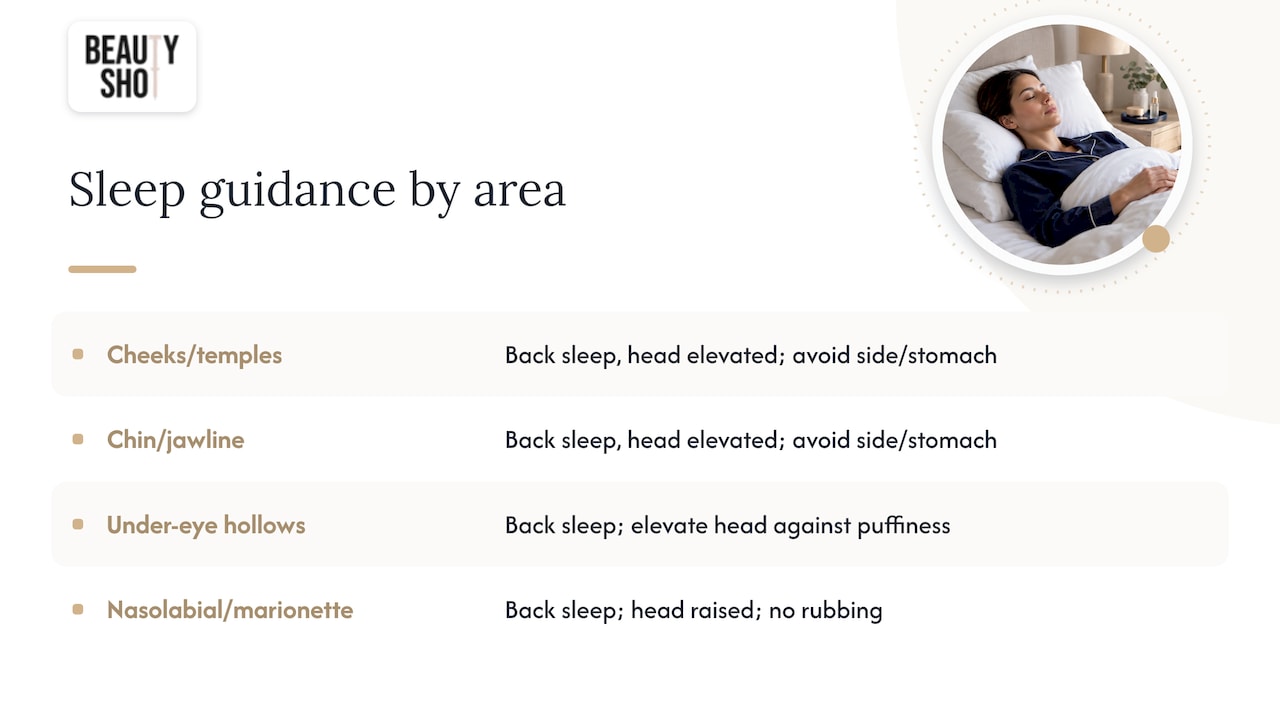
The same principle applies to other areas, with small changes. When you have filler in the cheeks, temples, chin or jawline, side and stomach sleeping can press on the treated area, so back sleeping with elevation still makes sense. For under-eye hollows, head elevation matters too, since this area tends to look puffy after fluid settles overnight. For the nasolabial folds and marionette lines, the same approach works: back, head raised, no rubbing.
Under-eye treatment is a delicate area, and it is worth understanding the potential reactions for any filler site. This overview of tear trough filler risks explains what swelling and vision-related warning signs can look like around the eyes. You can read more about our approach to specific areas on our dermal fillers page.
If you are comparing treatments, our article on lip fillers vs. dermal fillers explains how they differ.
When swelling is more than normal: who to call
Most swelling after lip filler is temporary. Health Canada notes that dermal fillers can cause pain, bruising, redness, swelling or edema, nodules, infection, skin discolouration, allergic reaction and improper placement, and that many reactions are temporary but some can last months and require treatment. That is why I give every patient clear instructions on what to watch for.
Contact your injector, or your doctor, if you notice:
- Redness, swelling or pain that gets worse instead of better. HealthLink BC advises calling a doctor if symptoms worsen 1 to 3 days after treatment, as this may indicate infection.
- New redness, swelling or pain after the first day.
- Fever, or an area that feels hot and increasingly tender.
Seek emergency care right away, or call 911, if you have vision changes, severe pain, or skin that turns pale, white or dusky. HealthLink BC lists rare serious complications including retinal artery blockage with blindness, skin breakdown, sepsis and abscess. These are uncommon, but they are time-sensitive, and you should never wait until morning to see whether they pass.
For bruising specifics, our guide to lip filler bruising and when to call explains what is typical. For swelling that lingers, see how to reduce swelling after lip fillers.
Our perspective
When patients come in for lip filler, the question I hear most at the end of the appointment is, “Can I sleep normally tonight?” It is a good question, because it shows you are already thinking about how to look after your result.
My answer is always calm and practical. We place the product with care, with the aim of a refreshed, balanced look that still looks like you. Aftercare is simply the quiet part that supports it: back sleeping, two pillows, no pressure on your lips for the first night or two, and patience with the swelling.
At Beauty Shot, all injectables are performed by an advanced cosmetic Registered Nurse, and we build each plan around your anatomy and your goals. That means your aftercare is not a generic sheet. We talk through your lifestyle, whether you sleep on your side, and what you have coming up this week, so you leave knowing exactly what to do.
And if something does not look or feel right, you do not need to wonder. Call us. We would much rather hear from you early than have you worry alone.
Felix
Before you book: plan your recovery around your calendar
A little planning makes the first nights easier:
- Pick a quiet evening. Book an appointment when you do not have a major event or early flight in the next few days.
- Set up your bed before you leave. Put out the extra pillows, a clean pillowcase and a cold pack in the freezer.
- Think about your work week. Mild swelling can be visible, so a day with fewer in-person meetings helps.
- Tell your injector how you sleep. If you are a committed stomach sleeper, say so. We can suggest strategies that fit you.
Our clinic’s full lip filler aftercare guide walks through the rest of recovery, and the essential dos and don’ts are a handy checklist. If you are wondering about your first morning, see how soon you can wear makeup after lip fillers.
Know your product
Health Canada advises patients to consult an experienced medical professional, understand the risks and benefits, and follow the product’s Canadian Product Monograph or Instructions for Use. It also advises that patients receiving hyaluronic acid fillers ask to see the product label and verify authorization, because unauthorized products have not been assessed for safety, effectiveness or quality. Asking about your product is a normal part of an informed consultation.
Lip filler with a nurse injector in Woodbridge
If you are considering lip filler or other dermal fillers and want a clear, honest conversation before treatment, we would be glad to meet you. Every injectable treatment at Beauty Shot Medical Clinic in Woodbridge, Vaughan, is performed by an advanced cosmetic Registered Nurse with 9+ years of injection experience. We focus on subtle, natural-looking results and an individualized plan for each patient. You can see everything we offer on our services page, or explore dermal filler treatment areas to find what suits you. If you would like a softer lip shape with Botox or Dysport, learn about our lip flip treatment.
FAQ
How should I sleep after lip fillers?
Sleep on your back with your head raised on two pillows, and keep your lips from pressing into the pillow. This is the position most aftercare guidance recommends for the first night or two. Use a clean pillowcase and avoid rubbing or touching your lips.
Can I sleep on my side after lip filler?
Avoid it for the first day or so, since side sleeping can put pressure on tender, swollen lips. After that, try it gently, starting on the less swollen side, and stop if it hurts. If you roll onto your side by accident, simply turn back and carry on.
How long should I sleep on my back after fillers?
There is no single number that suits everyone. Plan on the first night or two, then return to your usual position when your lips are no longer sore and swelling is mild. If you wake up puffy, go back to two pillows for another night.
How long before lip filler looks normal?
The most obvious swelling often eases within a few days, but Cleveland Clinic says it can take two to four weeks for swelling to fully resolve and the filler to settle. Your result continues to refine during that time. If something looks uneven after the swelling has gone down, contact your injector.
Does sleeping elevated really help?
Healthline’s aftercare guidance recommends sleeping with your head elevated to reduce swelling after lip filler. It is a simple, low-effort step that many patients find leaves them less puffy in the morning. It does not replace your injector’s instructions, so follow those first.
Sources
- Lip Fillers Aftercare: 10 Tips, What to Expect, and More (Healthline)
- What can you do to help your injectable fillers last longer (American Society of Plastic Surgeons)
- Lip Filler Aftercare: What Not To Do (Cleveland Clinic)
- Filler Injections (HealthLink BC)
- Cosmetic injections (Health Canada)
- Unauthorized injectable drugs and medical devices seized (Health Canada, October 19, 2021)
- Tear Trough Filler Risks