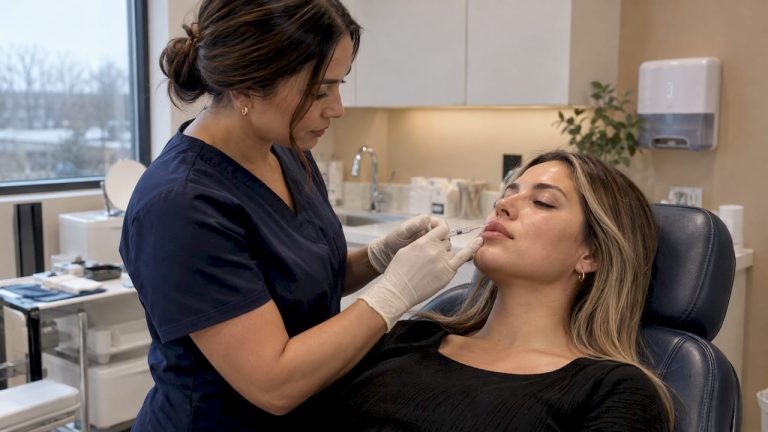
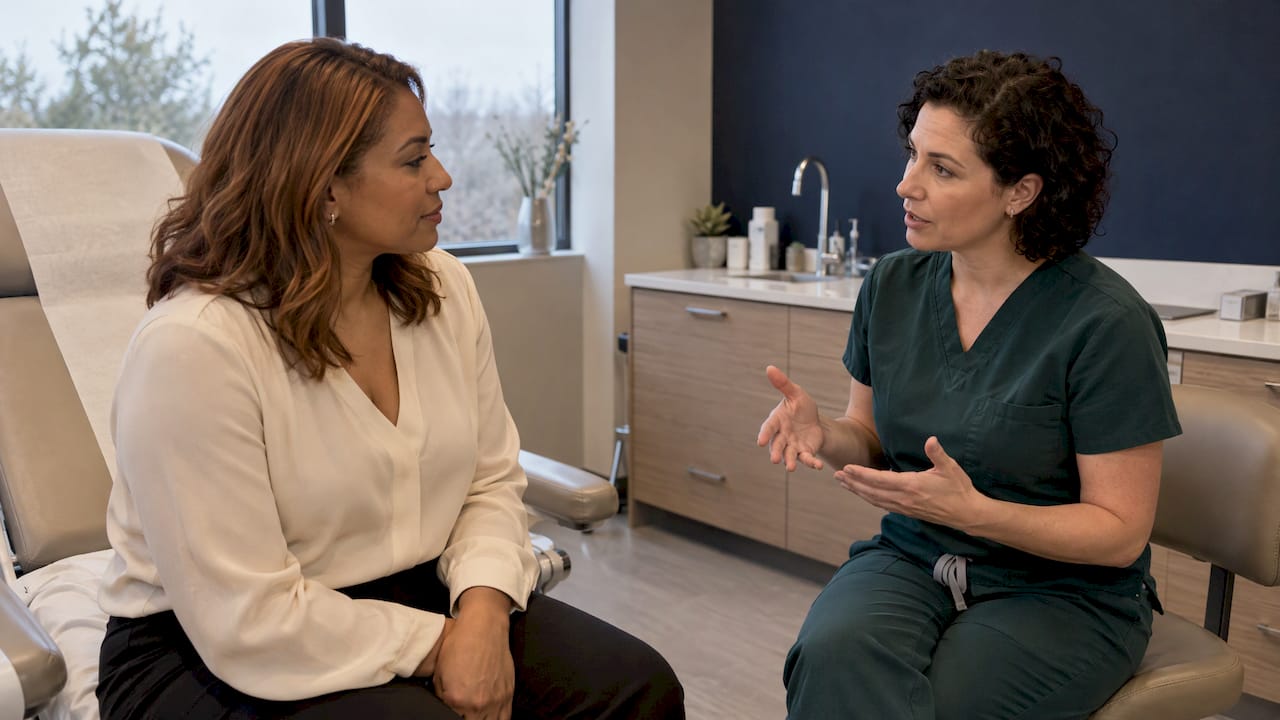
A contraindication is a reason not to have a treatment at all, or to wait until the reason has passed. For Botox, the firm ones are an allergy to any botulinum toxin product, an infection where the injection would go, and certain nerve and muscle disorders. Pregnancy, breastfeeding, some antibiotics and upcoming surgery call for a conversation first. If you are unsure which group you fall into, tell your injector before the day of treatment. A nurse who knows your full history can plan around it, and can tell you honestly when the answer is “not now.”
This guide is written for adults in Woodbridge, Vaughan and across the GTA who are thinking about Botox or Dysport for the first time, or who want to be sure their next appointment is a safe one. It covers who should avoid treatment, what to disclose, what to do about alcohol, and what to watch for afterwards.
TL;DR
- Do not have Botox if you are allergic to any botulinum toxin product or its ingredients, or if you have an infection in the area to be injected.
- Tell your injector first about nerve or muscle conditions such as myasthenia gravis or ALS, pregnancy or breastfeeding, planned surgery, and any recent botulinum toxin treatment.
- Medications matter. Aminoglycoside antibiotics, muscle relaxants and blood thinners all change the plan. Bring a full list of medications and supplements.
- Alcohol: skip it for 24 hours before treatment at minimum. We prefer 24 to 48 hours around your appointment.
- Get urgent care if you have trouble swallowing, speaking or breathing after an injection.
Who should not get Botox
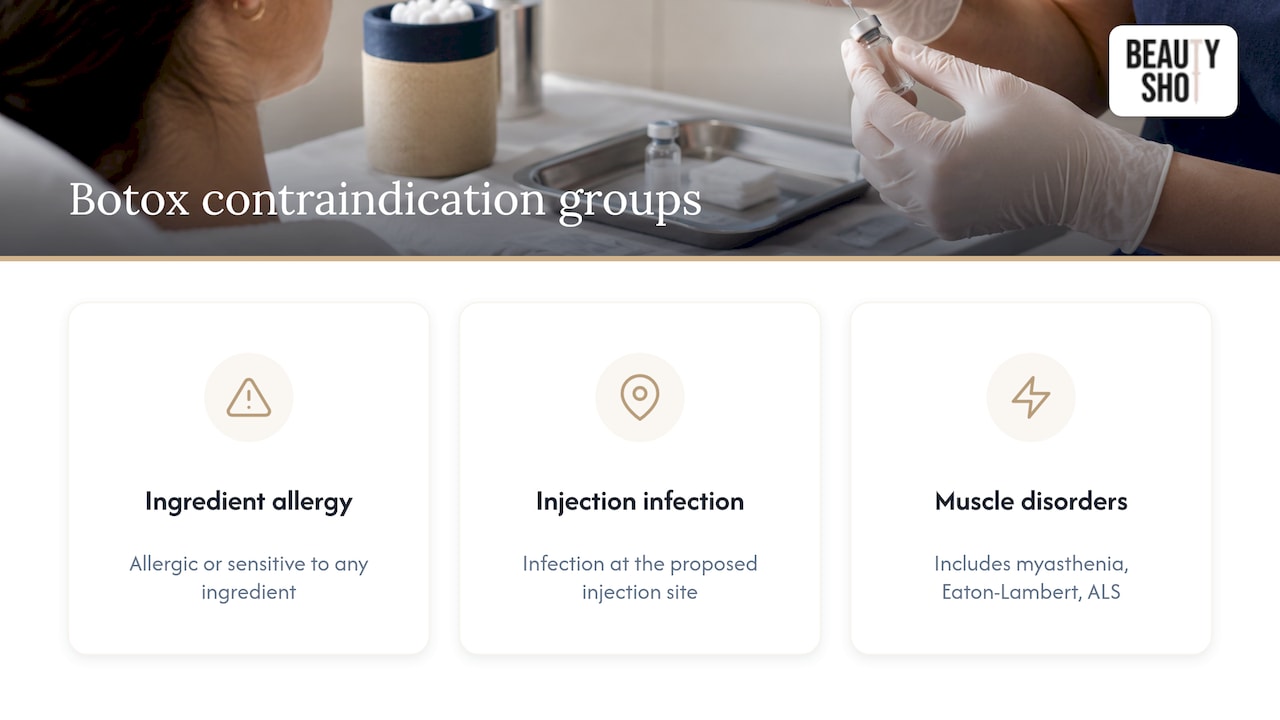
The Canadian patient information for Botox is the clearest starting point because it is written for people in this country. AbbVie Canada’s patient medication information says not to use Botox if you are allergic or sensitive to any ingredient, if there is an infection in the muscles where it would be injected, or if you have a muscle disorder such as myasthenia gravis, Eaton-Lambert syndrome or ALS.
The Canadian product monograph filed with Health Canada, the full technical document for the product, lists two contraindications that apply to cosmetic use: hypersensitivity to any botulinum toxin type A or to anything in the formulation, and infection at the proposed injection site.
In plain terms, that gives you three groups.
1. Allergy or past reaction to botulinum toxin
If you have ever had a serious reaction to Botox, Dysport or another botulinum toxin product, you should not be injected again with any of them. The FDA’s Botox Medication Guide names the other products in this family, including Dysport and Xeomin, for exactly this reason: an allergy to one is a reason to avoid the rest.
If you have a history of allergy to anything in the vial, say so, even if you are not sure which ingredient was the trigger.
2. Infection where the injection would go
A skin infection, a cold sore flare or an active break-out in the treatment area is a reason to wait. Injecting through infected skin risks spreading the problem, and it is also easy to fix by rescheduling. Once the skin has healed, treatment can go ahead.
3. Neuromuscular disorders
Botox works by temporarily blocking the signal between a nerve and the muscle it controls. That is the point of the treatment for frown lines, and it is the reason people whose nerve-to-muscle signalling is already impaired should stay away. The American Academy of Family Physicians lists neuromuscular disorders such as myasthenia gravis, allergy to product components and keloid scarring as contraindications to botulinum toxin injection. If you have one of these conditions, your own physician or neurologist is the person to speak to before any cosmetic injection.
When to wait rather than skip
Some situations are not permanent “no” answers. They are “talk to us first” answers, and sometimes the right call is to postpone.
Pregnancy and breastfeeding
The Canadian patient leaflet flags pregnancy and nursing as situations to discuss with your healthcare professional before treatment, noting that rabbit studies showed abortion or birth defects. A Canadian monograph for another botulinum toxin product, Nuceiva, says it should not be used in pregnancy because the potential risk is unknown, and that use during lactation is not recommended because it is not known whether it passes into breast milk.
Botox is elective. If you are pregnant, trying to conceive or breastfeeding, the sensible plan is to pause and return when that stage is over. Tell your injector at booking, not at the chair.
Planned surgery or general anaesthetic
The same Canadian leaflet lists upcoming surgery under a general anaesthetic as something to raise before treatment. If you have a procedure booked, mention it and agree on timing with your surgical team.
Recent botulinum toxin treatment
The FDA guide asks you to disclose any botulinum toxin product you have had in the last four months. Repeating treatment too soon is one of the avoidable problems in cosmetic injecting. Canadian guidance on intervals differs slightly by product: Health Canada’s cosmetic injections page says Botox Cosmetic should be given no more often than every two months, while the Dysport Aesthetic monograph says no more often than every three months, and the Botox Cosmetic monograph recommends intervals of three months or more to reduce the chance of the body forming neutralizing antibodies. Our own page on a three-month minimum between treatments explains how we plan a schedule around that.
Other health conditions to mention
Alberta Health Services lists the following as things to tell your provider before botulinum toxin: bleeding problems, glaucoma, heart disease, diabetes, seizures, trouble swallowing, and breathing problems such as asthma or emphysema. These are not automatic reasons to refuse treatment. They are reasons for your injector to adjust the plan, or to ask you to check with your doctor first.
Medications and supplements to tell your injector about
Bring a current list. Include prescriptions, over-the-counter pain relievers, vitamins, herbal products and anything you take occasionally. The American Academy of Dermatology asks patients to share all of this, plus any previous surgeries and cosmetic treatments, so that the injector can tell whether your risk is higher than average.
| What you take | Why it matters |
|---|---|
| Aminoglycoside antibiotics (gentamicin, neomycin, tobramycin) | They can add to the muscle-weakening effect of botulinum toxin. Cleveland Clinic lists them as an interaction. |
| Muscle relaxants | Also listed by Cleveland Clinic as an interaction. |
| Other botulinum toxin injections | Recent doses count toward your total. |
| Blood thinners and anti-inflammatories (warfarin, aspirin, ibuprofen) | They raise the chance of bruising, according to Cleveland Clinic’s Botox guide. |
Do not stop a prescribed medication on your own. If you take a blood thinner, speak with the doctor who prescribes it before changing anything. If you have been prescribed an antibiotic, our page on antibiotics and Botox walks through what to tell your injector.
If you are thinking of combining Botox with another treatment on the same visit, we also cover that in combining Botox with other treatments.
Can you drink alcohol before Botox?
Plan on having none the day before. Cleveland Clinic’s guidance says alcohol makes you more prone to redness and bruising and advises not drinking for 24 hours before the procedure. Alcohol widens blood vessels and can thin the blood slightly, so the small injection points are more likely to show a mark.
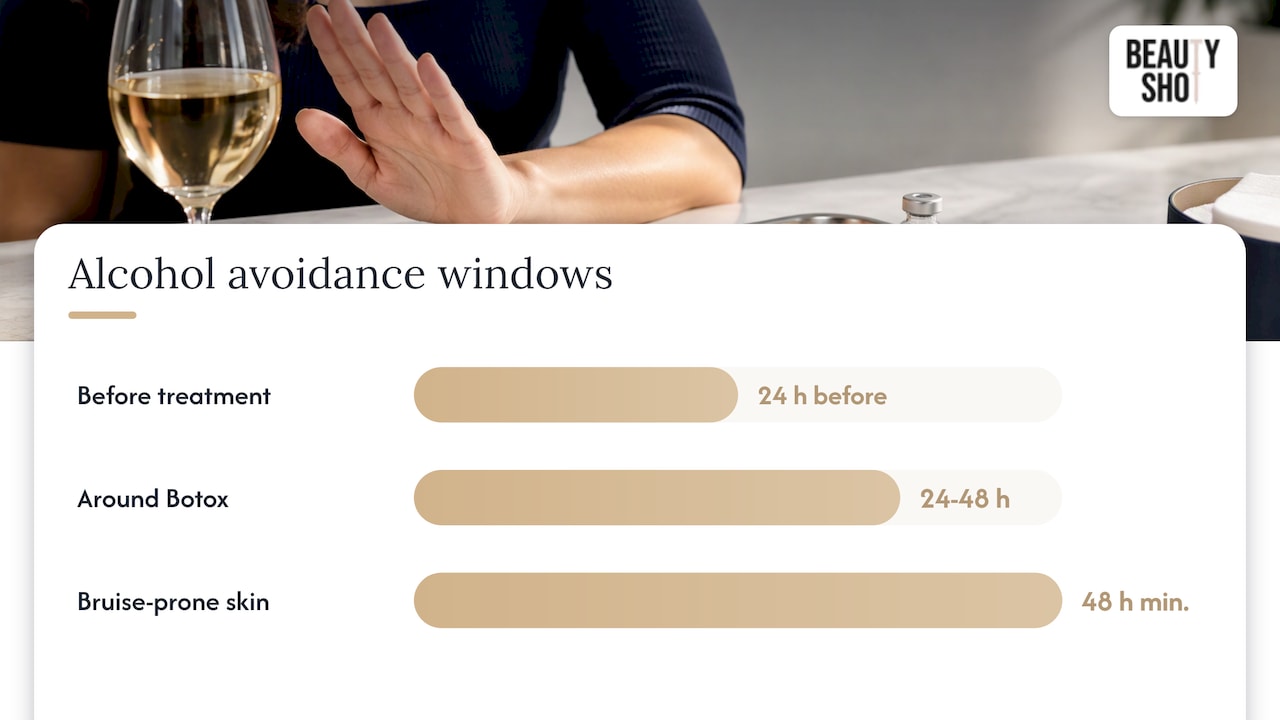
The risk here is bruising, not a dangerous reaction. A glass of wine the night before is unlikely to harm you, but it can leave a visible bruise on the day of a work meeting or a wedding photo. Our nurse injector advice, laid out in skipping alcohol 24 to 48 hours around Botox, is to leave it out for that window on both sides of your appointment.
A few practical points:
- Day of treatment: no alcohol, and avoid arriving after a heavy night.
- Afterwards: Alberta Health Services also advises limiting alcoholic drinks, and warns that Botox can occasionally cause muscle weakness, droopy eyelids or blurred vision. Avoid driving or operating machinery until your vision and alertness feel normal.
- Bruise-prone skin: if you bruise easily, treat the 48-hour window as the minimum, and avoid aspirin and ibuprofen unless your doctor has told you to take them.
If you will be at an event soon after your appointment, see our notes on makeup after Botox and sun exposure after Botox when you plan your day.
What to do before your appointment
A short checklist makes the visit safer and the result better.
- Write down your history. Allergies, nerve or muscle conditions, past reactions, recent surgery, pregnancy plans, breastfeeding.
- List every medication and supplement. Include antibiotics you finished recently.
- Note your last botulinum toxin date. The brand and the approximate month are enough.
- Check your skin. If there is an active infection, cold sore or irritated patch in the treatment area, tell us and plan to reschedule.
- Avoid alcohol for at least 24 hours beforehand.
- Know your goal. Natural, refreshed results come from a plan that fits your face, not from the maximum dose.
If you are new to injectables and want to understand each stage, how the Botox injection process works takes you through it.
Warning signs after treatment
Botox is widely used, and most side effects are mild and short-lived: small bumps, redness, a headache or a bruise. Serious reactions are uncommon, but you should know what to look for. Health Canada says to seek immediate medical care if you develop swallowing, speech or breathing difficulties.
The Canadian monograph also notes that the effects of botulinum toxin can, on rare occasions, spread beyond the injection site. Call 911 or go to the nearest emergency department if you have trouble breathing or swallowing. For anything milder that worries you, such as a heavy eyelid or an uneven expression, contact your injector the same day. Our Dysport aftercare guide maps out the first 48 hours.
Why the injector matters as much as the product
The American Academy of Dermatology points out that your risk of complications is individual, and that results depend largely on the skill of the person injecting. Reviewing your medical history is how an injector learns whether you are higher risk.
At Beauty Shot Medical Clinic in Woodbridge, every injectable treatment is performed by an advanced cosmetic Registered Nurse with more than nine years of injection experience, not by an assistant or technician. That is the person who will ask about your history, explain the plan and place the injections.
Botox, Dysport and your treatment options
If you have worked through the questions above and are clear to proceed, the next question is which treatment suits your goals. We offer Botox and Dysport for expression lines, a lip flip, hyperhidrosis treatment and a range of dermal fillers. You can see everything on our services page, read about the lip flip with Botox or Dysport, or explore dermal filler areas such as cheeks, chin, jawline and under-eye hollows. Each treatment plan is individualized, and our focus is subtle, natural-looking results.
Perspective
Most of the patients who ask me about contraindications are not worried about the rare, serious ones. They are worried about being told no. I would rather you hear a gentle “let’s wait” from me than go home with a result that was wrong for your body at that moment.
A good consultation is mostly listening. I want to know what you take, what you have been diagnosed with, and what you are hoping to see in the mirror. Botox should leave you looking refreshed and still like yourself, and that starts with a safe plan.
If you are pregnant, breastfeeding, unwell or have a condition we have not discussed, tell me. Honest answers are the most useful tool I have. I will not rush you, and I will never recommend more than you need.
Felix
FAQ
Who is not suitable for Botox?
People with an allergy to any botulinum toxin product or its ingredients, an infection at the injection site, or a neuromuscular condition such as myasthenia gravis or ALS should not have Botox. Pregnancy, breastfeeding and planned surgery are reasons to postpone and discuss with a healthcare professional first.
Can I drink the night before Botox?
It is best to avoid alcohol for at least 24 hours before treatment, because it increases redness and bruising at the injection points. We suggest leaving it out for 24 to 48 hours around your appointment, especially if you bruise easily.
Can I get Botox if I am taking antibiotics?
Some antibiotics, specifically the aminoglycosides such as gentamicin and neomycin, can add to Botox’s muscle-weakening effect. Tell your injector the name of the antibiotic and when you finished the course so the timing can be planned safely.
How often can I have Botox?
Canadian product information recommends spacing treatments at least two to three months apart, depending on the product. Most people are planned on a schedule of about every three months or longer, which also reduces the chance of building antibodies to the toxin.
What should I do if I have trouble swallowing or breathing after Botox?
Get emergency medical help straight away. Difficulty swallowing, speaking or breathing after any botulinum toxin injection needs immediate care, as Health Canada advises.
Sources
- AbbVie Canada: Botox patient medication information
- Botox product monograph, Health Canada drug product database
- Nuceiva product monograph, Health Canada drug product database
- FDA Botox Medication Guide
- American Academy of Family Physicians: Botulinum toxin procedures
- Health Canada: Cosmetic injections
- Dysport Aesthetic product monograph, Health Canada
- Botox Cosmetic product monograph, March 2025
- Alberta Health Services: Botulinum toxin injection
- American Academy of Dermatology: Botulinum toxin preparation
- Cleveland Clinic: OnabotulinumtoxinA injection
- Cleveland Clinic: Botox preparation and side effects