Glabellar Botox reliably softens the vertical frown lines between the eyebrows when an experienced injector maps the muscle activity first and adjusts the pattern to the anatomy in front of them. Most labelled protocols call for onabotulinumtoxinA units divided across multiple injection sites, and patients typically see the full effect by around two weeks.
The one caveat worth remembering before you book anything: this is a small, crowded area of the face, and technique matters more here than in almost any other injection zone. The eyelid sits close by, the muscles pull in different directions, and no two foreheads move quite the same way.
Here’s what actually determines whether your result looks refreshed or looks “off”:
- Whether the injector maps your muscle movement at maximum frown, not just at rest
- Whether the dose and site pattern get adjusted for your anatomy, rather than applied from a fixed template
- Whether the injector has enough experience to recognize early signs of a complication and manage it quickly
TL;DR:
- Proper muscle mapping during maximum frown is crucial, as nearly 20% of patients have a frontalis-dominant pattern requiring personalized injection points.
- Dosing should be tailored based on individual muscle strength, with the standard being 20 units of onabotulinumtoxinA divided across five sites, but adjustments are common for optimal results.
- Experienced injectors minimize complication risks, especially eyelid ptosis, by using correct injection depth, site placement, and proper technique, rather than relying solely on standard templates.
- Dynamic assessment and anatomical knowledge are essential, as some patients recruit the frontalis heavily during frowning, affecting injection strategy and outcomes.
- A thorough consultation includes movement mapping, brow symmetry, eyelid screening, and health review to ensure safe and effective treatment personalized to each face.
What is glabellar Botox and how does the treatment work?
Glabellar Botox is the injection of botulinum toxin type A into the muscles between and above the eyebrows that create the “11 lines” or frown lines when you scrunch your brow. It’s one of the most requested treatments in facial rejuvenation, and for good reason: this small muscle group does an outsized amount of work in making a face look tense, angry, or tired, even when you feel perfectly calm.
The glabella itself is the smooth, slightly raised patch of skin above your nose and between your brows, sitting above the bony landmark called the nasion. Its skin is thicker than most of the surrounding forehead, and the muscles underneath contract in a way that folds that thicker skin into visible creases over time, according to anatomical reference material on the region.
The four muscles behind every frown line
Understanding why glabellar Botox works (and why it can go wrong in inexperienced hands) starts with knowing which muscles are actually pulling the strings.
- Corrugator supercilii: pulls the eyebrows medially and downward, creating the vertical lines directly between the brows.
- Procerus: sits lower, over the bridge of the nose, and pulls the medial brow down, producing the horizontal line just above the nose.
- Orbicularis oculi: the muscle ringing the eye, which contributes to lateral movement patterns and interacts with the lower glabellar complex.
- Frontalis: the broad muscle covering the forehead, and the only elevator in this group. It lifts the brow and opposes everything the other three do.
That last point is the one many patients never hear explained clearly. The frontalis is not part of the “problem” muscle group, it’s the counterbalance. If an injector treats the corrugators and procerus aggressively without accounting for frontalis strength, the brow can lose its natural support and drop slightly, or arch oddly at the tail. This is why a thorough injector reviews frontalis activity as part of assessing the glabella, not as an afterthought, a point supported by facial anatomy reviews focused on optimizing brow outcomes.
Every face frowns differently. Some people generate almost all their movement from the corrugators. Others recruit the frontalis heavily even during a frown, which shows up as forehead texture changes alongside the vertical lines. That’s why dynamic movement mapping, watching the muscles fire at maximum frown rather than guessing from a resting face, is considered essential technique rather than an optional extra.

Fact worth knowing: research using ultrasound imaging on frowning patients found the glabellar complex doesn’t move as one unit. It splits into distinct dynamic types, with a majority of patients show a corrugator and procerus dominant pattern during frowning, while a smaller group shows meaningful frontalis involvement (https://pmc.ncbi.nlm.nih.gov/articles/PMC8778322/) during frowning. That’s nearly one in five patients whose ideal injection map differs from the textbook standard, and it’s a big part of why a cookie-cutter approach doesn’t serve every face equally well.
Who is a good candidate, and what should you expect?
Glabellar Botox is indicated for moderate to severe dynamic lines, the creases that appear when you actively frown, rather than lines etched into the skin at rest from years of repeated movement. If your “11 lines” show up mainly when you’re concentrating, squinting, or annoyed, and soften when your face relaxes, you’re typically an excellent candidate.
Deeper static lines, present even at rest, still respond well to treatment, though they may benefit from a longer course of consistent treatments, or a complementary approach discussed at consultation, to soften etched-in texture over time.
The realistic timeline
- Days 1 to 7: You’ll usually notice the first softening within this window. Some patients feel a subtle “heaviness” or tightness in the treated area before they see visible change.
- Around two weeks: This is when the toxin reaches its full effect, and it’s the point at which your injector should assess the result and decide if any touch-up is needed.
- Three to four months: Typical duration of visible effect, though this varies by metabolism, muscle strength, dose, and how consistently you’ve treated the area over time. Frequent, consistent treatment often trains the muscle to relax more between sessions.
Some patients ask about secondary effects beyond wrinkle softening, like mood or migraine improvement. Early research has explored links between glabellar treatment and mild mood benefits or reduced migraine frequency, but the evidence is still developing and shouldn’t be a reason to seek treatment on its own. Think of it as a possible bonus observation in some patients, not a promised outcome.
If you’re curious how quickly you’ll notice a difference after your own appointment, we’ve broken down the onset timeline in more detail here.
Injection technique: the 5-point pattern and when to adapt it
The standard starting point for most injectors is the classic 5-point pattern: two injections into each corrugator supercilii (one per side, roughly bracketing the muscle belly) and one central injection into the procerus. This layout has been the backbone of glabellar treatment for years, largely because labelled dosing for onabotulinumtoxinA specifies 4 units per site across those five points, totalling 20 units.
That said, “standard” doesn’t mean “one size fits all,” and this is where injector skill separates a good result from a great one.
1. The conventional five-point map
The two lateral corrugator points sit just above the bony orbital rim, angled slightly to avoid tracking toward the eyelid. The procerus point sits centrally, lower down near the nasal bridge. Depth matters here: corrugator injections tend to go slightly deeper given the muscle’s position, while the lateral-most points are often placed more superficially to reduce the risk of toxin spreading toward the levator palpebrae, the muscle that holds your eyelid up.
2. GLO 3+2: an anatomy-based refinement
A technique gaining traction in clinical literature is GLO 3+2, which reorganizes injection points based on precise anatomical landmarks rather than a fixed grid. Instead of treating the corrugator and procerus as separate targets, this method maps three points along the primary movement axis and two supporting points based on individual muscle bulk and frown pattern. Reviews describing this approach argue it produces more consistent softening with less risk of asymmetry because it follows how the muscle actually contracts in that specific patient, rather than assuming every glabella is shaped the same.
3. Type A versus Type B: what ultrasound reveals
Building on the dynamic frown patterns mentioned earlier, injectors who use ultrasound assessment (or simply careful dynamic observation) classify patients into two broad groups:
- Type A patients show corrugator and procerus dominant movement. The standard five-point pattern usually works well here with minimal modification.
- Type B patients recruit the frontalis noticeably during frowning. For these patients, adding targeted frontalis points to the injection map improved outcomes in ultrasound-guided studies, compared to sticking rigidly to the glabellar sites alone.
This distinction matters practically. A Type B patient treated with only the standard pattern may end up with a decent glabellar result but a forehead that still creases oddly, or a brow that behaves unpredictably because the elevator muscle wasn’t accounted for.
Needle depth and placement, in plain terms
Corrugator injections generally go into the muscle belly, deep enough to reach contractile tissue but shallow enough to stay well clear of the orbital septum. Procerus injections sit centrally and can be placed just under the skin given the muscle’s superficial position at that point. The lateral-most corrugator points, closest to the eyebrow’s outer edge, warrant particular caution: placing these too low or too deep increases the risk of toxin migrating toward the levator palpebrae and causing eyelid ptosis, which is the single complication patients worry about most and the one experienced injectors are trained hardest to avoid.
Pro Tip: Before finalizing your injection map, a skilled injector will ask you to frown as hard as you can and will palpate the area with two fingers, feeling for exactly where each muscle bulges. This “pinch test” combined with dynamic observation catches Type B patterns and unusual muscle bulk that a resting-face assessment would miss entirely. If your injector skips this step and goes straight for a pre-drawn dot pattern, that’s worth asking about.
How much Botox is used, and how is it reconstituted?
The labelled starting point for glabellar treatment is straightforward: 20 units of onabotulinumtoxinA, delivered as 4 units at each of five sites. That figure comes directly from the product monograph and serves as the benchmark most injectors reference, even when they ultimately adjust it.
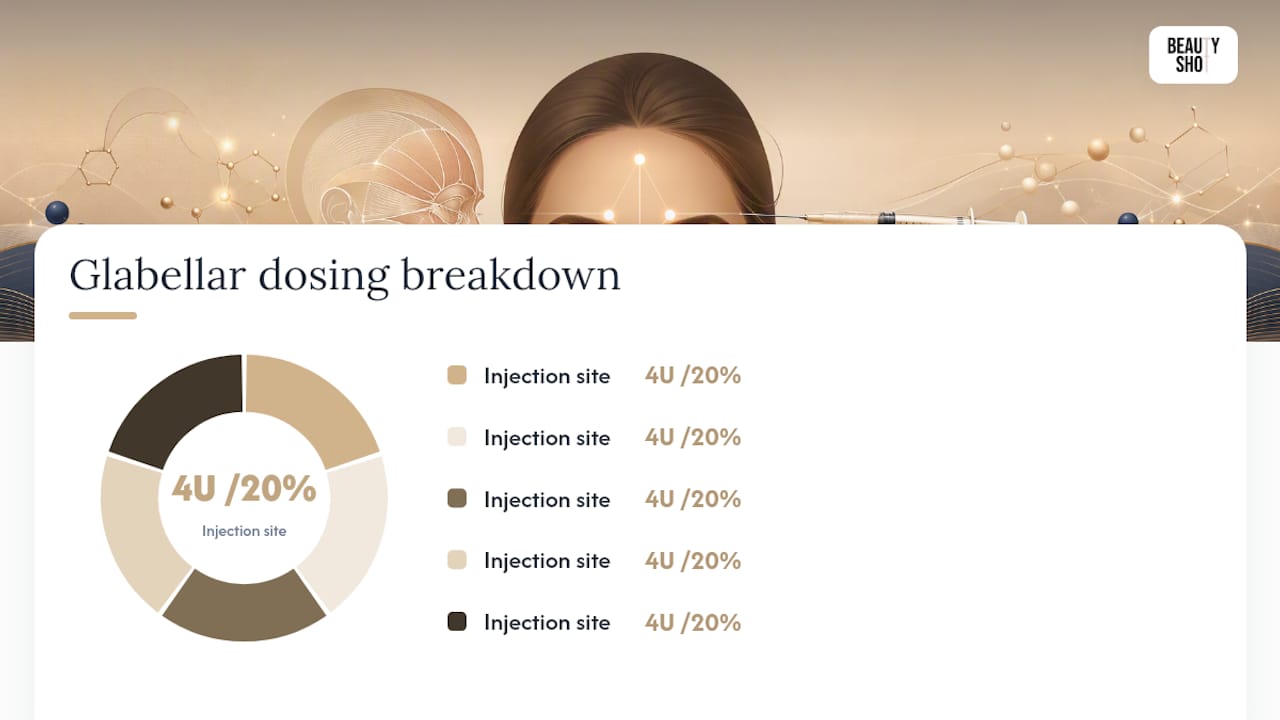
Where real-world practice diverges from the label: clinical literature on glabellar treatment describes a range of dosing spread over several injection points, depending on muscle strength, patient goals, and how much softening versus movement preservation the patient wants. A patient with strong, well-developed corrugators (common in people who frown frequently or have done so for decades) may need a dose toward the higher end. Someone with lighter muscle tone, or a patient who wants the faintest hint of movement preserved rather than complete stillness, may do better with less.
Dose isn’t arbitrary. Adjustments typically come down to:
- Muscle strength and bulk, assessed through palpation and dynamic movement.
- Desired softening level, since some patients want lines essentially erased while others prefer a softened, natural look with some expression retained.
- Treatment history, as muscles that have been treated consistently over time often respond to slightly lower maintenance doses.
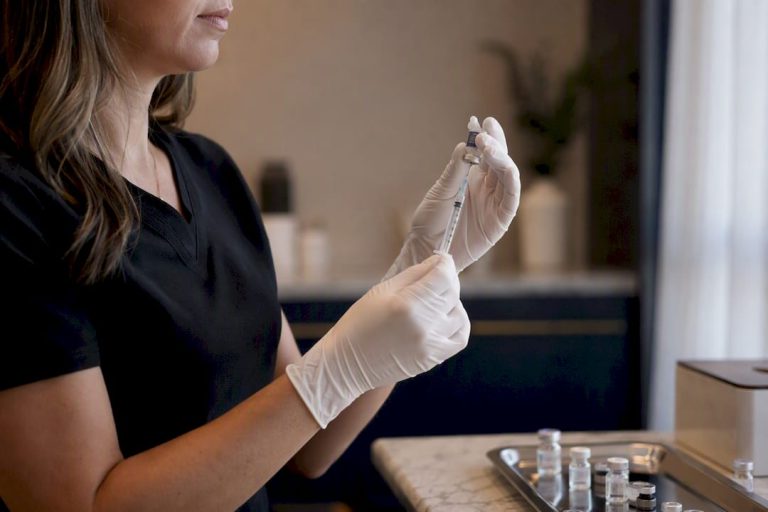
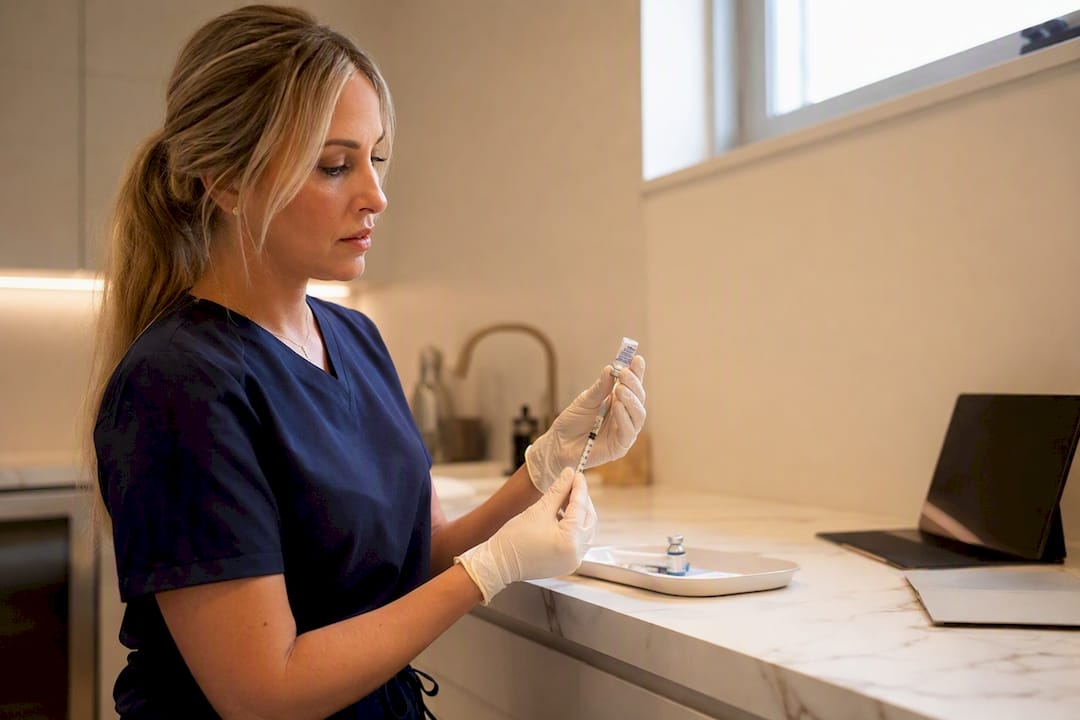
Reconstitution, the process of diluting the toxin powder with sterile saline before injection, also affects outcomes more than most patients realize. A more concentrated solution (less saline added) tends to stay more localized at the injection site, while a more dilute solution can spread further, which is sometimes useful for smoother coverage but riskier near the eye. A clinic that documents its concentration consistently, appointment to appointment, is one that’s treating dosing as a precise clinical variable rather than guesswork.
Safety profile, common side effects, and managing complications
Most people tolerate glabellar Botox extremely well. The honest picture, based on clinical review data, is that overall complication rates for upper-face botulinum toxin treatments include mostly mild and temporary effects(https://pubmed.ncbi.nlm.nih.gov/35178552/), but the overwhelming majority of that figure is mild and temporary: think small bruises at the injection site, a brief tension headache, or slight asymmetry in the first few days as the toxin takes effect unevenly.
The complication patients actually worry about, eyelid ptosis (a drooping upper eyelid), is far less common. That same research indicates ptosis occurs in fewer than 1 to 2% of cases when injections are performed by experienced injectors, which tells you something important: this isn’t primarily a toxin risk, it’s a technique risk, and it drops substantially with injector skill.
Common, minor reactions you might notice:
- Small bruises or pinpoint redness at injection sites, usually fading within a week
- Mild headache in the first 24 to 48 hours
- Slight, temporary asymmetry while the toxin fully takes effect over the first two weeks
Rarer but clinically important:
- Eyelid ptosis, typically appearing 48 hours to two weeks after treatment
- Diplopia (double vision), which is uncommon and usually linked to toxin spread affecting eye muscles
The technique choices that prevent most of these issues aren’t exotic. Correct injection depth, staying superficial at the lateral corrugator points closest to the eye, accurate dosing, and asking patients to remain upright and avoid rubbing the area for the first few hours after treatment all meaningfully lower the odds of toxin migrating somewhere it shouldn’t.
If ptosis does occur, the first-line management is topical apraclonidine 0.5%, an eye drop that stimulates a different muscle (Müller’s muscle) to compensate and lift the lid slightly while the toxin effect wears off. Oxymetazoline has also been used in some cases as a supplementary option. Recovery is simply a matter of waiting out the toxin’s natural course, typically resolving within a few weeks, though it can feel like a long few weeks if it happens to you.
If you notice drooping, unusual vision changes, or asymmetry that isn’t improving, contact your injector promptly rather than waiting for your next scheduled visit. For a broader rundown of what’s normal versus what warrants a call, our guide to common Botox side effects walks through the full spectrum.
What a thorough consultation covers before you’re ever injected
A rushed consultation is one of the biggest red flags in cosmetic injectables, and the glabella is not a forgiving area to skip steps in. A proper pre-treatment assessment should include the following, in roughly this order:
- Dynamic movement mapping. You’ll be asked to frown as hard as you can, multiple times, so your injector can watch exactly which muscles fire and how strongly.
- Brow symmetry assessment. Most faces have some natural asymmetry, and a good injector notes this before treatment so it isn’t mistaken for a treatment effect afterward.
- Eyelid position screening. A baseline check for any pre-existing ptosis or brow heaviness, since these findings change how conservatively the treatment plan should be approached.
- Medication and health history review. Certain neuromuscular conditions, some anticoagulant medications, active skin infection in the treatment area, and pregnancy or breastfeeding are all reasons to delay or avoid treatment, and Health Canada guidance is clear that cosmetic injectables should only be delivered by qualified healthcare professionals who can properly screen for these factors.
Informed consent should cover more than a signature on a form. You should leave the conversation understanding your expected timeline, the range of normal variability in how your face might respond, the possible adverse events (even the rare ones), and exactly how to reach the clinic if something feels off afterward. If a provider glosses over this part to get you into the chair faster, that’s worth noticing.
What actually happens during and after your appointment
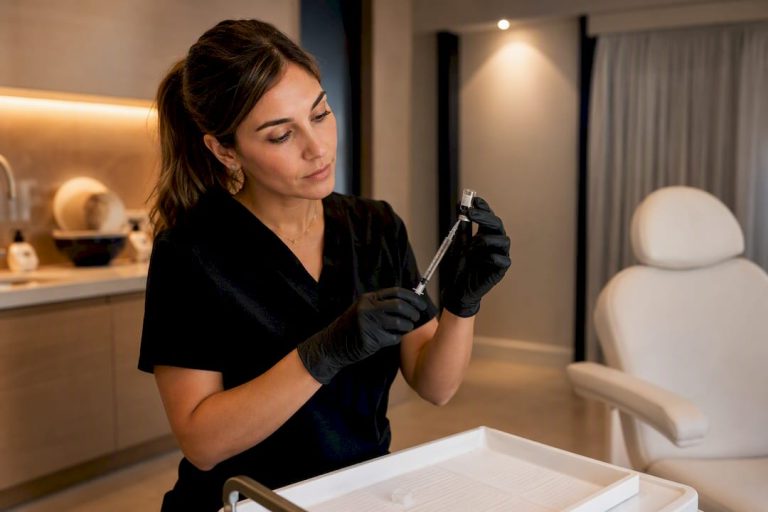
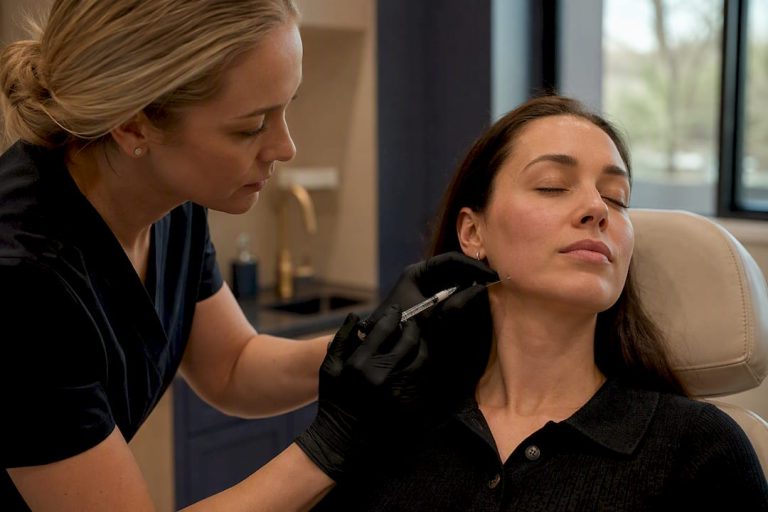
The appointment itself is quick, usually well under thirty minutes, but a well-run one follows a clear sequence. After consent is reviewed and any final questions are answered, most injectors take reference photos and may mark injection points directly on the skin. The injections themselves take only a few minutes given how small the treatment area is, followed by a brief check for immediate reactions and a note in your chart documenting exact sites and units used, which matters for consistency at your next visit.
What to expect right afterward:
- Minor redness or small bumps at injection sites that settle within an hour or two
- Little to no real downtime. Most patients return to normal activities the same day
- Advice to avoid strenuous exercise, saunas, or lying flat for several hours, based on the general principle that staying upright and avoiding excess heat or pressure on the area limits unwanted toxin spread
- A recommendation to skip vigorous facial massage in the treated zone for at least a day
Most clinics schedule a follow-up around the two-week mark, timed deliberately to match when the toxin reaches full effect. That visit is your chance to flag any asymmetry or areas that didn’t respond as expected, and it’s when a minor touch-up, if needed, typically happens. If anything feels notably wrong before that, don’t wait for the scheduled check-in. For a fuller walk-through of the whole visit from booking to follow-up, see what to expect during the Botox procedure.
What a nurse-led approach adds to glabellar treatment
Every point in this guide, movement mapping, Type A versus Type B assessment, adjusting the five-point pattern, comes down to one underlying truth: the glabella rewards an injector who treats each face as its own case study rather than a template to fill in.
At Beauty Shot Medical Clinic, treatments are performed by an advanced cosmetic Registered Nurse with a background in acute medical and ICU nursing, training that shapes how closely anatomy and risk are assessed before a single unit is drawn up. That clinical foundation matters most in a region like the glabella, where a few millimetres of placement or a slightly miscalculated dose is the difference between a natural result and one that needs correcting.
In practice, this looks like:
- Dynamic frown assessment at every consultation, not just at your first visit, since muscle patterns can shift slightly over time with repeated treatment
- Dose and technique tailored to your specific corrugator and frontalis balance, rather than a fixed unit count applied to everyone
- A documented follow-up plan, so any needed adjustment at the two-week mark is handled promptly, and a clear way to reach the clinic if something feels off before then
The goal is always the same: you look rested and a little less tense, not different, and definitely not frozen.
The gap between “standard technique” and good technique
The conventional advice on glabellar Botox treats the five-point pattern as gospel: five dots, four units each, done. That advice isn’t wrong, exactly, but it’s incomplete in a way that matters. Roughly one in five patients has a frontalis-dominant frown pattern that the standard map doesn’t fully address, and treating everyone identically ignores that reality.
What the research actually supports is a hierarchy of priorities: assess muscle movement dynamically before deciding anything, adapt the pattern when the anatomy calls for it, and treat the eyelid ptosis risk as a technique problem to prevent, not a toxin side effect to accept. Reported complication rates hover around the same figure whether an injector is careful or careless. What changes with skill is the rate of the complication people actually fear.
If you’re evaluating an injector, ask fewer questions about brand of toxin and more about how they decide where to place each point. That single question tells you more about your likely outcome than almost anything else on this page.
— Felix
Considering glabellar Botox? Here’s the practical next step
Reading about technique is useful, but the real variable in your outcome is who’s holding the needle. Beauty Shot Medical Clinic in Woodbridge offers glabellar Botox performed by an advanced cosmetic Registered Nurse who builds every treatment plan around your specific frown pattern, brow position, and muscle strength, rather than defaulting to a fixed grid of dots. That means your first consultation includes real dynamic movement assessment, not a five-minute chat before injections begin.
If you’ve been putting off treatment because you’re worried about looking frozen or uneven, that’s exactly the concern this kind of individualized mapping addresses directly. You can start by learning more about how Botox works and what makes a treatment plan effective, or go ahead and book a consultation for Botox and Dysport to get a personalized assessment of your glabellar area and a realistic dosing plan built around your face.
Key Takeaways
Glabellar Botox softens dynamic frown lines effectively when dose, depth, and injection pattern are matched to individual muscle anatomy rather than applied from a fixed template.
| Point | Details |
|---|---|
| Labelled dosing benchmark | Onabotulinumtoxin A dosing is 20 units total, given as 4 units across five injection sites. |
| Full effect takes two weeks | First changes appear within a week, but assess and adjust only once the two week mark is reached. |
| Ptosis risk is technique-driven | Eyelid ptosis occurs in fewer than 1 to 2% of cases with experienced injectors, versus a broader overall complication rate. |
| One in five patients need a modified map | Ultrasound studies show roughly 19% of patients show frontalis-dominant frowning (Type B) that benefits from added injection points. |
| Individualized assessment matters most | Beauty Shot Medical Clinic performs glabellar Botox through an advanced cosmetic Registered Nurse who maps dynamic movement before choosing dose and pattern. |
This article is general information, not a substitute for advice from a qualified doctor. Consult a qualified healthcare professional about your own circumstances before acting on anything here.
Sources
- Management of complications following botulinum toxin facial injections: narrative review
- BOTOX Cosmetic product monograph (DailyMed)
- Integrative assessment for optimizing aesthetic outcomes when treating glabellar lines with botulinum toxin type A: appreciation of the role of the frontalis
- Anatomy, Head and Neck: Glabella – StatPearls
FAQ
What does Botox in the glabella do?
It relaxes the corrugator supercilii and procerus muscles that pull the eyebrows together during a frown, softening the vertical and horizontal lines this movement creates between the brows.
What is the riskiest place for Botox?
The lateral corrugator injection points, closest to the eyebrow’s outer edge, carry the highest risk in this region because toxin placed too low or too deep here can migrate toward the muscle that lifts the eyelid.
Is Botox good for glabellar lines?
Yes, it’s a well-established, effective treatment for moderate to severe dynamic glabellar lines, with the standard onabotulinumtoxinA protocol delivering full results by around two weeks.
What are the risks of glabella Botox?
Most reactions are mild, like bruising, temporary headache, or slight asymmetry, while the more concerning risk, eyelid ptosis, occurs in under 1 to 2% of cases when experienced injectors perform the treatment.
Recommended
- The Safety of Botox: What Research Tells Us – Beauty Shot | Botox Fillers Woodbridge Vaughan
- BOTOX Uncovered: Is It Safe Long-Term and What Side Effects Should You Know? – Beauty Shot | Botox Fillers Woodbridge Vaughan
- The Science Behind Botox: How Does It Work? – Beauty Shot | Botox Fillers Woodbridge Vaughan
- How the Botox injection process works in 2026