A Nefertiti lift uses small, precisely placed doses of botulinum toxin along the jawline and platysma muscle to soften vertical neck bands and sharpen jawline definition. It suits people with mild to moderate muscle banding and reasonably elastic skin. Results are temporary, technique-dependent, and not a substitute for surgery when skin laxity is advanced.
TL;DR:
- The procedure typically uses 26 to 36 units of botulinum toxin, with treatment times of 20 to 30 minutes and effects lasting a few months.
- Suitable candidates have mild to moderate neck banding, elastic skin, and early jowling driven mainly by muscle activity, not significant sagging or fat.
- Risks include temporary bruising, tenderness, and rare complications like swallowing difficulty, which depend heavily on precise superficial injection technique.
- Post-treatment care involves avoiding rubbing, strenuous activity, and heat exposure for 24 to 48 hours, with maintenance every three to six months.
- The Nefertiti lift effectively softens vertical neck bands and enhances jawline contours but cannot tighten skin, reduce fat, or replace surgery for advanced laxity.
How is a Nefertiti lift with Botox performed?
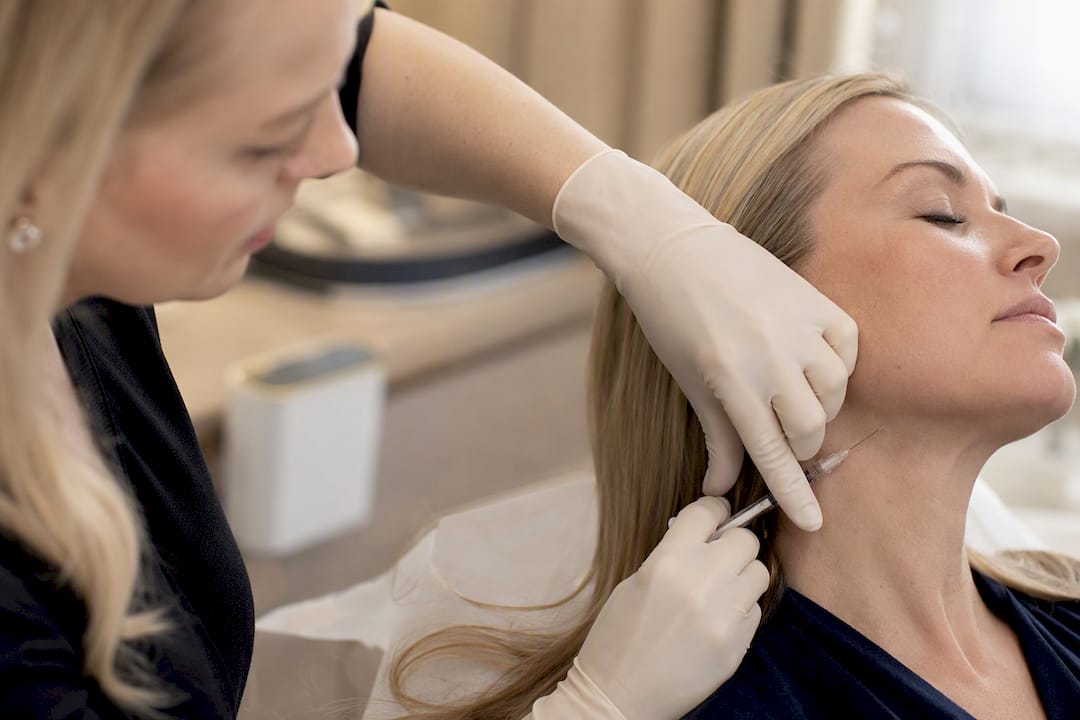
The technique gets its name from the smooth, elongated jawline seen on the ancient Egyptian bust of Nefertiti, and the goal is exactly that: a cleaner line from ear to chin without heaviness pulling downward. Nurse injectors treat two connected areas in the same session: the platysmal bands (the vertical cords that show when you clench your jaw or grimace) and a row of points along the mandibular border.
The original description of this pattern comes from Dr. Arthur Levy, whose 2007 paper on the Nefertiti lift technique outlined doses up to 20 units per side with high patient satisfaction and low complication rates when placement was careful. A typical session follows this sequence:
- Assessment of the platysmal bands with the patient actively clenching, to map exactly which fibres pull downward.
- Marking injection points along the jaw and into the visible bands, spaced to avoid pooling toxin in one area.
- Superficial micro-injections, kept shallow to stay clear of the sternocleidomastoid muscle beneath the platysma.
- Post-injection check for symmetry before the patient leaves the chair.
Clinical trial protocols for onabotulinumtoxinA in this area have tested total doses in the 26 to 36 unit range, and most in-clinic treatments fall somewhere in that neighbourhood depending on band strength and jaw anatomy. The appointment itself runs 20 to 30 minutes, no numbing cream is usually needed, and most people return to normal activity the same day aside from mild redness at injection sites.
Who is a good candidate for a Nefertiti lift?
Not every jawline concern responds to a neuromodulator, and setting that expectation upfront is part of a responsible consultation, not a sales pitch. The best outcomes happen in patients whose skin can still spring back once the muscle underneath relaxes.
Good candidates typically have:
- Mild to moderate platysmal banding, visible mainly on clenching or speaking
- Skin that retains elasticity, without significant sagging at rest
- Early jowling where muscle pull, not fat volume, is the main driver
- No neuromuscular disorders, and are not pregnant or breastfeeding
Onset generally begins within a few days, with peak effect around the two-week mark. Duration commonly runs a few months, though this varies with metabolism, muscle strength, and dose. A phase 3 trial of onabotulinumtoxinA for platysmal bands found statistically significant improvement in prominence and satisfaction versus placebo by day 14, with benefits gradually declining through day 120. Separate randomized data links treatment with meaningfully higher satisfaction and reduced psychosocial bother from visible neck banding, which tracks with what many patients describe in consultation: the bands make them feel tense or tired-looking even when they aren’t.
What can a Nefertiti lift realistically improve?

This procedure works on muscle activity, not on excess skin or deep fat pads, so the honest answer depends on what’s actually causing your jawline concern.
What it does well:
- Softens vertical platysmal bands that show when speaking or clenching
- Creates subtle re-contouring along the jaw by releasing the downward pull of the platysma
- Requires essentially no downtime
What it doesn’t do:
- Tighten loose or crepey skin
- Meaningfully reduce heavy jowls or significant submental fat
- Replace the structural correction surgery provides in advanced laxity
For patients with both muscle banding and volume loss, many injectors pair this treatment with dermal filler to restore jawline support, since Botox and fillers work through different mechanisms and often complement rather than compete with each other.
What are the risks of a Nefertiti neck lift?
The neck is less forgiving anatomically than the forehead, which is exactly why injector experience matters more here than in almost any other Botox treatment.
Mild, common effects include temporary bruising, small bumps at injection sites, and slight tenderness, most resolving within days.
Injector training and anatomy knowledge are among the primary determinants of safety for neck injections. A board-certified nurse practitioner’s perspective on Nefertiti lift risk notes it’s more technique-dependent than standard forehead or crow’s feet Botox.
Rarer but important risks include difficulty swallowing, transient neck weakness, or voice changes. These are almost always tied to toxin diffusing beyond the platysma into deeper swallowing muscles, which is why anatomical reviews stress superficial placement and avoiding the sternocleidomastoid as the core safety principle for this area.
Practically, that means:
- Keeping total neck-region dosing conservative, with many experienced practitioners capping totals around 50 units to limit diffusion risk
- Injecting shallowly rather than deep into muscle bulk
- Mapping the platysma while the patient actively clenches, so the injector treats only the fibres actually causing the band
Health Canada’s guidance on botulinum toxin products reinforces that these treatments should only be performed by qualified practitioners working from proper informed consent, given how much outcome and safety depend on technique.
What should you do after treatment, and how often do you need touch-ups?
Recovery from a Nefertiti lift is straightforward, but a few simple habits protect your results in the first two days.
- Avoid rubbing or massaging the treated area for 24 to 48 hours, and skip strenuous exercise or heat exposure (saunas, hot yoga) during that window.
- Expect small bumps or occasional bruising that settles within a few days.
- Book a two-week review so your injector can check symmetry and decide whether a small touch-up is needed.
- Plan maintenance roughly every 3 to 6 months, depending on how quickly your muscle activity returns.
Pro Tip: If you bruise easily, avoid alcohol, and blood-thinning supplements like fish oil or vitamin E for a couple of days before your appointment; it won’t guarantee a bruise-free visit, but it lowers the odds.
Longevity varies with metabolism, muscle strength, and how much prior toxin exposure you’ve had. Reviewing how long Botox results typically last before your first appointment helps set realistic expectations for your maintenance schedule.
How does a Nefertiti lift compare to fillers, threads, and surgery?
Choosing between these options comes down to what’s actually happening under your skin, not personal preference alone.
- Botox (Nefertiti lift): relaxes the platysma to soften bands and reduce downward pull; best for muscle-driven concerns with good skin elasticity.
- Dermal fillers: restore lost volume along the jaw or chin to rebuild structural support; better suited to volume loss than muscle overactivity, and often used alongside Botox for facial balancing.
- Thread lifts: offer a mechanical, temporary pull on skin using dissolvable sutures, with modest results for mild laxity.
- Surgical neck lift: addresses excess skin, significant platysma separation (diastasis), or heavy fat deposits that injectables cannot correct.
An honest assessment weighs skin laxity and the degree of platysmal separation. When those are advanced, no amount of toxin will produce a surgical result, and a qualified injector should say so plainly.
What should you ask at your consultation?
A short list of questions during your consultation tells you a lot about whether an injector is right for this specific treatment.
- What training and case experience do you have specifically with neck and platysma injections?
- Can you show me an injection map and estimated total units for my anatomy?
- What’s your protocol if I experience swallowing difficulty or asymmetry?
- Do you have before-and-after photos of patients with a similar jawline and neck presentation?
- How is pricing structured, per unit or as a package, and what’s included in follow-up care?
Health Canada’s guidance on cosmetic injections specifically flags practitioner qualifications and informed consent as non-negotiable safety factors, and a good consultation should address both without you having to ask twice.
Why injector expertise matters more for neck Botox
Beauty Shot Medical Clinic is led by an advanced cosmetic Registered Nurse with training in Botox, MD Codes, and Allergan injection techniques, alongside a Sunnybrook Hospital medical and ICU nursing background. That clinical foundation shapes how neck and jawline treatments are planned: anatomy-based assessment first, conservative dose caps second, and a scheduled follow-up to confirm symmetry rather than guesswork. Readers can review real patient outcomes in the clinic’s before and after gallery to see how this approach plays out in practice.
What the research actually tells us about the Nefertiti lift
Most of what gets written about the Nefertiti lift online treats it like a minor variation on standard Botox, a few extra units along the jaw and you’re done. The clinical evidence doesn’t support that casualness. The neck sits closer to muscles governing swallowing and voice than almost any other area treated cosmetically, and the difference between a beautifully soft jawline and a genuinely uncomfortable complication often comes down to a few millimetres of injection depth.
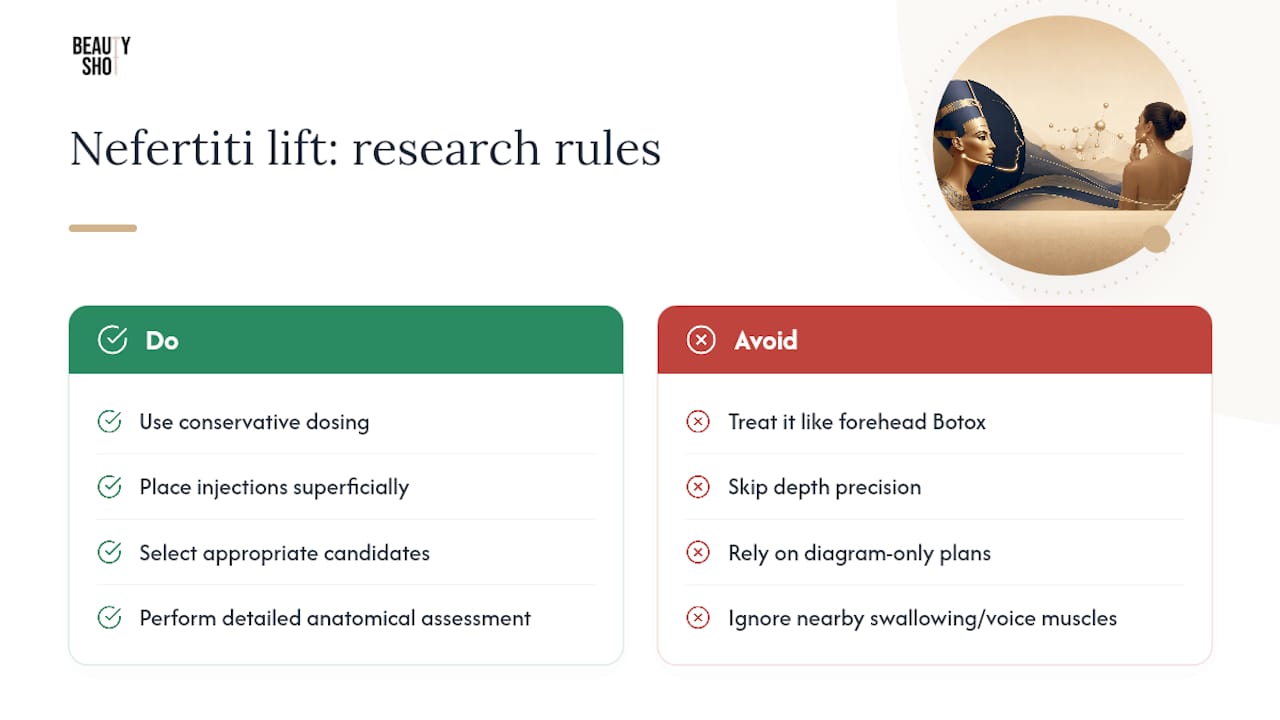
What the trial data actually supports is a narrower, more useful claim: in the right candidate, with conservative dosing and superficial placement, this treatment reliably improves platysmal banding and patient satisfaction, with effects that fade predictably over months rather than disappearing overnight. It doesn’t support treating this as interchangeable with forehead Botox, and it doesn’t support skipping a proper anatomical assessment because the injection points look simple on a diagram.
The gap between marketing and reality here isn’t about whether the Nefertiti lift works. It’s about whether the person holding the needle understands why the dose and depth matter as much as they do.
— Felix
Ready to talk about your jawline and neck goals?
If a softer jawline and calmer neck bands are what you’re after, without surgery and without an overdone look, a Nefertiti lift assessed by an experienced injector is a reasonable place to start. Beauty Shot Medical Clinic builds every treatment plan around your specific anatomy, using conservative dosing and a scheduled follow-up rather than a one-size-fits-all injection map. Irene’s approach favours subtle, age-appropriate change over dramatic transformation, which is exactly what this treatment is designed to deliver when it’s done well. If you’d like to find out whether your jawline and neck concerns are a good match for this technique, or whether a combination approach fits your goals better, the next step is simple: book a consultation and get a personalized plan. You can start by reading through the clinic’s guide to injectable cosmetics and requesting an appointment from there.
Sources
- Safety and efficacy of onabotulinumtoxinA for platysmal bands (phase 3 study)
- The ‘Nefertiti lift’: a new technique for specific re-contouring of the jawline (Levy, 2007)
- A study to assess safety and effects of onabotulinumtoxinA for platysma prominence (NCT04994535)
- Anatomy and safety considerations for neck injections (PMC review)
FAQ
Does Botox help with a Nefertiti lift?
Yes. Botox (or another botulinum toxin) is the active treatment in a Nefertiti lift, relaxing the platysma to soften vertical neck bands and improve jawline definition.
What does a Nefertiti lift typically cost?
Pricing is usually based on total units used, commonly in the range clinical protocols test (around 26 to 36 units), so cost varies with the strength of your bands and your injector’s dosing plan; ask for a per-unit or package quote at consultation.
What are the downsides of a Nefertiti neck lift?
It doesn’t tighten loose skin or remove significant fat, results are temporary, and rare risks like swallowing difficulty or neck weakness can occur if toxin diffuses beyond the platysma, which is why superficial, technique-precise injection matters.
Does a Nefertiti lift help with jowls?
It can offer subtle improvement for early, muscle-driven jowling by releasing downward pull along the jawline, but it has limited effect on heavy jowls caused by significant fat or skin laxity, where filler or surgical options are more appropriate.
Recommended
- Does Masseter Botox Slim Your Face? Realistic Jawline Results Explained – Beauty Shot | Botox Fillers Woodbridge Vaughan
- Masseter Botox Before and After: What Changes (and What Doesn’t) – Beauty Shot | Botox Fillers Woodbridge Vaughan
- Are jaw fillers the secret to a perfectly sculpted jawline? – Beauty Shot | Botox Fillers Woodbridge Vaughan
- How Do Jawline Fillers Create a More Defined and Chiseled Appearance? – Beauty Shot | Botox Fillers Woodbridge Vaughan