Most first-time patients need 0.5 to 1.0 mL, which is half a syringe to one full syringe, to see a natural, visible change in lip fullness. One millilitre is the most common single-session starting dose. Anything beyond that is usually built up over two or more appointments rather than injected all at once, since the right number depends on your anatomy, your goals, and how your tissue responds. A proper consultation is what actually confirms your number.
TL;DR:
- Most first-time patients receive 0.5 to 1 mL of lip filler, with the typical starting dose being 1 mL, to achieve natural-looking results.
- Larger volumes beyond 1 mL are generally staged over multiple appointments to ensure safety and proper tissue response.
- Factors such as baseline lip volume, tissue quality, age-related loss, and asymmetry determine how much filler is needed for each individual.
- Swelling peaks within 24 to 72 hours after treatment, and final results become visible after two to four weeks, emphasizing staged assessment.
- Cost is proportional to the volume injected, with staged plans offering flexibility to avoid overfilling and reduce risks like bruising or uneven results.
How many syringes for lips: a quick reference by goal
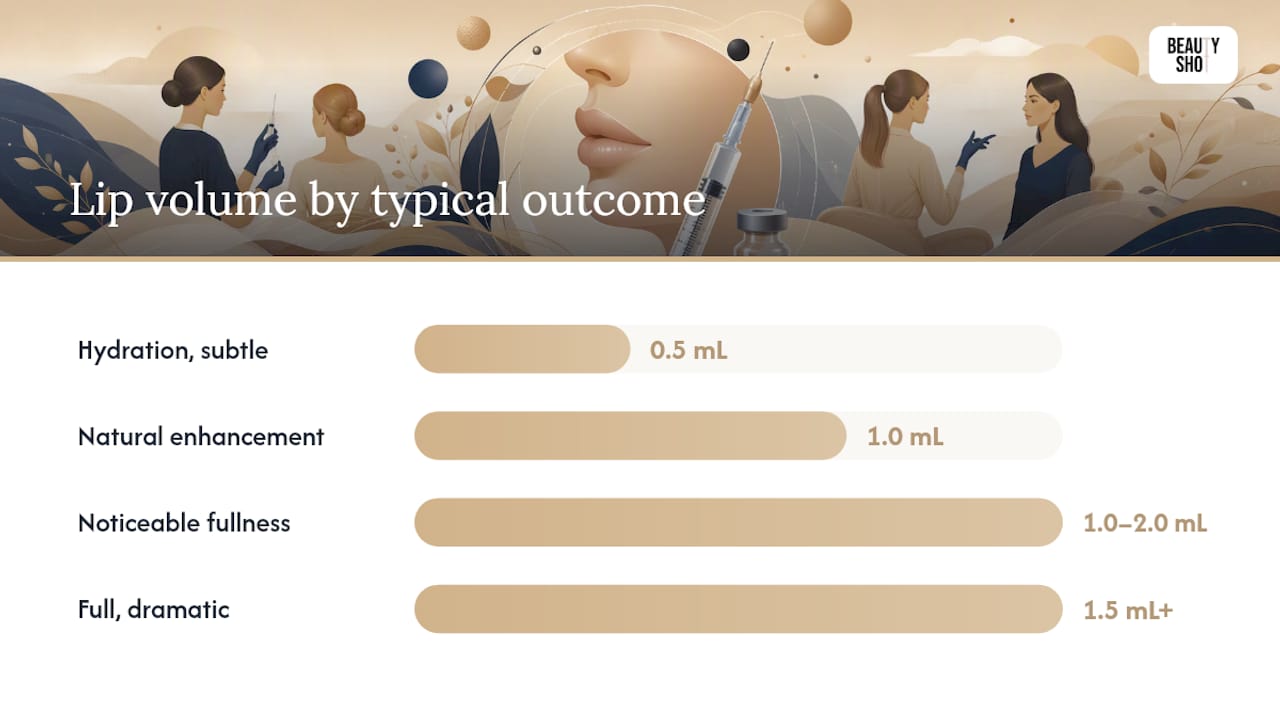
Before you book anything, it helps to see how syringe volume maps to outcome. Injectors talk about lip filler in millilitres rather than “syringes” for good reason: one standard syringe holds 1 mL, so “half a syringe” simply means 0.5 mL. That distinction matters because a lot of patients walk in assuming more syringes automatically means better results, and that is not how healthy, natural-looking lips work.
Here is how the ranges generally break down in practice.
| Volume | Typical outcome | Who it usually suits |
|---|---|---|
| 0.5 mL | Hydration, subtle definition, softened lines | First-timers, those wanting a “just my lips, but better” look |
| 1.0 mL | Natural enhancement, visible but balanced fullness | The most common starting dose for new patients |
| 1.0–2.0 mL (staged) | Noticeable fullness, added projection and shape | Patients building volume over two or more visits |
| 1.5 mL+ (staged only) | Full, dramatic volume | Rare, and never recommended in a single session |
Note the pattern: nothing above 1 mL happens in one sitting if it is done responsibly. Clinical guidance consistently recommends treating anything past that first millilitre as a staged process, not a single appointment. That protects both your safety and your ability to like what you see in the mirror.
Why first-time patients start conservatively, and how building works
There is a clinical reason your injector will likely recommend 0.5 to 1 mL for your first visit, even if you are picturing a fuller result. Lip tissue swells, and it swells unpredictably from person to person. Starting small lets your injector see how your tissue genuinely responds before adding anything further.
A typical, sensible protocol looks like this:
- Initial conservative dose. Most first sessions land between 0.5 and 1 mL, chosen based on your lip anatomy and stated goals.
- Healing and review. You return, virtually or in person, at roughly the one to two week mark once swelling has fully resolved.
- Add volume only if needed. If you and your injector agree the result should go further, a second syringe or partial syringe is scheduled as a separate appointment.
A second syringe tends to come into play for very thin lips with little natural volume, significant age-related lip loss, or asymmetry that needs targeted correction on one side more than the other. None of that is unusual, and none of it means your first result “wasn’t enough.” It means your injector is building toward your goal deliberately instead of guessing.
What actually changes how many syringes you need
Two people can want the “same” lips and need completely different volumes to get there. Your baseline anatomy does most of the deciding, not your Pinterest board.
A few factors carry the most weight:
- Baseline lip volume and tissue quality. Naturally thin lips with less collagen support often need more product to achieve the same visible lift as fuller, more elastic lips.
- The look you actually want. Hydration and softness call for far less product than genuine added fullness or projection.
- Age-related volume loss. Lips lose structural support over time, and skin laxity can mean more product is needed just to restore what used to be there, before you even add enhancement on top.
- Asymmetry correction. Uneven lips often need targeted, side-specific dosing rather than an equal amount injected on both sides.
- Safety limits per session. Tissue can only stretch and accommodate so much filler safely in one sitting, which caps how much any responsible injector will place in a single visit regardless of what you request.
One peer-reviewed case example illustrates this well: a patient in her thirties with lips that rolled inward received roughly 0.6 mL in the upper lip and 0.7 mL in the lower lip for correction, well under a full syringe per lip, and it created a meaningful change in contour. Volume and visible result are not a straight line.
Pro Tip: Bring a couple of photos of your lips from five or ten years ago to your consultation. Seeing your own baseline volume helps your injector distinguish between restoring what age took away and adding something new, which changes the mL plan significantly.
How technique and product choice change what a syringe can do
The same 1 mL can look completely different depending on where it goes and how it is placed. Placement strategy matters as much as the number on the syringe.
Injectors generally choose between a few core approaches:
- Vermilion border injections sharpen and define the lip’s outer edge, using very small volumes to create visible structure.
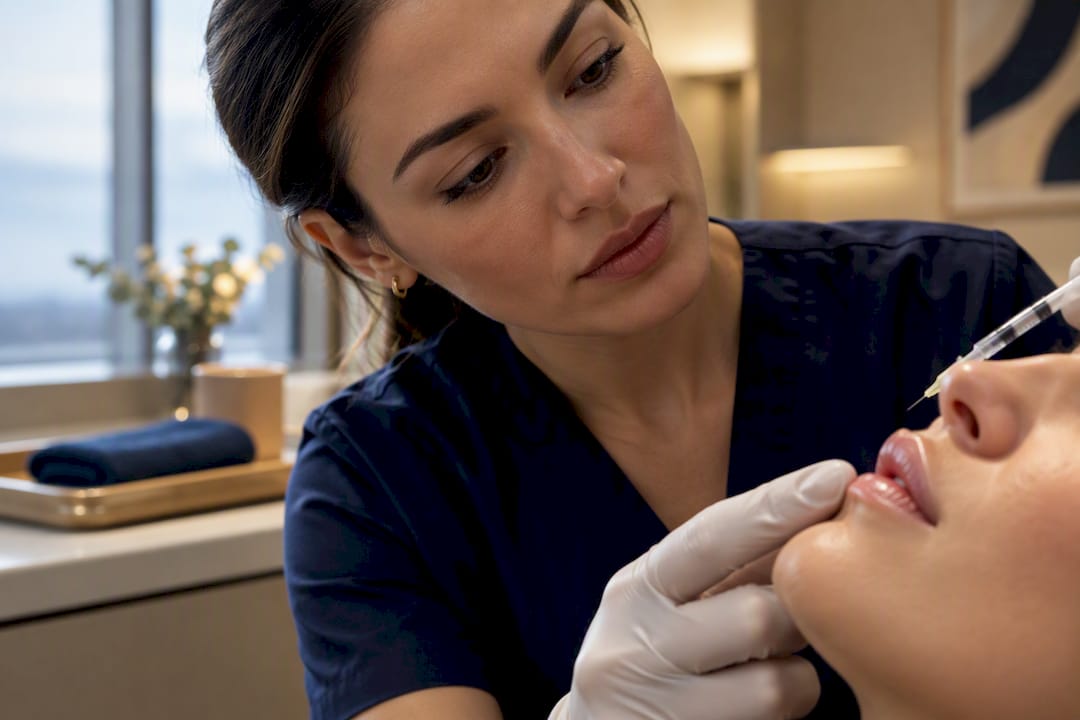
- Submucosal placement adds eversion and fullness to the body of the lip, which is where most of the volume in a typical treatment goes.
- Needle technique allows precise, point-by-point contouring, useful for correcting small asymmetries or building specific shape.
- Cannula technique distributes volume more broadly through fewer entry points, often with less bruising, and is favoured for overall lip augmentation.
Product rheology, meaning how firm or soft a filler behaves once injected, also affects how far a millilitre goes. A softer, more flexible filler tends to integrate smoothly for a natural feel, while a firmer product can hold more structure and projection per mL. An experienced injector selects the product and the placement together, not the volume alone, which is part of why the same amount of filler can look completely different depending on who is holding the needle.
Why you shouldn’t judge your lips in the first 48 hours
Your lips will look bigger than your final result within the first day or two, and that is expected, not a sign something went wrong. Swelling typically peaks between 24 and 72 hours after treatment, then gradually eases over the following one to two weeks.
Here is roughly how healing unfolds:
- Day 1 to 3: Swelling is at its most noticeable; lips may feel firm or look uneven side to side.
- Week 1 to 2: Most visible swelling resolves; the shape starts to settle into its true form.
- Week 2 to 4: Final result is fully visible, with the filler settled and integrated into the tissue.
This is exactly why staging works so well for larger volume goals. Judging a 0.5 mL result on day two, before swelling resolves, can make it look like “too much” or “not enough” when it is neither. Simple aftercare, gentle ice in the first 24 hours and avoiding excessive heat or intense exercise, helps swelling resolve on schedule.
What an experienced injector looks for before recommending a volume
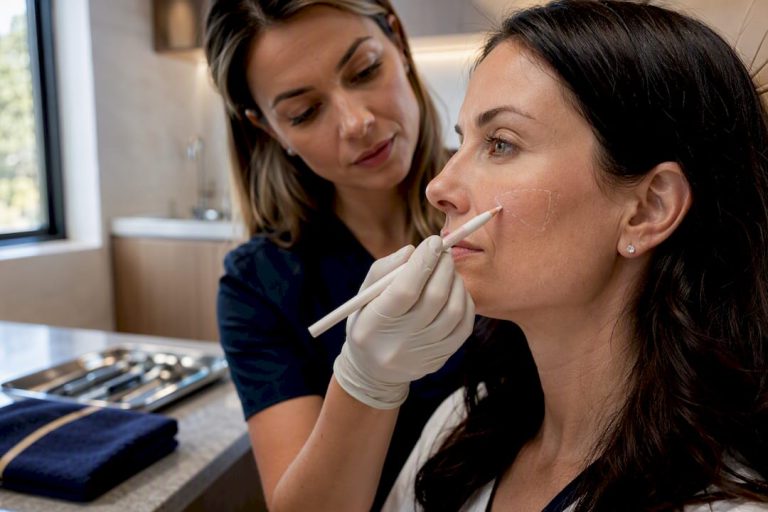
A responsible consultation is not about picking a number off a menu. It starts with your anatomy: lip proportion relative to the rest of your face, resting symmetry, and a vascular safety check before anything is injected.
From there, a conservative starting range, generally 0.5 to 1 mL, gets recommended for new patients, with a staged plan mapped out if your goals call for more over time. All injectable treatment is performed by an advanced cosmetic Registered Nurse, and the guiding philosophy stays the same for every patient: subtle, proportionate, and still recognizably you.
Before your consultation, it helps to have on hand:
- Recent photos of your lips, including a few from previous years if you have them
- Your medical history and current medications
- Any prior filler history, including product type and approximate volume, if known
What determines the cost for your syringe plan
Cost tracks volume fairly directly, since pricing for lip filler is typically quoted per syringe or per millilitre. A conservative 0.5 mL first treatment costs less than a full 1 mL session, and a staged plan spread across two visits costs roughly what a single larger session would, just split over time.
This is one of the practical reasons staging appeals to a lot of patients beyond the safety benefit. Instead of committing to a large volume and a larger bill in one visit, you pay for 0.5 to 1 mL, see how it settles over a few weeks, and then decide whether a second appointment makes sense for your goals and your budget. It also means you are never locked into a bigger commitment than you actually wanted, since you can stop after the first syringe if the result already feels right.
Beautyshotmedicalclinic does not publish flat filler pricing, since your exact volume and product needs are only known after an in-person assessment. Current pricing details are available directly through the dermal fillers services page, and your consultation will give you a specific, personalized quote based on the plan discussed.
Risks that rise with higher syringe volumes
More volume in one session generally means more swelling, more bruising, and a higher chance the final look feels heavier than intended. It is not that larger volumes are inherently unsafe when placed by a qualified injector, but the margin for error narrows as volume increases in a single visit.
Overfilling is the complication patients worry about most, and it is largely preventable through conservative dosing and staging rather than trying to correct it after the fact. Vascular complications, while uncommon, are also a real consideration with any filler volume, which is why a pre-treatment vascular safety check and careful injection technique matter regardless of whether you are getting 0.5 mL or 1.5 mL. Larger volumes injected too quickly, or without allowing tissue to settle between sessions, raise the risk of an uneven or overly firm result that then needs time, or occasionally dissolving enzyme, to correct.
This is precisely why a staged approach protects you twice over: it limits complication risk per visit, and it gives you a natural checkpoint to stop if your first result already meets your goal.
How long your results last depends on how much filler you used
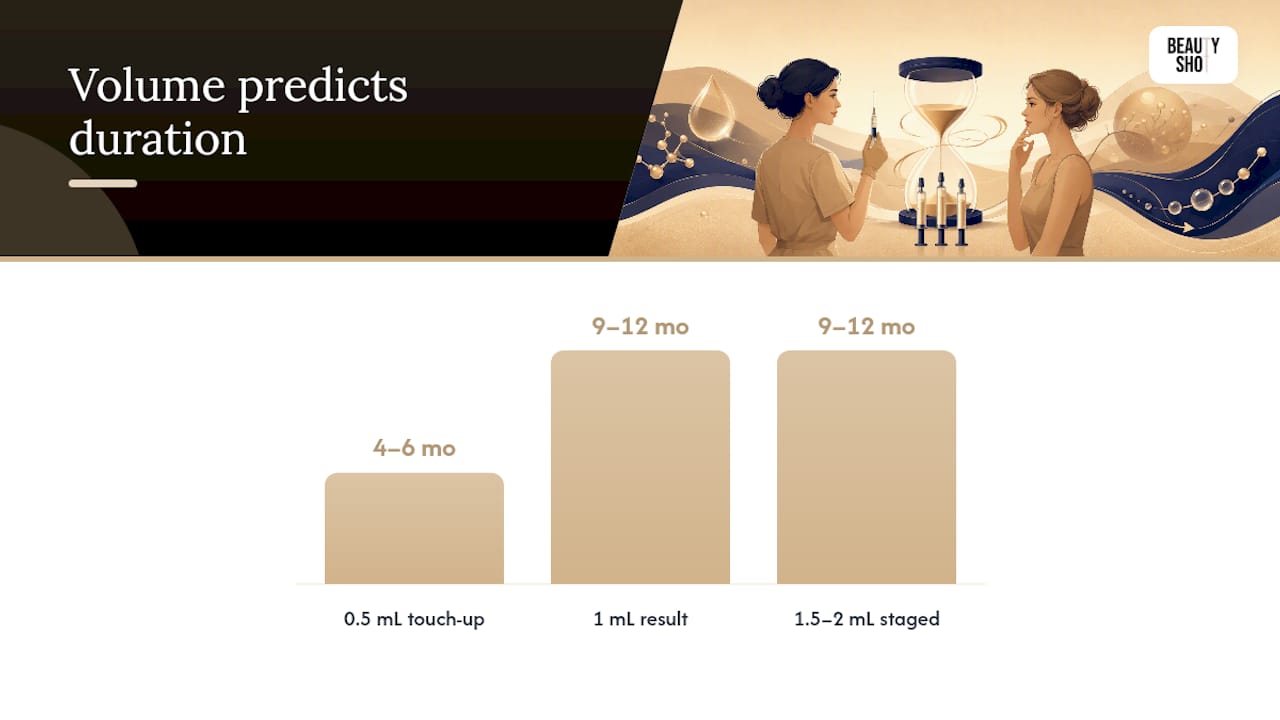
Larger volumes tend to last somewhat longer than very small ones, simply because there is more product for your body to gradually metabolize before you notice a difference. A typical hyaluronic acid lip filler lasts roughly six months to a year, though this varies by product, metabolism, and how much was used.
A 0.5 mL touch-up may soften sooner, sometimes closer to the four to six month mark, because there is simply less volume present to begin with. A fuller 1 mL result, or a staged 1.5 to 2 mL outcome, tends to hold its shape closer to the nine to twelve month range for many patients. Neither timeline is better than the other; it is a trade-off between how much maintenance you want to commit to and how much fullness you are after. Metabolism plays a role too, since some patients naturally break down hyaluronic acid faster than others regardless of how much was placed.
A nurse injector’s closing thought on choosing your number
You do not need to walk into a consultation already knowing your exact millilitre count. My role is to look at your anatomy, listen to what you want your lips to say about you, and build a plan that gets there safely, often over more than one visit.
The goal is never to chase a trend. It is facial balance, and lips that still look like yours, just a little more confident.
— Felix
How Beautyshotmedicalclinic helps you find your right number
Guesswork is the biggest risk in lip filler, not the injection itself. A key advantage is that treatment plans start with an in-person assessment by an advanced cosmetic Registered Nurse who determines specific volume needs based on anatomy, rather than defaulting to a standard “one syringe” package regardless of fit.
At your first appointment, expect a conversation about your goals, a look at your lip anatomy and symmetry, and a recommended starting volume, typically 0.5 to 1 mL for new patients. If you and your injector decide more volume would suit you better, a follow-up appointment gets scheduled once your lips have fully healed, so every addition is based on how your tissue actually responded, not a guess made on day one.
The clinic offers Botox and Dysport, dermal fillers including lip and peri-oral treatment, cheek and jawline balancing, and hyperhidrosis treatment, generally performed by an experienced nurse injector from consultation through follow-up. If you are ready to find out what volume actually fits your lips, review the dermal fillers and lip treatment options and book a consultation to build your personalized plan.
Sources
Clinical detail on placement technique and case dosing comes from a peer-reviewed lip filler technique article, staging guidance from Dr. Melis Ulger’s clinical dosing guide, and safety context from the American Society of Plastic Surgeons.
This article is general information, not a substitute for advice from a qualified doctor. Consult a qualified healthcare professional about your own circumstances before acting on anything here.
- PMC peer-reviewed clinical article on lip filler techniques
- How Much Lip Filler Do You Need for Natural-Looking Results? – Orange County Plastic Surgery
- How Many mL for Lip Fillers? A 2026 Guide for Your First Session – Dr. Melis Ulger
FAQ
Is 2 syringes of lip filler a lot?
Two millilitres is on the higher end and is generally staged across two or more sessions rather than injected all at once. Most patients achieve a noticeable, balanced result well before reaching that amount, and 1 mL remains the most common starting dose for a full first treatment.
Is 1 syringe of lip filler equal to 1 mL?
Yes, one standard syringe holds 1 mL of product, which is the same as 1 cc. This is why injectors increasingly describe treatment plans in millilitres rather than syringe counts, since it is more precise for partial or fractional dosing.
Is 0.5 mL of filler enough for lips?
For many patients, yes, especially those wanting subtle hydration, softened lines, or a natural refresh rather than dramatic added fullness. Whether 0.5 mL is “enough” depends entirely on your baseline lip volume and your specific goals, which is exactly what a consultation is designed to assess.
Can you get less than half a syringe of lip filler?
Yes, injectors can place smaller fractional amounts for touch-ups, minor asymmetry correction, or maintaining a previous result. This kind of precise, small-volume dosing is common in follow-up appointments rather than first-time treatments.
How many syringes for lips is considered natural-looking?
Most patients achieve a natural, balanced look with 0.5 to 1 mL in their first session, since this range enhances shape and hydration without overwhelming your existing proportions. Beautyshotmedicalclinic’s approach favours this conservative starting point, with additional volume added only after healing confirms it is the right next step.