

Facial harmony is defined as the balanced relationship between facial thirds, proportions, and contours that makes a face appear naturally refreshed and cohesive. How filler restores facial harmony is through targeted volume placement that supports the face’s underlying structure rather than changing who you are. Products like hyaluronic acid fillers and Poly-L-Lactic Acid (PLLA) work by replenishing lost volume in key areas, lifting and contouring the cheeks, chin, and jawline to restore proportion. The result is subtle and gradual. You look like yourself, only more rested and balanced.
How are fillers used to restore facial harmony through strategic volume placement?
Volume loss is the root cause of most facial imbalance. As you age, fat pads in the midface shrink, the cheeks flatten, and the jawline softens. These changes affect the entire face, not just one area.
Skilled injectors think in thirds: the upper face (forehead and brow), the midface (cheeks and under-eye area), and the lower face (chin and jawline). When one third loses volume, the others appear disproportionate. Treating the face as a whole system produces far more natural results than addressing a single line or fold in isolation.

A cheek-first approach is one of the most clinically sound filler techniques for harmony. Restoring volume to the midface lifts the overlying tissue, which naturally softens nasolabial folds without placing filler directly into them. Direct fold filling adds bulk without structural support, which can create a puffy, unnatural appearance.
The chin is another area that carries more weight than most patients expect. Treating a recessed chin restores proportion to the entire lower face and indirectly balances the nose and jawline. This is a clear example of how one well-placed treatment improves multiple areas at once.
- Cheeks: Restore midface volume, lift tissue, and soften lines without overfilling
- Chin: Improve lower face proportion and balance the profile
- Jawline: Define the lower third and create a cleaner facial frame
- Temples: Replace lost volume that causes a hollowed, aged appearance
- Under-eyes: Soften the tear trough to reduce shadowing and fatigue
Pro Tip: Ask your injector to assess your face in thirds before any treatment. A full-face assessment reveals which areas are driving imbalance, so treatment addresses the cause rather than the symptom.
What is the difference between facial balancing and conventional filler treatments?
Conventional filler treatments are reactive. A patient points to a line or a fold, and filler is placed there. Facial balancing is a different philosophy entirely. It assesses the whole face at rest and in motion, treating the root cause of volume loss rather than its surface symptoms.
The distinction matters because reactive treatment can make imbalance worse over time. Adding volume to one isolated area without considering the surrounding structures can shift proportions in an unintended direction.
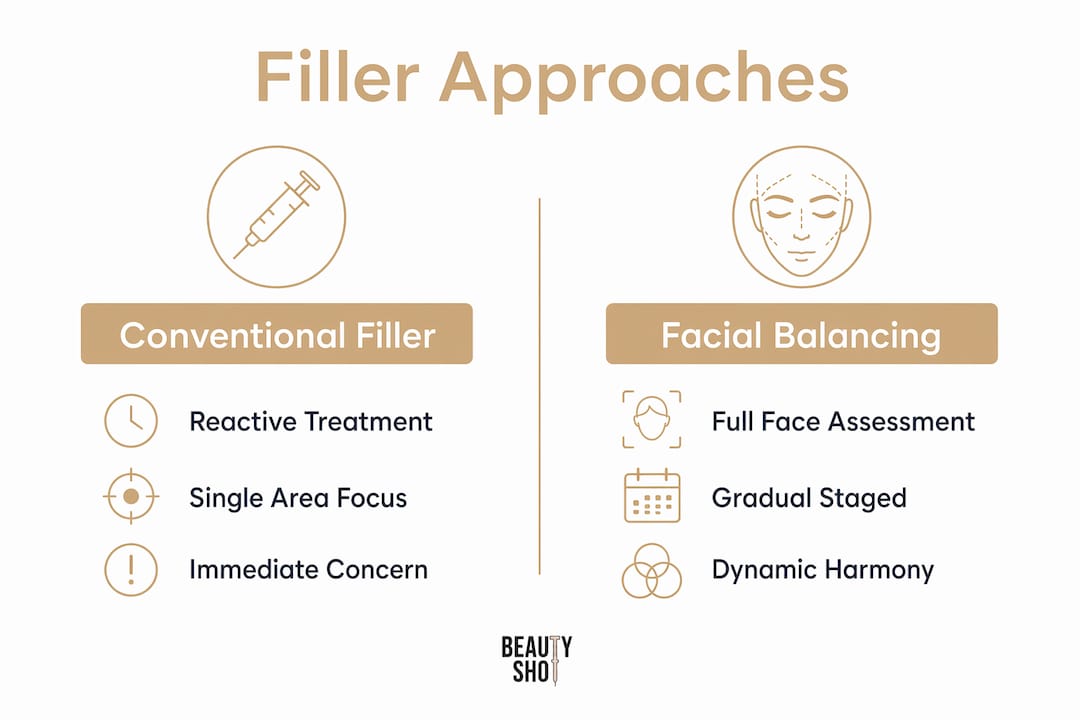
| Approach | Conventional filler | Facial balancing |
|---|---|---|
| Assessment | Single area or concern | Whole face at rest and in motion |
| Goal | Reduce a specific line or fold | Restore proportion and structural support |
| Technique | Direct placement at the symptom site | Strategic placement at volume loss sites |
| Risk | Overfilling, unnatural appearance | Lower when staged and anatomy-led |
| Results | Variable, can look isolated | Cohesive, natural, refreshed |
Gradual, staged treatment produces more authentic results than a single large session. Incremental adjustments allow filler to integrate with facial movement and give both the patient and injector time to assess how the face responds. This approach also reduces the risk of overcorrection.
The goal of facial balancing is dynamic harmony. Perfect symmetry is unrealistic because no human face is perfectly symmetrical. The aim is a balanced appearance when the face is both at rest and in expression, which is a far more meaningful and achievable outcome.
How do fillers improve facial symmetry and address common asymmetries?
Fillers improve symmetry by restoring volume in soft tissue. They are not a substitute for surgery when asymmetry involves significant bony differences, but they are highly effective for the mild to moderate soft-tissue asymmetries that most people experience.
Common asymmetries treated with filler include:
- Uneven cheeks: One side may have less volume due to natural variation or asymmetric fat loss. Filler on the flatter side restores visual balance.
- Chin deviation: A slightly off-centre chin can be corrected with targeted placement to improve the lower face profile.
- Jawline irregularity: One side of the jaw may appear less defined. Filler adds structure and evens the frame.
- Lip asymmetry: One side of the upper or lower lip may be thinner. Small amounts of filler can address lip asymmetry without over-volumising.
- Under-eye hollowing: Asymmetric tear troughs create uneven shadowing that makes the face look tired on one side.
Hyaluronic acid fillers last between 6 and 18 months depending on the product and the treated area. This means results are not permanent, which is actually reassuring for patients new to treatment. If you want a change, it can be made. If you want to return to baseline, the filler dissolves naturally over time.
Fillers enhance inherent features toward balance rather than creating a new face. Realistic expectations are part of every good treatment plan. A skilled injector will tell you honestly what filler can and cannot do for your specific anatomy.
Pro Tip: Bring a photo of yourself from 5 to 10 years ago to your consultation. It shows your injector what your natural volume looked like, which guides restoration rather than alteration.
What are the best practices for achieving natural, harmonious filler results?
The quality of your outcome depends as much on the planning process as on the treatment itself. A thorough consultation and facial analysis are non-negotiable starting points.
- Full facial assessment first: Your injector should evaluate your face from multiple angles, at rest and while you are speaking or smiling. Facial movement and anatomy must inform placement decisions.
- Staged treatment over time: One session rarely achieves the full picture. Plan for gradual adjustments across multiple visits rather than a single large treatment.
- Choose an injector with anatomy training: Advanced training in techniques like MD Codes or Allergan methods reflects a deeper understanding of facial structure. This matters more than the brand of filler used.
- Communicate your goals clearly: Tell your injector you want to look refreshed, not different. This sets the tone for a conservative, natural approach.
- Understand post-treatment effects: Patients see immediate visible results after filler, with bruising or swelling resolving within days and improved symmetry noticeable within a week.
Managing expectations is part of the clinical process, not an afterthought. A good injector will explain what is achievable in one session versus what requires a staged plan. They will also discuss maintenance, since filler is not permanent and results benefit from periodic top-ups to sustain balance over time.
Combined treatment with PLLA and hyaluronic acid fillers has shown sustained improvements in facial contour and skin quality over nine months, particularly after volume loss. This combination approach reflects how modern filler techniques for harmony go beyond simple volume replacement to address skin texture and structural support together.
Choosing a reputable filler brand and a medically trained injector are the two factors most within your control. Both directly affect safety and the quality of your results.
Key takeaways
Filler restores facial harmony by addressing volume loss at its source across all three facial thirds, producing balanced, natural-looking results when applied with anatomy-led planning and a gradual treatment approach.
| Point | Details |
|---|---|
| Treat the cause, not the symptom | Restoring midface volume lifts tissue and softens lines without direct fold filling. |
| Facial thirds guide treatment | Assessing the upper, mid, and lower face together produces more balanced outcomes. |
| Gradual staging is best | Incremental sessions allow filler to integrate naturally and reduce overcorrection risk. |
| Symmetry goals must be realistic | Dynamic harmony at rest and in expression is the target, not perfect symmetry. |
| Longevity varies by area | Hyaluronic acid fillers last 6–18 months, making maintenance planning part of the process. |
Why subtlety is the most underrated skill in filler treatment
Patients often come in with a specific concern. A fold they have noticed. A hollowness under the eye. A jawline that has softened. My first job is always to listen. My second job is to look at the whole face before I touch anything.
The most common mistake I see in filler outcomes is not under-treatment. It is isolated treatment. Volume added to one area without considering the surrounding structures can shift the face in ways that look off, even if the treated area itself looks fine. That is why I always step back and assess proportion before I plan a single injection point.
What I have learned over nine years of injecting is that patients do not actually want to look different. They want to look like themselves again. That distinction changes everything about how I approach a treatment plan. I am not adding volume for volume’s sake. I am restoring what was there and supporting what remains.
The patients who are happiest with their results are almost always the ones who committed to a gradual plan. They came back after six weeks, we assessed together, and we made small adjustments. By the third or fourth session, the results were genuinely beautiful because they were built thoughtfully. Nobody looked at them and thought “fillers.” They just looked well-rested and proportionate.
Subtlety is not a limitation. It is the goal. If you can see the filler, something has gone wrong. The best outcomes are the ones where the treatment is invisible and the person is what you notice.
— Felix
Facial balancing at Beautyshotmedicalclinic in Woodbridge
Beautyshotmedicalclinic in Woodbridge, Vaughan, specialises in the facial balancing approach described throughout this article. Every treatment begins with a full facial assessment by an advanced cosmetic Registered Nurse with nine-plus years of clinical experience and training in MD Codes and Allergan techniques. The clinic uses medical-grade hyaluronic acid fillers and works with each patient to build a gradual, personalised plan focused on natural, refreshed results. Read the injectable cosmetics guide to understand your full range of options, or browse the before and after gallery to see real patient outcomes from the clinic’s facial balancing treatments.
FAQ
What does facial harmony mean in cosmetic treatment?
Facial harmony refers to balanced proportions between the upper, mid, and lower thirds of the face. Filler restores this balance by addressing volume loss in key structural areas like the cheeks, chin, and jawline.
How long do filler results last for facial balance?
Hyaluronic acid fillers last between 6 and 18 months depending on the product and the area treated. Maintenance sessions help sustain facial balance over time.
Can fillers fix facial asymmetry completely?
Fillers improve soft-tissue asymmetry effectively, but they are not a substitute for surgery when asymmetry involves significant bony differences. The goal is enhanced balance, not perfect symmetry.
How many filler sessions does facial balancing require?
Most patients benefit from a staged approach across multiple sessions rather than one large treatment. Gradual adjustments produce more natural results and allow the face to integrate volume over time.
Is facial balancing with fillers safe?
Facial balancing is safe when performed by a trained injector with a strong understanding of facial anatomy. Choosing a medically qualified provider and using reputable filler products are the two most important safety factors.
Recommended
- Choosing injectables for your face shape: a complete guide
- How do dermal fillers work to restore facial volume and smooth wrinkles? – Beauty Shot | Botox Fillers Woodbridge Vaughan
- Dermal Fillers in Woodbridge | Beauty Shot Medical Clinic
- Before & After Gallery | Beauty Shot Medical Clinic Woodbridge