

Injectables shape the face through four distinct mechanisms: neuromodulators relax muscle to soften bulk and movement, hyaluronic acid (HA) fillers add volume and structure, calcium hydroxylapatite (CaHA) provides immediate lift plus long-term collagen stimulation, and deoxycholic acid (Belkyra) dissolves stubborn submental fat. Most patients get their best results when a qualified injector combines two or three of these in a single, full-face plan rather than treating one area in isolation.
Each class behaves differently once it’s in the tissue. Neuromodulators like Botox typically show effect within a few days and last several months. HA fillers work faster, often visible immediately, and generally hold for 6 to 9 months depending on the product and placement, according to Health Canada’s guidance on cosmetic injections. CaHA builds on that with structural support that can persist for about a year as it stimulates your own collagen. Health Canada is explicit that these procedures should only be performed by qualified healthcare providers, and that’s not a bureaucratic formality. It reflects how much anatomical knowledge sits behind a syringe that looks simple from the outside.
If you’re weighing whether injectable contouring is right for you, the practical next step is straightforward: book a consultation, bring a list of current medications and supplements, and if you have them, a few photos from five or ten years ago. That history tells an experienced injector far more about how your face has changed than a single snapshot taken today.
- Neuromodulators (Botox/onabotulinumtoxinA): relax muscle, most useful for masseter slimming and jaw softening
- HA fillers: add volume and definition to chin, cheeks, jawline, lips, and under-eyes
- CaHA (Radiesse): structural lift with collagen stimulation, favoured for jawline and lower-face laxity
- Deoxycholic acid (Belkyra): dissolves fat under the chin, not a volumizing agent
- PLLA: gradual collagen biostimulation for broader facial volume loss
Key takeaways
Injectable contouring works best as a full-face, mechanism-matched strategy, using neuromodulators for muscle, HA and CaHA for volume and structure, and deoxycholic acid for fat, under a qualified provider’s supervision.
| Point | Details |
|---|---|
| Match the agent to the problem | Muscle bulk needs a neuromodulator, laxity favours CaHA, and volume loss responds well to HA. |
| Durability varies by class | Neuromodulators last 3–4 months, HA fillers 6–9 months, CaHA up to 12 months. |
| Full-face planning improves outcomes | Treating one feature in isolation can miss the actual source of an imbalance elsewhere. |
| Provider qualifications matter | Choose a licensed RN or MD with documented advanced training and a real before-and-after portfolio. |
| Beautyshotmedicalclinic offers RN-led, personalized planning | Consultations at Beautyshotmedicalclinic assess the whole face and build a conservative, staged treatment plan. |
Which injectable classes are used for contouring, and how does each one work?
The five injectable categories used in contouring work through completely different biological pathways, which is precisely why they’re so often layered together rather than used alone.
Neuromodulators (Botox is the best known, though Dysport is another onabotulinumtoxinA-family option) block the nerve signal that tells a muscle to contract. In contouring, this matters most at the masseter, the chewing muscle at the jaw angle. Relaxing it over several sessions can soften a square, heavy-set jawline into a more tapered shape. It’s also used at the brow and forehead to prevent the muscle pulling that deepens dynamic lines over time.
Hyaluronic acid fillers work as a volumizing gel, with details on the types and uses described at Dermal & Lip Fillers – Restore Volume & Enhance Features | Unity by MD – Integrative Medspa. Hyaluronic acid already exists naturally in your skin, and products in the Juvéderm Vycross family use cross-linking technology to control how the gel behaves once injected, whether it needs to hold a firm structural line at the jaw or spread softly for a natural cheek contour. HA is also the only major filler category with a true reversal option: hyaluronidase dissolves it within hours if a correction or complication requires it.
Calcium hydroxylapatite, sold as Radiesse, does two jobs at once. On injection it acts as an immediate structural filler, and over the following months it stimulates your body to lay down its own collagen. A panel of aesthetic specialists found that undiluted CaHA produced measurable improvements in jawline definition and dermal thickness, confirmed on ultrasound and histology, making it a favoured choice for patients with genuine skin laxity rather than pure volume loss.
Poly-L-lactic acid (PLLA) takes the biostimulation concept further. It contains no immediate filling gel at all. Instead it triggers a gradual collagen response over weeks to months, which suits patients who want broad, subtle volume restoration rather than a defined contour line.
Deoxycholic acid, the active ingredient in Belkyra, is the outlier of the group because it doesn’t add anything. It’s a fat-dissolving compound injected directly under the chin, breaking down fat cells that the body then clears naturally over a series of treatments.
| Injectable | Primary purpose | Mechanism | Typical onset | Typical duration | Reversible? |
|---|---|---|---|---|---|
| Neuromodulator (Botox) | Reduce muscle bulk/movement | Blocks nerve-muscle signal | 3–7 days | 3–4 months | No, wears off naturally |
| HA filler | Add volume, define contour | Hydrates and structures tissue | Immediate | 6–9 months | Yes, hyaluronidase |
| CaHA (Radiesse) | Structural lift, laxity | Volumizes plus stimulates collagen | Immediate, builds over months | Up to 12 months | No true reversal agent |
| PLLA | Gradual volume restoration | Collagen biostimulation | Weeks to months | 12–24 months | No |
| Deoxycholic acid (Belkyra) | Submental fat reduction | Dissolves fat cells | Weeks, over a series | Considered permanent once complete | No |
- Want to slim a heavy jaw angle without surgery? Neuromodulator in the masseter is generally the first-line option.
- Want to project a weak or receding chin? HA or CaHA placed at the pogonion typically does the job.
- Want to soften jowls and restore a defined jawline border? CaHA’s collagen-stimulating effect often outperforms HA alone for laxity.
- Have a persistent double chin that doesn’t respond to weight loss? Belkyra targets fat directly, which fillers and neuromodulators cannot do.
A widely cited comparison of the two categories notes that neuromodulators and fillers solve different problems entirely, one relaxing muscle, the other restoring volume, which is why so many contouring plans use both rather than picking a single product and hoping it covers every concern.
How injectables are used across the face, area by area
Contouring isn’t one technique repeated at different spots. Each facial zone has its own tissue depth, blood supply, and risk profile, and an experienced injector adjusts the product, the injection plane, and even the tool for every one of them.
Jawline. A high-G’ prime HA filler or CaHA is typically layered along the mandibular border to sharpen definition, often delivered with a blunt cannula rather than a needle to reduce bruising and vascular risk across the larger surface area. Our guide on how jawline fillers create definition walks through what that looks like in practice.
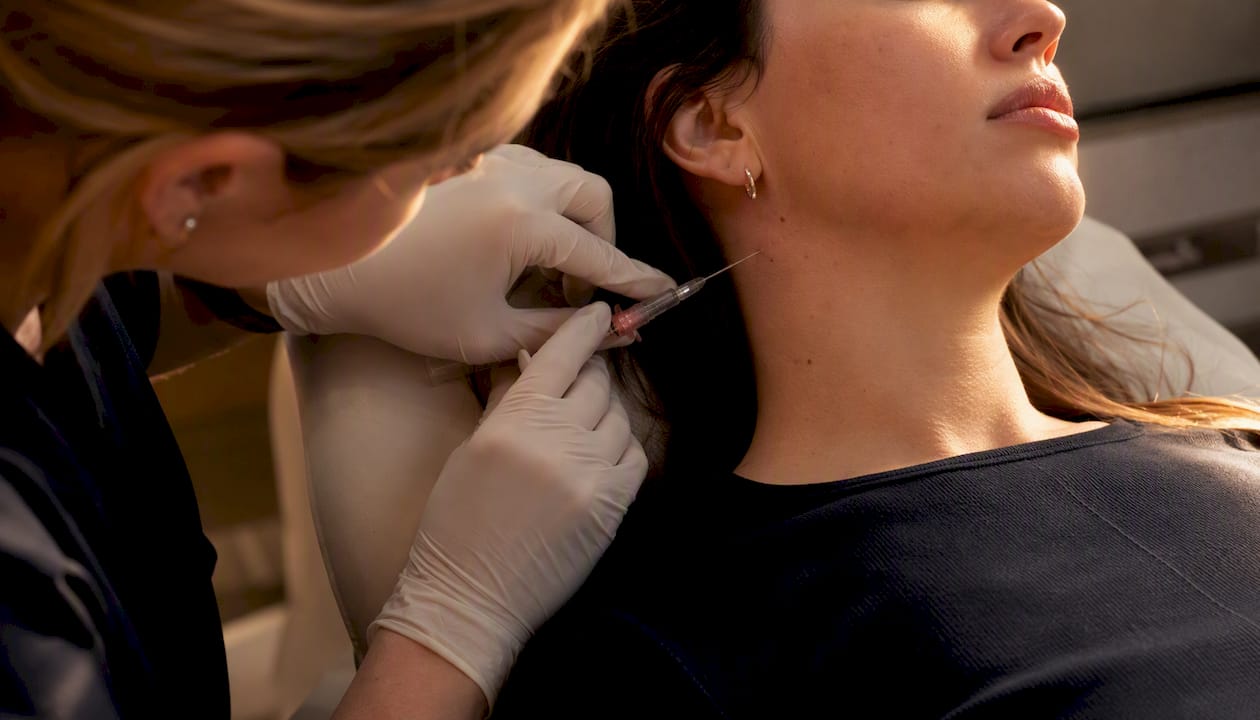
Chin. Projection is usually built with a supraperiosteal injection technique, meaning the product sits directly on bone, using a single-entry, multilayered retrograde approach that gives a controlled, predictable result rather than an overfilled look.
Cheeks. HA is placed to restore the mid-face volume that naturally declines with age, generally injected at a deeper plane to lift rather than a superficial one that can look puffy.
Masseter. Neuromodulator is injected intramuscularly, directly into the muscle body, and results build gradually as the muscle atrophies slightly with repeated treatment. Our piece on whether masseter Botox actually slims the face covers realistic timelines for this specific goal.
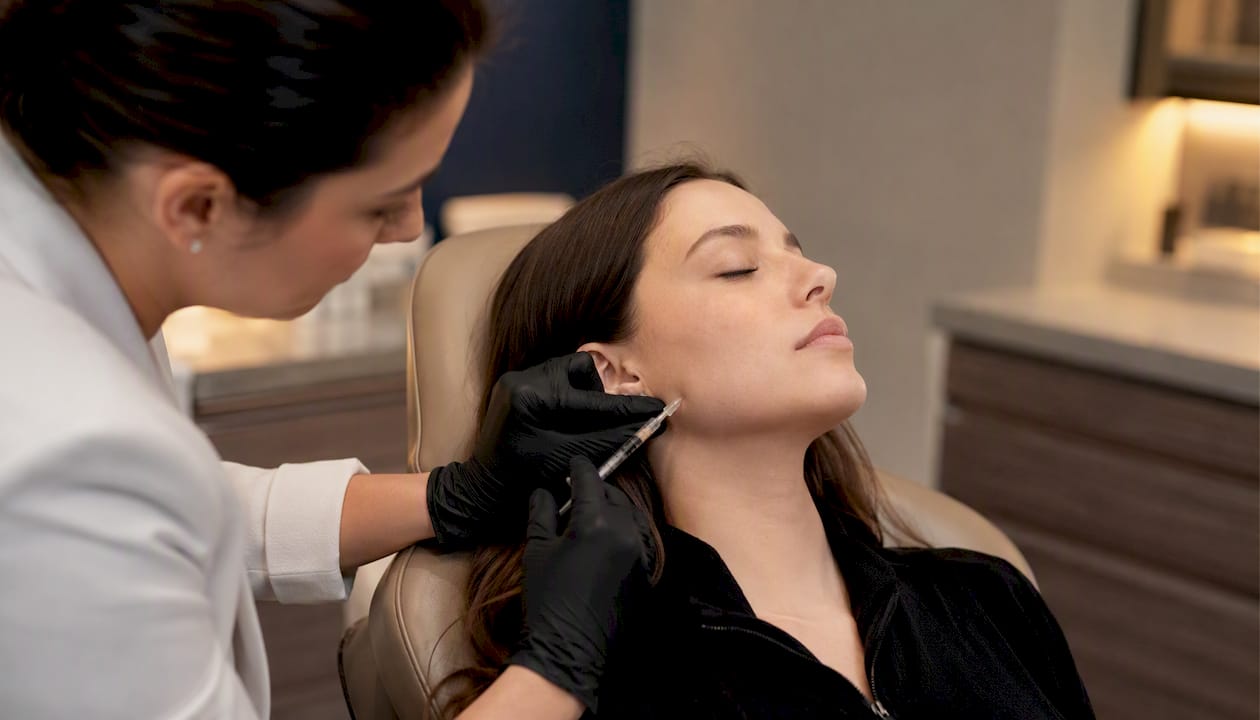
Submental area (under the chin). Belkyra is injected subcutaneously in a grid pattern across the fat pad, usually requiring two to four sessions spaced weeks apart.
Tear troughs and under-eyes. This is one of the more technically demanding zones, using a very small volume of soft HA placed superficially, because the skin here is thin and unforgiving of any product that isn’t properly matched to the depth.
Nose. Non-surgical rhinoplasty with HA can smooth a dorsal bump or refine the tip, but this area carries genuine vascular risk and demands an injector who knows the angular artery’s exact course.
Two zones deserve extra caution regardless of technique: the glabella (between the brows) and the nasal region both sit close to vessels that, if compromised, can cause tissue damage or, in rare cases, vision changes. Any clinic doing HA work in these areas needs hyaluronidase on hand and staff trained to recognize a vascular occlusion immediately.
Pro Tip: A single-zone request, like “just fix my chin”, often changes once you’re assessed from the side profile. A weak chin frequently makes the nose look larger than it is, so treating the chin alone can shift how your whole profile reads without ever touching your nose.
How a full-face contouring plan gets built
Combining injectable classes isn’t about stacking more product. It’s about sequencing treatment so structural problems get solved before cosmetic refinements layer on top.
- Structural deficits get addressed first. If a weak jawline or flat chin is contributing to jowling or a “heavy” lower face, that gets corrected with filler or CaHA before anything else is considered, because fixing the foundation often reduces how much correction is needed elsewhere.
- Neuromodulator and filler are frequently done in the same visit, since they act on different tissue layers, muscle versus subcutaneous or supraperiosteal space, and don’t interfere with each other.
- Touch-ups are staged conservatively. A first session is rarely the final result. Most experienced injectors deliver a moderate initial volume, let it settle for two to four weeks, then reassess before adding more.
- **Biostimulators like CaHA or PLLA get factored in for longer horizons, since their collagen-building effect continues to improve results for months after the appointment.
A practical, technique-focused approach to combining HA fillers with botulinum toxin A found that careful patient selection and solid anatomical knowledge kept complication rates low, mostly limited to mild, temporary bruising or swelling, when both product classes were used together in the same treatment plan.
- Photograph the face from front, both obliques, and profile before any product is discussed.
- Mark injection points with the patient upright and using natural facial expression, not lying flat.
- Start conservative on volume in a first session; it’s easier to add than to remove.
- Reassess at a follow-up appointment before committing to a second round.
Before you commit to a plan, ask your provider these questions:
- Are you assessing my whole face, or only the area I mentioned?
- Which injectable are you recommending for each zone, and why that one specifically?
- What’s your plan if I need a touch-up or a correction?
- Do you have hyaluronidase on-site if I have an HA filler reaction?
Injectables have real limits. If skin laxity is severe, if bone structure requires more correction than volume can provide, or if a patient is looking for a dramatic structural change, surgical consultation remains the more appropriate route. A responsible injector will tell you that directly rather than trying to solve a surgical problem with a syringe.
When do results show up, and how long do they last?
Timing expectations vary enormously by injectable class, and mismatched expectations are one of the most common sources of disappointment after a first treatment.
- Neuromodulators: onset in 3 to 7 days, full effect by day 14, duration around 3 to 4 months before muscle activity returns.
- HA fillers: visible immediately, with final settling over 2 weeks as any swelling resolves; duration commonly 6 to 9 months, per Health Canada, though denser products in areas with less movement can last longer.
- CaHA: immediate volumizing effect, with collagen-driven improvement continuing for months afterward; one study following jawline patients found 81% rated their contour restoration “improved” to “very much improved” at the one-year mark, with jawline scores improving by roughly 1.3 to 1.9 points on standardized scales.
- Belkyra: no immediate visible change; results emerge gradually across a series of two to four sessions spaced about six weeks apart, with full effect visible months after the final treatment.
A reasonable retreatment cadence looks like neuromodulator touch-ups every 3 to 4 months, HA maintenance around the 9-month mark depending on the area, and CaHA reassessment closer to the 12-month point since its effect fades more gradually than it appears.
Longevity isn’t fixed. Faster metabolism, high activity levels, and areas with heavy muscle movement (like the mouth) all break down product faster than a still area like the chin. Rheology, meaning how firm or soft a given filler is engineered to be, also plays into how long it holds shape under repeated facial movement. Budget for maintenance with that variability in mind rather than assuming every patient gets identical mileage from the same product.
Take a photo under consistent lighting at each visit. Small, gradual changes are easy to miss in the mirror day to day, but a photo series makes it obvious when it’s genuinely time for a touch-up versus when you’re just used to seeing the improved version of your own face.
What are the real risks, and how are complications managed?
Most injectable side effects are minor and temporary: bruising, swelling, and a few days of transient numbness at the injection site are common and expected, not a sign anything went wrong.
The rare but serious risks are what separate a well-run clinic from a risky one. Vascular occlusion, where filler is accidentally injected into or compresses a blood vessel, can cause tissue damage if not caught quickly. In extremely rare cases involving the glabella or nasal area, occlusion has been linked to vision changes. Infection and granuloma formation, a nodule of inflamed tissue, are also possible, though uncommon when sterile technique is followed properly.
Red flags that require immediate attention:
- Sudden, severe pain that’s disproportionate to the injection itself
- Skin blanching (turning white) or a dusky, mottled colour change
- Any change in vision
- Signs of infection: increasing redness, warmth, or fever days after treatment
Any of these means calling the clinic immediately, not waiting to see if it resolves. For HA-related vascular events, hyaluronidase can dissolve the product rapidly and is considered the standard emergency response, which is one more reason HA remains a preferred choice for patients who want a treatment with a genuine safety net.
A responsible clinic protocol includes documented informed consent, a thorough anatomical assessment before the needle ever comes out, sterile technique, hyaluronidase on-site, and a follow-up check-in after treatment. When you’re evaluating a provider, ask about licensure (RN or MD), specific advanced training beyond basic certification, and whether they can show you a portfolio of real before-and-after results, ideally from patients with a similar facial structure to yours.
What actually happens during a consultation and treatment appointment?
Here’s the sequence a well-run appointment generally follows, from the first phone call to walking out the door.
- Booking the consultation. You’ll typically be asked for a brief medical history and, if relevant, prior photos.
- The consultation itself. Expect a conversation about your goals, a full-face assessment (not just the one area you mentioned), and photographs from multiple angles.
- Informed consent. A proper clinic walks through the product being used, expected results, risks, and cost before anything is injected.
- Marking and preparation. The treatment areas are marked with you sitting upright, and topical numbing cream may be applied if needed.
- The injection session itself. This usually takes 15 to 45 minutes depending on how many areas are being treated.
- Immediate aftercare instructions. You’ll be given specific guidance before you leave, covering the next 24 to 48 hours.
Before your appointment, most clinics recommend avoiding blood thinners and certain supplements for 5 to 7 days beforehand, including aspirin, ibuprofen, vitamin E, and fish oil, since these increase bruising risk.
- Avoid alcohol the day before and day of treatment.
- Skip strenuous exercise, saunas, and hot yoga for 24 to 48 hours after.
- Sleep with your head elevated for the first night or two, particularly after under-eye or cheek treatment.
- Apply ice intermittently in the first few hours to limit swelling.
- Avoid touching, massaging, or applying makeup to the treated area for the rest of the day.
Downtime is usually minimal. Most patients return to normal activities the same day, though visible bruising can take a week or more to fully resolve. Before you book, ask directly about pricing structure: whether it’s charged per syringe or per unit, what brand of product is being used, and whether the injector will show you the product packaging or lot number. That transparency is a fair, reasonable thing to expect and any clinic worth choosing will offer it without hesitation.
Choosing the right injectable for your specific contouring goal
The clinical evidence on this is more specific than most patients realize, and it’s worth knowing before you walk into a consultation with a fixed idea of what you want.
A panel evaluating CaHA for lower-face laxity found it stimulates measurable collagen I and III expression along with objective jawline score improvements on ultrasound and histology, which is a meaningfully different outcome than pure volumizing. If your concern is genuine skin laxity, sagging along the jaw rather than just a lack of projection, CaHA’s biostimulation tends to outperform HA alone. If your concern is pure volume loss with minimal laxity, HA generally gives a more immediately controllable, adjustable result, with the added benefit of being reversible if you’re not happy with it.
For muscle-driven concerns, a heavy masseter or dynamic wrinkling from repeated muscle movement, neither filler nor CaHA is the right tool. Only a neuromodulator addresses the muscle itself.
| Goal | Best-suited agent | Why |
|---|---|---|
| Lift and projection (chin, cheeks) | HA filler | Immediate, controllable, reversible |
| Skin laxity and structural sag | CaHA | Immediate volume plus collagen stimulation over time |
| Muscle bulk (masseter, jaw) | Neuromodulator | Only agent that reduces muscle activity |
| Submental fat | Deoxycholic acid | Only agent that dissolves fat directly |
- Ask whether your specific concern is muscle, volume, laxity, or fat, since each has only one truly appropriate injectable category.
- Don’t assume more product always means a better result; overcorrection is a real risk with any filler.
- Prioritize a provider who can explain why they’ve chosen a specific product over simply naming a brand.
Consensus guidance on combining categories continues to shift as more product-specific research accumulates, but the underlying principle, matching mechanism to the actual anatomical problem, has stayed consistent across the literature for years.
How I approach injectable contouring in practice
I always start with the whole face, not the one feature a patient walks in wanting to fix. So often, someone will book in for “just my chin” or “just my jawline,” and once I look at their profile, I can see the concern is actually coming from somewhere else entirely, maybe volume loss in the cheek that’s making the jaw look heavier than it is. Anatomy-first assessment isn’t a slogan for me. It’s the difference between a result that looks proportionate and one that looks like a single feature was treated in isolation.
I stage treatment conservatively. I would rather see you back in three or four weeks for a small refinement than push too much product in on day one and have to manage an overcorrected look. That approach comes directly from my background in Medical/ICU nursing at Sunnybrook Hospital, where careful, incremental assessment was simply how you practised. I’ve carried that same discipline into my advanced training in MD Codes, Allergan technique, and through the Teoxane Academy and Clarion Medical programs.
- Safety comes before aesthetics, every single time.
- Results should look like you, only refreshed, never like a different person.
- Every consent conversation covers realistic outcomes, not idealized ones.
- Follow-up is built into the plan, not an afterthought.
- Treatment plans are personalized to your bone structure and skin, not a template.
My goal for every patient who sits in my chair is the same: that they leave looking like a well-rested version of themselves, one that their friends notice without being able to say exactly why.
How Beautyshotmedicalclinic supports your contouring goals
If you’ve read this far, you already understand that injectable contouring works best as a planned, full-face strategy rather than a single-product fix. That’s exactly how treatment is approached at Beautyshotmedicalclinic in Woodbridge, Vaughan, where every Botox, dermal filler, CaHA, and Belkyra treatment is performed by an advanced cosmetic Registered Nurse rather than delegated to a technician working from a standard protocol. Consultations typically run 30 to 45 minutes and include a full facial assessment, a conversation about realistic outcomes, and a personalized plan built around your bone structure, not a generic package. Bring your medical history, current medications, and any older photos that show how your face has changed over the years. If you’re ready to move from research to a real plan, you can read our honest guide to injectable cosmetics or book a consultation directly through our dermal fillers page to get started.
Sources
- Health Canada — Cosmetic injections
- Contouring Plus: lower third approach with CaHA and HA — PMC10083035
- Clinical study on CaHA jawline enhancement — PMC10971119
- Cleveland Clinic — What’s the difference between facial fillers and Botox? — 2023-08-31
This article is general information, not a substitute for advice from a qualified doctor. Consult a qualified healthcare professional about your own circumstances before acting on anything here.
FAQ
What is the main purpose of injectables in facial contouring?
Injectables reshape the face by adding volume where it’s lost, relaxing muscles that create bulk or lines, or dissolving fat, depending on which class of injectable is used and where.
What procedure is often described as taking years off the face?
A combination approach, using neuromodulator for dynamic lines plus HA or CaHA for restored volume, is the treatment most often associated with a refreshed, less tired-looking appearance, since it addresses both muscle movement and volume loss at once.
What is the purpose of facial contouring with injectables?
The goal is to restore or enhance facial proportion and definition, such as a stronger jawline, better cheek projection, or a softer jaw angle, using targeted volume, muscle relaxation, or fat reduction rather than surgery.
How does an injection work for contouring?
The injector places a small, precise amount of product at a specific depth (muscle, subcutaneous fat, or against bone) matched to the goal, and the effect builds over minutes to weeks depending on which injectable class is used.
Are injectables safe for contouring?
Injectables carry a strong safety profile when performed by a qualified, licensed provider following proper anatomical assessment and sterile technique, though minor bruising and swelling are common and rare but serious risks like vascular occlusion require immediate attention.