

Most patients do well returning every three to four months, though some stretch comfortably to six depending on how their muscles respond and what they’re hoping to achieve. The official prescribing guidance is clear on one point: dosing more frequently than every three months hasn’t been clinically evaluated for safety or effectiveness, so that interval isn’t a suggestion. Your ideal schedule still comes down to your anatomy, your goals, and a proper reassessment with a qualified injector.
TL;DR:
- Muscle strength, dose, metabolism, activity level, and toxin formulation significantly influence individual Botox duration, with effects typically lasting three to four months.
- The three to four month interval is a minimum safety threshold, not a schedule, and treatments should be guided by how long results last for each person.
- Repeated high doses or injections more frequently than every three months can increase the risk of antibody formation, reducing treatment effectiveness over time.
- Treatment timing varies by area, with the forehead and crow’s feet generally requiring re-treatments every three to four months, while larger muscles like the masseter may last longer.
- Continuity with a qualified injector who tracks your response and history optimizes safety, natural results, and helps establish a personalized, effective treatment schedule.
What determines your botox frequency?
Your muscles, not the calendar, set the real timeline. A handful of biological and lifestyle factors decide whether you’re back at three months or comfortably stretching to five.
Age plays a bigger role than most patients expect. Research on botulinum toxin shows average time to onset of roughly a week and average duration near three months, though that range varies widely, and age, dose, and toxin type are among the strongest predictors of both numbers. Older patients sometimes notice the effect kick in faster, but how long it lasts still depends heavily on muscle strength and treated area.
Here’s what tends to shift your personal timeline:
- Muscle strength: Someone with a naturally strong, expressive forehead often burns through the effect faster than someone with lighter muscle activity.
- Dose: Higher units generally last longer, which is why we always aim for the lowest effective dose rather than maxing out every visit.
- Metabolism and activity level: A small study found that higher physical activity was linked to shorter duration of cosmetic botulinum toxin effects according to a small study across follow-up visits.
- Toxin formulation: Different BoNT/A products show modest differences in onset and duration, which is worth discussing at consultation rather than assuming one product behaves identically to another.
Pro Tip: Keep a simple note on your phone of the date you were treated and when you first noticed movement returning. That single habit tells your injector more about your personal timeline than almost anything else.
How often should you treat each area?
Timing isn’t one-size-fits-all across the face, and it shouldn’t be. The area you’re treating, and what you want that area to look like, both shape the plan.
- Forehead, glabella, and crow’s feet. These respond to the classic three to four month rhythm for most patients, largely because the muscles involved are used constantly through everyday expression.
- Masseter (jaw slimming or clenching relief). This muscle is larger and denser, so results here can last longer for some patients, though dosing and technique differ enough that it deserves its own conversation rather than a copy-paste schedule.
- Therapeutic uses like chronic migraine. These follow evidence-based protocols set by the treating physician, and they are governed by different clinical standards than cosmetic maintenance. A clinical trial is currently comparing shorter therapeutic intervals against the standard 12-week cycle, but that research applies to medical indications, not routine cosmetic touch-ups.
- Your first year versus your third. New patients typically need closer follow-up, often at the three to four month mark, while we fine-tune dose. Once we’ve found your sweet spot, many patients settle into two or three treatments a year.
- Subtle softening versus full relaxation. If you want your forehead to still move naturally when you’re surprised, we use lower units and you may need a touch-up sooner. If you want fuller stillness, higher dosing usually buys more time between visits.
Combining Botox with fillers or other treatments doesn’t have to complicate scheduling, though it’s worth coordinating rather than layering everything into one aggressive appointment. Your injector can walk you through how treatment areas affect duration and how a broader treatment plan and touch-up timing fits together.
What are the safety limits on Botox dosing?
The prescribing information is unambiguous here, and it’s the single most important safety fact in this entire conversation. Duration runs approximately three to four months, and dosing more frequently than every three months has not been clinically evaluated.
There’s also a hard ceiling on total dose. When treating adult patients across one or more indications, the maximum cumulative dose should generally not exceed a certain threshold within any three-month interval.
Repeated high-dose or overly frequent injections can raise the risk of neutralizing antibodies forming, which reduces how well the toxin works over time. Using the lowest effective dose and spacing treatments as long as your results allow is one of the most reliable ways to protect your long-term response.
Beyond antibody risk, know the signs that warrant a call to your clinician: difficulty breathing or swallowing, unusual muscle weakness spreading beyond the treated area, or vision changes. These are rare, but they’re the reason a medically trained injector matters.
- Never let a clinic push you toward shorter intervals “just to be safe” — it isn’t.
- Watch for asymmetry or heaviness rather than assuming more units always means better results.
- Health Canada’s guidance on cosmetic injections reinforces using the lowest effective dose and the longest feasible interval.
What to do if your Botox wears off early
If you’re noticing movement return well before the three-month mark, the answer isn’t automatically “book sooner.” A proper reassessment comes first.
A thorough check should include:
- Confirming the exact product and dose used at your last visit.
- Reviewing injection placement and technique against your specific muscle pattern.
- Asking about recent illness, new medications, or major changes in physical activity.
- Considering antibody testing if you’ve had many prior treatments with limited response.
Pro Tip: If two consecutive treatments both wear off unusually fast, that’s a pattern worth investigating, not just repeating with more units.
Rather than defaulting to shorter and shorter intervals, your injector might adjust your dose modestly, discuss a different toxin formulation, or add a complementary treatment. Genuine early wear-off tied to a documented medical need is different from wanting your results to simply last longer, and that distinction should be part of your consent conversation. Good aftercare habits can also support how evenly your results settle in the first two weeks.
How your injector builds your personalized schedule
A responsible maintenance plan starts long before your first injection and gets refined with every visit after.
- Baseline documentation. Expect photos, a movement assessment, and a full history of prior toxin use, medications, and any autoimmune conditions.
- A conservative first year. Most injectors start with a moderate dose, then schedule your follow-up around when you’d realistically expect wear-off, watching closely for how long the effect actually holds.
- Lengthening the interval over time. If your results stay durable, many patients move from four visits a year down to two or three without losing the look they want.
- Questions worth asking at consultation. How many units are being used, what duration should I expect, what’s the plan if I notice early wear, and what are the safety limits for my specific treatment plan?
Seeing the same qualified injector visit after visit matters more than people realize. Continuity means someone who already knows your muscle pattern, your dose history, and your face at rest, which supports both safety and a more natural-looking outcome.
Beauty Shot Medical Clinic’s approach to Botox scheduling
I’m Irene Soni, R.N., and every Botox treatment at Beauty Shot Medical Clinic is performed by an advanced cosmetic Registered Nurse, never delegated to unsupervised staff. My approach favours the lowest effective dose and a schedule built around your actual response, not a generic calendar.
What that looks like in practice:
- A first-year plan with closer follow-up so we find your true interval, not a guess.
- Reassessment before any dose adjustment, especially if results seem to fade early.
- A focus on natural-looking, age-appropriate results rather than frozen stillness.
- Documentation of your history, prior toxin use, and treatment goals at every visit.
If you’re weighing your own maintenance timeline, our page on combining Botox with other treatments is a useful next read before your consultation.
Why the “every three months” rule gets misunderstood
The conventional advice on Botox frequency treats three months like a countdown timer, and that’s where most patients go wrong. It isn’t a target to hit. It’s a floor, not a schedule.
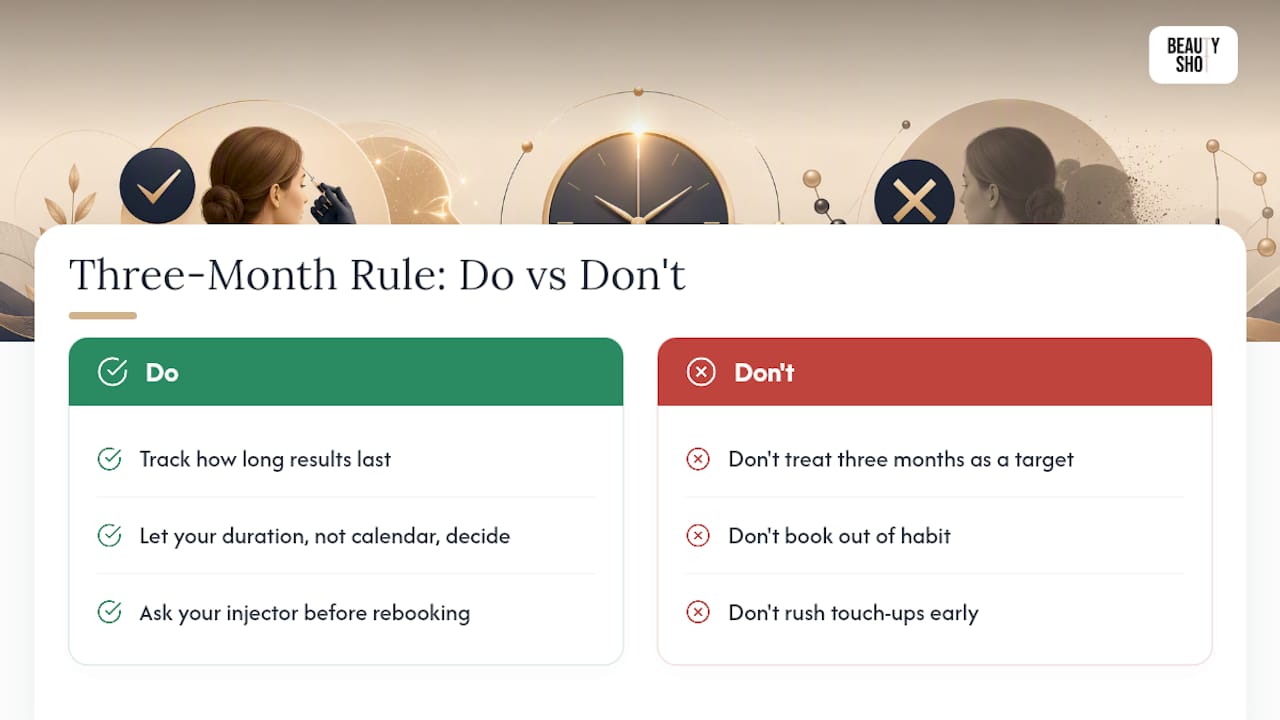
What the evidence actually supports is something less tidy but more honest: duration varies enormously by dose, muscle strength, activity level, and even the toxin formulation used, so two patients treated the same week can be due for touch-ups months apart. The rigid three-month mindset pushes people toward booking out of habit rather than out of need, which is exactly the pattern that raises antibody risk over years of treatment.
If there’s one thing worth prioritizing, it’s this: track how long your own results actually last before your next booking, and let that number, not the calendar, drive the conversation with your injector. A good practitioner will tell you when to wait longer, not just when to come back sooner.
— Felix
Ready to build a schedule that actually fits your face?
Beauty Shot Medical Clinic gives you something a lot of walk-in injectable spots don’t: continuity with the same advanced cosmetic Registered Nurse who tracks your dose history, your response pattern, and your goals over time, rather than starting from zero at every visit. That matters most with Botox frequency specifically, since the right interval for you depends on data from your own past treatments, not a generic chart taped to a treatment room wall.
Located in Woodbridge, Vaughan, the clinic focuses on subtle, age-appropriate enhancement rather than a one-size-fits-all injection count. If you’re ready to find your actual maintenance interval instead of guessing, book a consultation and explore Botox’s journey from toxin to trusted beauty treatment to see how a personalized plan comes together from your very first visit.

This article is general information, not a substitute for advice from a qualified doctor. Consult a qualified healthcare professional about your own circumstances before acting on anything here.
Sources
- DailyMed – BOTOX COSMETIC prescribing information
- Time to onset and duration of botulinum toxin efficacy in movement disorders
- Health Canada — cosmetic injections guidance
FAQ
Is getting Botox every 3 months too often?
No, three months is the standard maintenance interval studied for safety and effectiveness. Going shorter than that hasn’t been clinically evaluated, so it’s the floor to respect, not a sign you’re overdoing it.
What is the rule of 3 in Botox?
There’s no single official “rule of 3,” but in practice it usually refers to the three-month minimum interval between treatments and the guidance to stay near the lowest effective dose across roughly three-month cycles.
What is the 4-hour rule for Botox?
This typically refers to avoiding lying down, exercising, or touching the treated area for about four hours after injection to help the product settle properly, though your injector’s specific aftercare instructions should always take priority.
What happens after 10 years of Botox?
Long-term repeated treatment at appropriate doses and intervals hasn’t been shown to cause permanent muscle damage in the areas typically treated, and many patients maintain results reliably for years by keeping to the lowest effective dose and reassessing regularly with their injector.
Can you get Botox too often?
Yes, dosing more frequently than every three months hasn’t been clinically evaluated, and doing so may raise the risk of neutralizing antibodies forming, which can make future treatments less effective.