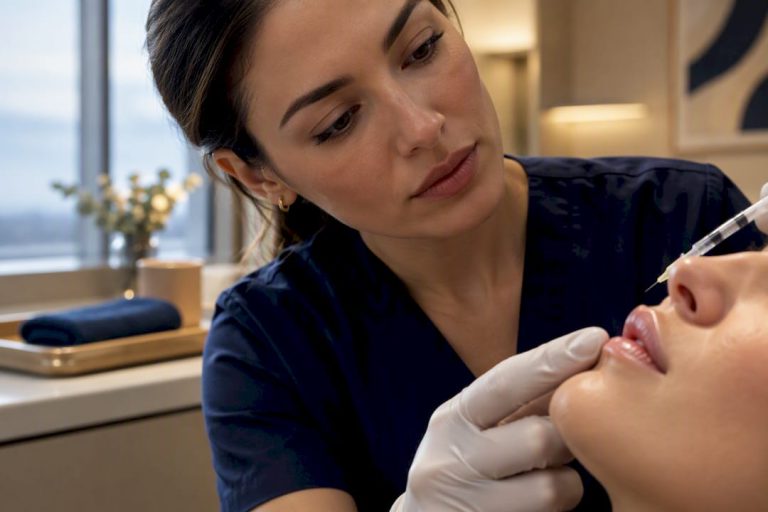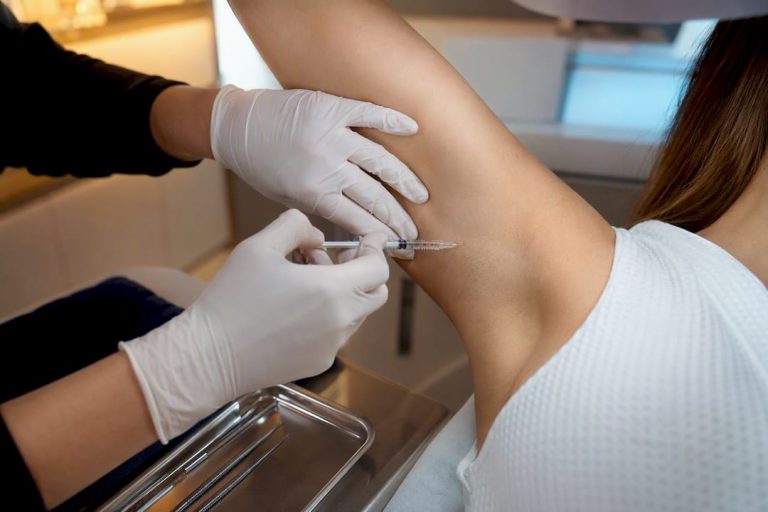

Yes, Botox can be a safe, effective short-term option for many men, provided a qualified injector tailors dosing and placement to male anatomy. It is a temporary medical treatment, not a permanent fix, and results depend heavily on individual assessment. Before booking, confirm the product’s authorization status and ask what the follow-up plan looks like.
TL;DR:
- Men generally need individualized dosing for areas like the glabella and forehead due to anatomical differences, not just more units.
- Proper assessment and conservative starting doses at the consultation help preserve natural expressions and avoid brow heaviness or over-relaxation.
- Authentic products with Health Canada’s authorization are essential, and vials should be verified for proper DIN to reduce risks of contamination or counterfeit issues.
- Results typically emerge within 3 to 7 days, fully settle by two weeks, and last three to four months, varying with muscle strength and treatment areas.
- Long-term planning involves three to four sessions annually, with re-evaluation of muscle response and anatomy changes over time to maintain natural, age-appropriate results.
What is Botox for men and how does it work?
Botulinum toxin type A, the active ingredient in Botox, works by temporarily blocking the nerve signals that tell a muscle to contract. Less contraction means the overlying skin creases less, so lines soften without paralyzing the whole face when it’s dosed correctly.
Health Canada classifies Botox Cosmetic as a prescription drug with its own Drug Identification Number (DIN), the same regulatory tier as other prescription medications. That matters more than most men realize: it means a legitimate provider should be able to show you where cosmetic injections fall under Canadian health regulation and confirm the vial in front of you matches an authorized product.
The timeline is predictable, even if the exact experience varies person to person:
- Onset: visible softening typically begins within 3 to 7 days.
- Full effect: usually settles in by the two-week mark.
- Duration: effects generally last 3 to 4 months, with some individual cases stretching toward 6 months.
If you want the deeper mechanism behind why the effect fades on its own, the science behind how Botox works breaks down the metabolic process in plain language.
Why do men choose Botox, and what results do they actually want?
Most men who come in for a consultation aren’t chasing a frozen, line-free forehead. They want to look like a rested version of themselves, not a different person entirely.
The benefits that come up most often in conversation:
- Softer forehead and frown lines without erasing all facial movement.
- A more “awake” or less permanently annoyed resting expression.
- Reduced jaw tension from clenching or grinding, in appropriate candidates.
- Less severe underarm or palm sweating for men bothered by hyperhidrosis.
- A refreshed look that colleagues and friends notice without being able to say why.
The goal, always, is age-appropriate refreshment, not a redesign. Preserving the heavier brow, the stronger jawline, and the natural furrow lines that read as masculine expression is part of the technique, not an afterthought.
Pro Tip: If your main goal is a relaxed jaw rather than smoother lines, say so at the consultation. Masseter Botox for tension or grinding is dosed and placed differently than Botox for wrinkles, and mentioning your actual priority upfront saves a touch-up visit later.
Which treatment areas work best for men?
Male facial anatomy changes the math on where and how much product goes in. Thicker skin, denser muscle mass, and a heavier brow all shift the plan compared to a typical female patient.
- Forehead: the frontalis muscle in men tends to be stronger and often works to hold the brow up. Over-treating it can cause brow heaviness or a hooded look, so a skilled injector leaves enough movement to keep the brow supported.
- Glabella (the “11” lines between the brows): men frequently need more product here than the standard chart suggests, since the corrugator and procerus muscles are usually more developed. Even so, dosing needs to be individualized rather than being pulled from a fixed male average.
- Crow’s feet: placement stays lateral, away from the cheek muscles used in genuine smiling, so expression isn’t dulled.
- Masseter (jawline): used for jaw slimming or bruxism-related tension. Effects on jaw shape build gradually over several weeks as the muscle shrinks, and timing expectations should be set at the consultation, not assumed.
- Neck and lower face: treated with more caution, since muscles here sit close to structures involved in swallowing and speech.
Dosing, safety, and regulatory notes every man should know
There’s no universal “male dosing chart” that works across every face. A 2021 systematic review found that published dosing recommendations lack a dependable male-specific protocol, partly because men have historically been underrepresented in clinical studies. That gap is exactly why clinical judgment, not a formula, has to drive your treatment plan.
Another detail that trips people up when comparing quotes: unit counts aren’t interchangeable across botulinum toxin brands. A “unit” of one product isn’t biologically equal to a unit of another, so comparing two clinics purely on quoted units tells you very little.
Health Canada’s own guidance underscores why product authorization isn’t optional paperwork. Recent recall notices document unauthorized injectable products seized after being sold online, some carrying serious contamination or dosing risks. Before treatment, it’s reasonable to ask to see the vial and confirm its DIN against Health Canada’s drug product database.
Watch for these warning signs after any injection:
- New difficulty breathing, swallowing, or speaking.
- Drooping that spreads beyond the treated area.
- Generalized muscle weakness.
Any of these calls for immediate medical attention, not a wait-and-see approach.
What happens during a Botox consultation and appointment?
A rushed consultation is the biggest red flag in this entire process. A proper one covers real ground before a needle comes near your face.
- Consultation: the injector reviews your goals, watches your face at rest and in motion, and asks about your full medication and supplement list, prior aesthetic treatments, allergies, and any neurologic history. The Canadian Society of Plastic Surgeons specifically recommends this kind of movement assessment, benefits and limitations discussed, and a clear follow-up plan agreed before treatment.
- The appointment itself: skin is cleansed, injection points are marked based on your muscle movement, and the injections themselves take only a few minutes. Most appointments run 20 to 30 minutes total, including the consultation portion.
- Immediate aftercare: mild redness, tenderness, or a small bruise at an injection site is common and usually fades within a few days. Most men return to normal activity right away, though it’s smart to avoid scheduling right before an important event given the small chance of temporary bruising or asymmetry.
- Follow-up: don’t judge results the same day. Full effect takes about two weeks to settle, and a planned follow-up assessment (not a same-day mirror check) is when you and your injector decide if any refinement is needed.
Pro Tip: Write down every medication and supplement you take, including fish oil and anything blood-thinning, and bring the actual list to your consultation rather than trying to recall it on the spot. If you want a fuller walkthrough of what a first visit involves, this guide to the Botox consultation process covers it step by step.
How much does Botox for men cost, and what should you ask?
There’s no honest single number to quote here. Price depends on the product used, whether you’re charged per unit or per treatment area, the injector’s training, and whether follow-up is bundled in. A flat national average would be misleading given how much these variables shift the final fee.
A suspiciously low headline price is often a sign that assessment time, product quality, or follow-up care has been stripped out to hit that number. Before booking, ask the clinic directly:
- Who is actually performing the injection, and what is their training?
- Which product is being used, and can they show the DIN?
- What’s included in the quoted price? Consultation, product, and follow-up, or just the injection itself?
- What’s the policy if you need a minor touch-up or experience a side effect?
Getting straight answers to these four questions tells you more about a clinic than any price comparison will. For more on how these cost factors interact, this breakdown of Botox pricing is worth a read before your first appointment.
What credentials should you verify before treatment?
Evidence-based care starts with who’s holding the needle. Confirm your injector’s specific training in cosmetic injectables, not just a general medical or aesthetics background, and ask how they document your treatment plan for future visits.
At minimum, verify three things at any appointment: the injector’s credentials and hands-on experience with male anatomy, the product’s authorization status (vial and DIN), and a written plan that includes a follow-up date. A personalized plan for a male patient typically starts conservatively, especially in the forehead, with room to add product at a follow-up rather than over-treating on day one. That approach reduces the risk of the heavy, static look many men specifically want to avoid. Treatments performed by an advanced cosmetic Registered Nurse, working from a documented, anatomy-specific plan, reflect this same standard of care. If you’d like more background on how injectables are formulated, this explainer on Botox ingredients covers what’s actually in the vial.
Beyond the mirror: the psychological and social side for men
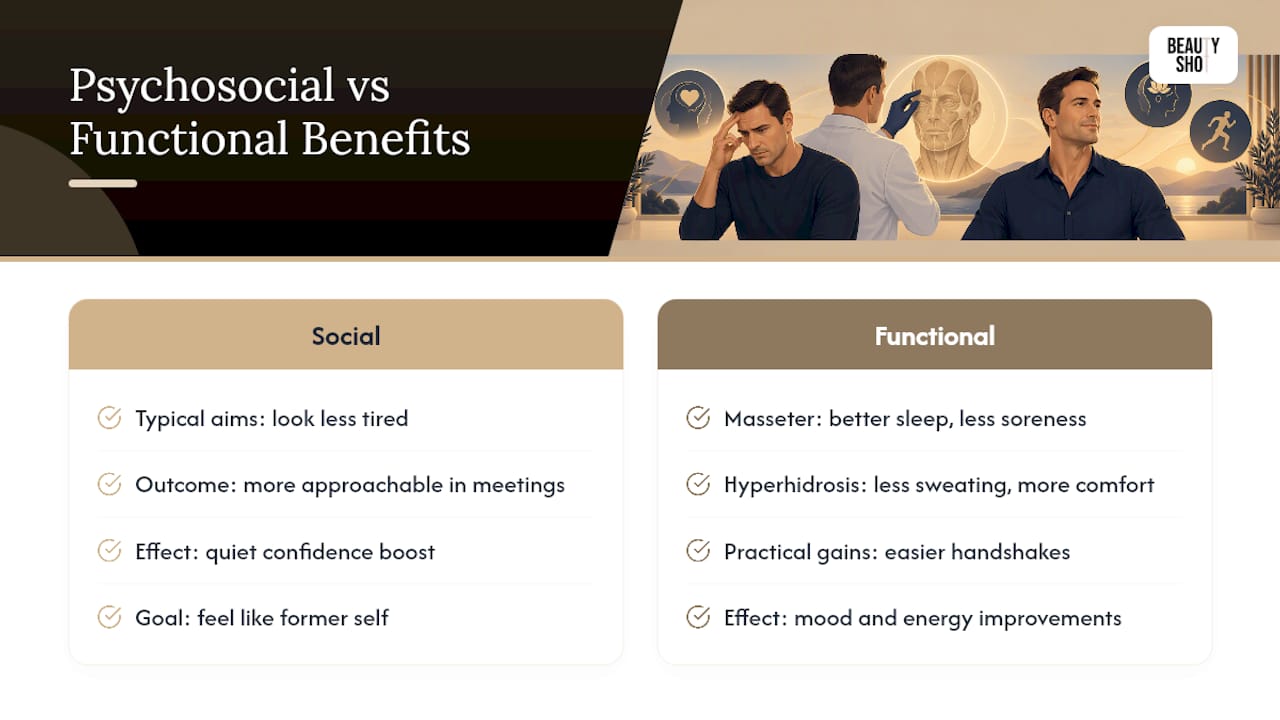
Men rarely book a consultation purely for vanity’s sake, even when they’re hesitant to say so out loud. The motivation is usually more specific: looking less tired in video calls, less perpetually stressed in photos, or simply more like the guy they remember being ten years ago.
That “still like myself” outcome carries weight socially. A softened frown line or a less heavy brow can change how approachable someone reads in a business meeting or a first date, without anyone being able to pinpoint what changed. That subtlety is the point. Men who feel self-conscious about looking tense or older than they feel often report a quiet boost in confidence once the change settles in, not because they look different, but because they look less strained.
There’s also a practical, less-discussed angle: masseter treatment for jaw tension or grinding can improve sleep quality and reduce jaw soreness for some men, which has knock-on effects on mood and energy that have nothing to do with appearance at all. Hyperhidrosis treatment carries a similar quiet-confidence effect, removing a source of daily self-consciousness that has nothing to do with vanity and everything to do with comfort in ordinary situations like shaking hands or wearing a dress shirt.
None of this requires a dramatic transformation. The men who report the most satisfaction tend to be the ones whose results are subtle enough that people notice they seem good, not that they had anything done.
How does Botox compare to other treatments men consider?
Botox sits in a specific lane: it treats dynamic wrinkles caused by muscle movement, not volume loss or skin laxity. Understanding that distinction helps explain why it’s often paired with, rather than positioned against, other non-surgical options.
Dermal fillers address a different problem entirely, restoring volume in the cheeks, temples, or jawline rather than relaxing muscle activity. Men dealing with a flattened midface or a weak jawline profile often get better results from filler in those areas than from Botox, since no amount of muscle relaxation adds back lost volume.
Skincare and topical retinoids can improve skin texture and fine surface lines over months, but they don’t touch the deeper, movement-driven creases Botox targets. They work well as a complement, not a substitute.
Combination approaches are increasingly common, using Botox for upper-face dynamic lines and filler for jawline or cheek structure in the same overall plan. Combining treatments strategically tends to produce more balanced results than relying on either category alone, since they’re solving different structural problems.
The honest takeaway: Botox isn’t competing with these other categories so much as covering one specific job. A good consultation identifies which problem you actually have before recommending a fix.
What misconceptions keep men from trying Botox?
The biggest one is the assumption that Botox automatically means a frozen, artificial look. That result almost always traces back to over-treatment or a generic dosing approach, not to the treatment itself. Done conservatively, with movement preserved where it matters, the outcome should be that people notice you look well rested, not that you look treated at all.
A second misconception is that Botox is inherently a women’s treatment and that seeking it makes a man vain or high-maintenance. The rise of the term “brotox” reflects a cultural shift already underway, not a fringe trend. Men increasingly view it the same way they view teeth whitening or a good haircut: routine upkeep, not a confession of insecurity.
A third misconception involves cost expectations. Some men assume Botox is either prohibitively expensive or, at the other extreme, that any clinic offering a rock-bottom price is a bargain rather than a warning sign about what’s being skipped.
Finally, there’s a quiet assumption that asking questions during a consultation is somehow unnecessary or awkward. It isn’t. A thorough intake process that asks about your medical history and prior treatments is a sign of a responsible provider, not red tape. Men who treat the consultation as a real appointment, rather than a quick errand, tend to end up far happier with the outcome.
How should men plan for Botox over the long term?
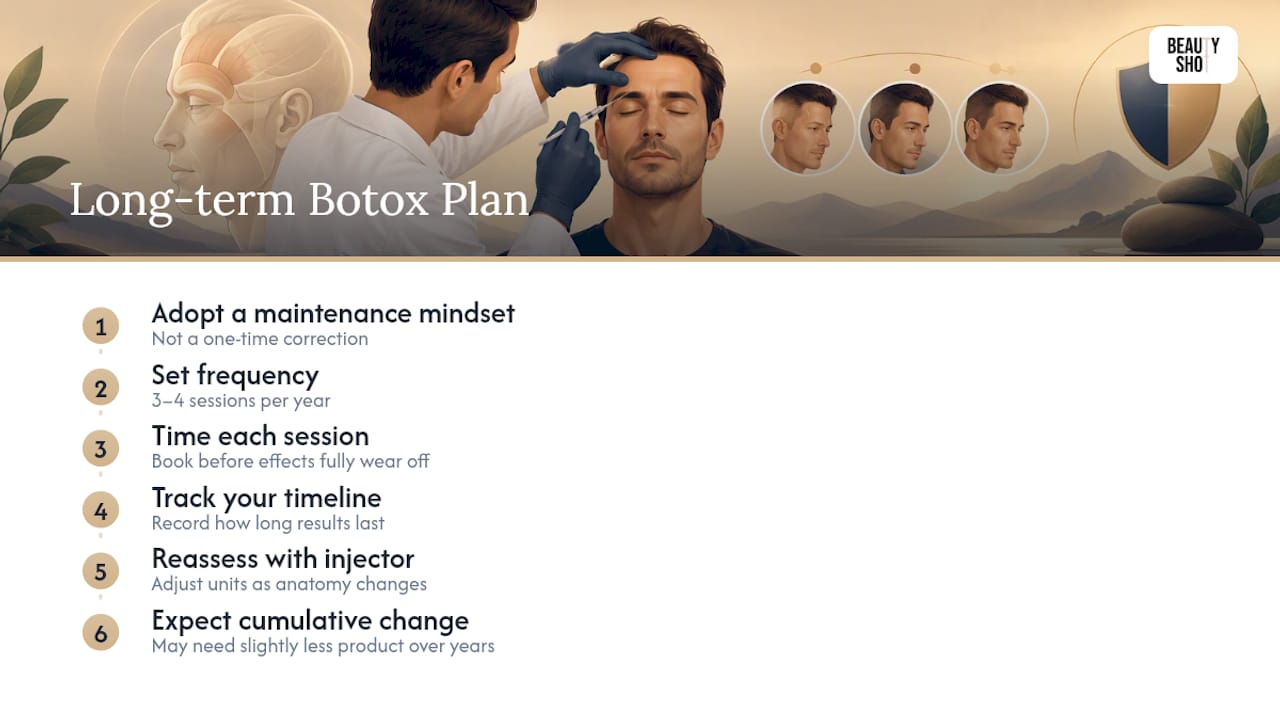
Botox is a maintenance treatment, not a one-time correction, which changes how you should think about long-term planning. Results fade over 3 to 4 months, so the real decision isn’t whether to get treated once, but whether you want to build a recurring routine around it.
Most men who stick with treatment settle into a rhythm of three to four sessions a year, timed around when lines start becoming visible again rather than waiting until they’re fully back. Tracking how long your own results last helps you plan the next booking before, not after, the effect wears off. Understanding your own results timeline makes this much easier to schedule around work and travel.
Anatomy also shifts gradually with age, so a plan that worked well at 35 may need slight adjustment by 45. Brow position, skin thickness, and muscle strength all change over a decade, which is why an injector reassessing you at each visit, rather than repeating the same units automatically, matters more the longer you continue treatment.
There’s also a cumulative effect worth knowing about: some men find that consistent treatment over a few years means muscles gradually need slightly less product to achieve the same softening, since the muscle itself has been trained toward less forceful contraction. This isn’t guaranteed for everyone, but it’s a reasonable long-term expectation to discuss with your injector rather than a promise to bank on.
What results should men realistically expect?
Setting the right expectation before treatment prevents almost every disappointment that comes up afterward. Botox softens; it doesn’t erase deep, long-set static wrinkles that exist even when your face is completely still, and it won’t change bone structure, skin quality, or volume loss.
The first treatment is often the most conservative one, deliberately so. A cautious starting dose lets your injector see how your specific muscles respond before adding more at a follow-up. That means your very first result may look subtler than what you eventually settle into after one or two sessions, and that’s by design, not a sign the treatment underperformed.
Timing your expectations matters too. Full effect takes roughly two weeks, so evaluating results on day three is premature. Judging too early is one of the most common reasons men feel let down by a treatment that was actually working exactly as planned.
Finally, expect variability between men, even for the same treatment area. Muscle strength, skin thickness, and how deeply set a line has become before treatment all affect the final result. A friend’s outcome isn’t a promise of your own, and a good injector will tell you that honestly rather than guaranteeing a specific look.
A male-focused take on Botox that most guides skip
Most Botox content online is written for a female audience and lightly reworded for men, and it shows. The generic advice to “just use more units” for male patients misses the actual point entirely: the issue isn’t quantity, it’s anatomy. A stronger frontalis muscle or denser glabellar complex doesn’t call for a blanket dose increase so much as a different assessment of how that specific face moves.
Where I think the conventional advice falls shortest is in treating brow support as an afterthought. Men lose brow position more easily than women do when the forehead is over-treated, because male brows sit lower and rely more on frontalis activity to stay lifted. That’s a technique issue, not a units issue, and it deserves more attention than most consumer guides give it.
If there’s one thing worth prioritizing above all else, it’s the consultation itself. Ask how your injector assesses your brow at rest and in motion, ask whether they start conservatively, and ask what their reassessment timeline looks like. Men who ask these questions upfront consistently report results that look like a well-rested version of themselves, not an altered one.
— Felix
Ready to book a male-focused Botox consultation?
Treatments for male anatomy require specific assessment rather than a standard chart. Treatments should be tailored based on individual brow position, muscle strength, and goals, rather than relying on a fixed unit count because of gender. That distinction is the difference between a generic result and one that actually looks like you, just less tired.
Whether you’re weighing Botox for forehead lines, exploring masseter treatment for jaw tension, or curious about pairing injectables with dermal fillers for a more balanced result, the starting point is the same conversation. Explore the full range of Botox and Dysport treatments available and book a consultation to get a plan built specifically around your face, not a template.
Sources
- Canada
- Neurotoxin (For Treatment of Wrinkles) – The Canadian Society of Plastic Surgeons
- Neuromodulators in Men
- Health Canada drug product database entry for BOTOX COSMETIC
- Unauthorized injectable health products sold online and seized — Canada recalls
FAQ
Is Botox a good idea for men?
For most healthy adult men, Botox is a reasonable option for softening dynamic lines and, in some cases, easing jaw tension, when a qualified injector assesses your specific anatomy first. It isn’t right for everyone, particularly those with certain neuromuscular conditions or active infections at the treatment site, which is exactly why a proper consultation reviewing your medical history and prior treatments comes before any injection.
What is the average cost of Botox for men?
There’s no reliable flat price to quote, since cost depends on the product used, the treatment area, and whether follow-up care is included. Beauty Shot Medical Clinic doesn’t publish set per-unit pricing online, so the most accurate next step is booking a consultation to get a quote based on your specific treatment plan.
Can I exercise or resume normal activity after Botox?
Yes, most men resume regular daily activity immediately after treatment, though it’s wise to avoid vigorous exercise or lying flat for a few hours to reduce the small risk of product migration. Strenuous workouts are typically fine to resume within a day, but check with your specific injector, since aftercare guidance can vary slightly by clinic and treatment area.
How long does Botox last on a man?
Results typically last 3 to 4 months, with some individual cases extending closer to 6 months depending on the area treated and how your muscles respond. Men with stronger facial muscles sometimes notice the effect fading slightly sooner than average, which is why tracking your own timeline helps with planning the next appointment.