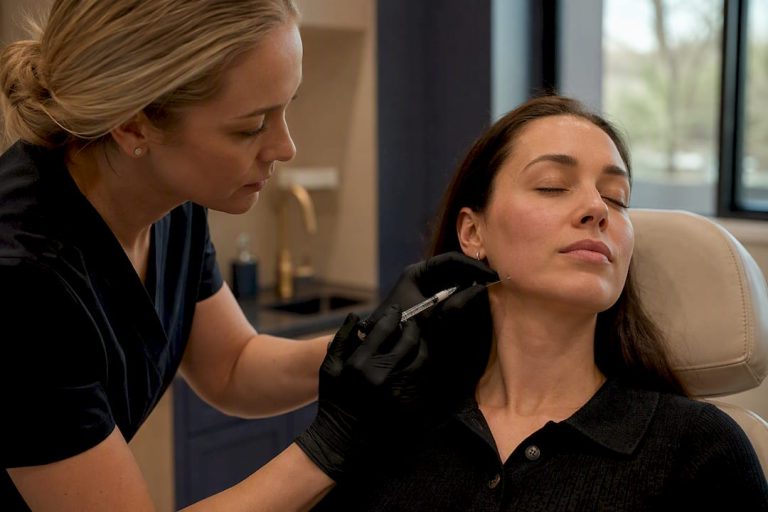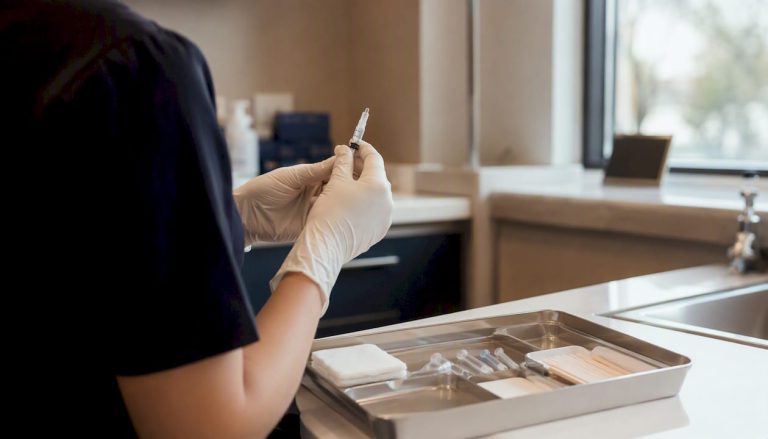

A Botox unit is defined as a measure of biological activity, not a physical quantity of liquid or weight. That distinction matters more than most patients realise. Understanding how Botox units are measured helps you ask better questions, set realistic expectations, and feel confident walking into your appointment. The FDA-approved starting dose for glabellar lines is 20 units, divided across five injection points. That number comes from standardised dosing guidelines, not guesswork. This guide explains exactly how those units are defined, calculated, and applied to your treatment.
How Botox units are measured: potency, not volume
Botox units measure biological activity derived from a proprietary mouse bioassay, not a fixed physical quantity like milligrams or millilitres. Each unit represents a standardised level of potency specific to that brand’s laboratory testing method. This is why two products can look identical in a syringe but carry very different dosing requirements.
A standard Botox vial contains 100 units of freeze-dried powder. That powder has no volume until your injector reconstitutes it with sterile saline. The total units in the vial stay fixed at 100 regardless of how much saline is added. What changes with dilution is the concentration, meaning how many units are packed into each fraction of a millilitre.
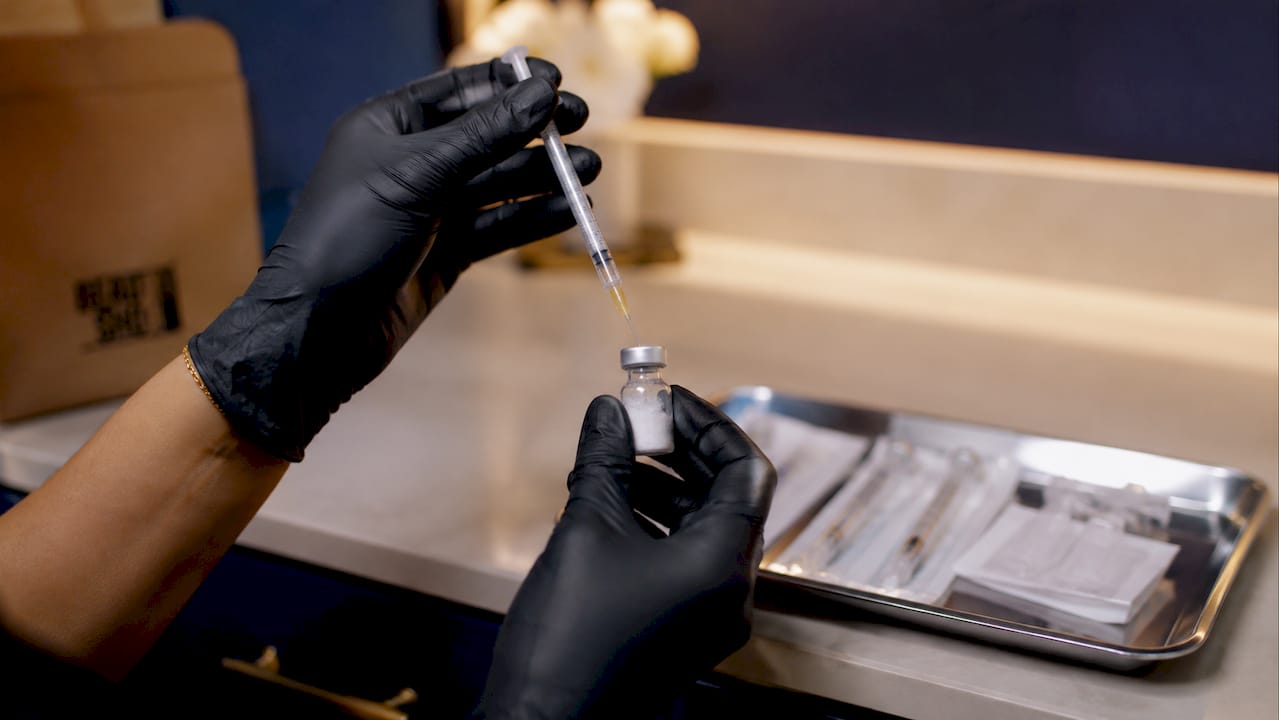
This is the part that surprises most patients. You are not paying for liquid. You are paying for biological activity. The millilitres are simply the delivery vehicle. Knowing this helps you understand why your injector talks in units, not syringes.
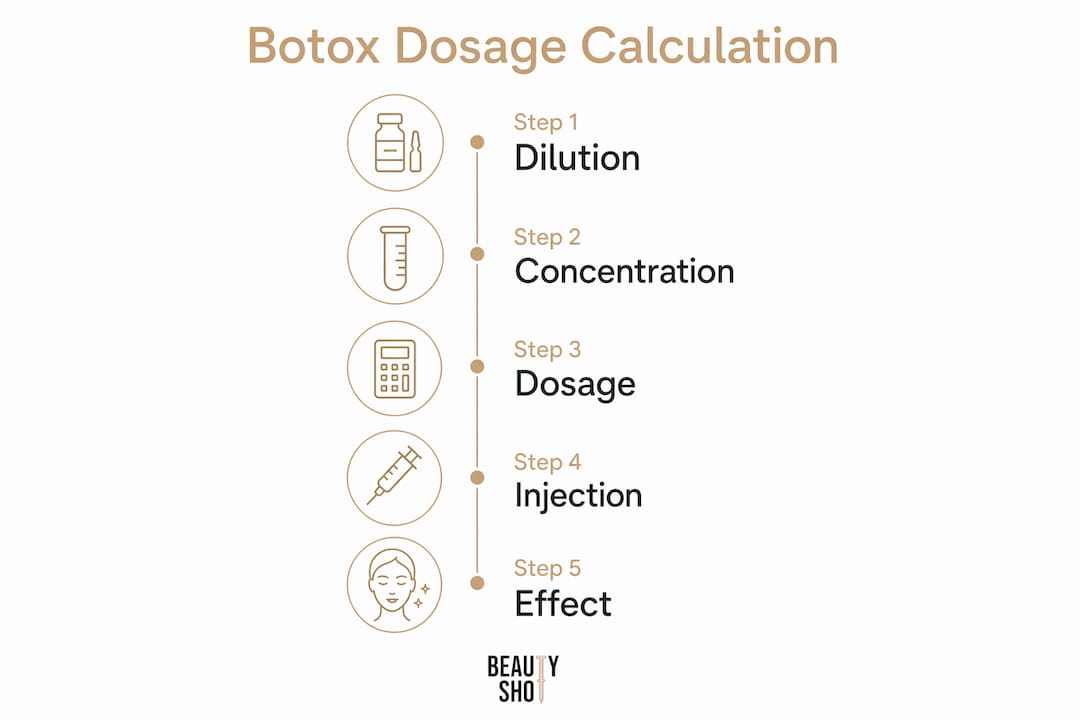
How is Botox dosage calculated from dilution?
Reconstituting Botox with 2.5 mL of saline per 100-unit vial produces a concentration of 4 units per 0.1 mL. That is the most common clinical standard, and it gives injectors a predictable, repeatable way to draw doses.
The table below shows how different dilution volumes affect concentration without changing the total units available.
| Saline added | Total units | Concentration |
|---|---|---|
| 1 mL | 100 units | 10 units per 0.1 mL |
| 2.5 mL | 100 units | 4 units per 0.1 mL |
| 4 mL | 100 units | 2.5 units per 0.1 mL |
| 5 mL | 100 units | 2 units per 0.1 mL |
Higher concentration dilutions carry a greater risk of dosing error because small volume differences translate into large unit differences. A 0.05 mL miscalculation at 10 units per 0.1 mL means 5 units off target. At 4 units per 0.1 mL, the same volume error means only 2 units. Standardised dilution protocols exist precisely to reduce this risk and keep dosing consistent across appointments.
Your injector calculates the units you receive by multiplying the volume drawn by the known concentration. If the vial is reconstituted to 4 units per 0.1 mL and your injector draws 0.5 mL, you receive 20 units. The units are calculated from concentration and volume, not weighed during the procedure.
Pro Tip: Ask your injector what dilution they use. A confident, experienced injector will tell you without hesitation. That transparency is a good sign you are in skilled hands.
Why Botox units are not interchangeable across brands
Each neurotoxin brand uses a proprietary bioassay, which means one unit of Botox does not equal one unit of another brand. The units reflect that brand’s unique potency measurement. Applying a unit-to-unit equivalence between brands is a clinical error.
The most common example is Botox versus Dysport. The conversion ratio is approximately 1:2.5 to 1:3, meaning 20 units of Botox corresponds to roughly 50 units of Dysport for the same treatment area. That is not a difference in strength. It reflects the different bioassay scales each manufacturer uses.
| Brand | Glabellar dose | Conversion to Botox |
|---|---|---|
| Botox | 20 units | 1:1 (reference) |
| Dysport | 50 units | 1 Botox unit ≈ 2.5 Dysport units |
This is why your injector needs to know exactly which product they are using before calculating your dose. Switching brands mid-treatment without adjusting the unit count is a safety risk. At Beautyshotmedicalclinic, each patient’s treatment plan specifies the product and the unit count together, so there is never any ambiguity.
Pro Tip: If you are switching clinics or products, always confirm the brand name and unit count from your previous treatment. That information helps your new injector calculate an equivalent dose safely.
How injectors determine the right dose for you
Botox dosage is not one-size-fits-all. Muscle size, patient age, gender, skin condition, and previous dose response all influence how many units your injector selects. A patient with strong, well-developed forehead muscles will typically need more units than someone with lighter muscle activity in the same area.
Your injector begins by assessing your anatomy through visual observation and palpation, feeling the muscle beneath the skin to gauge its size and tension. This hands-on assessment, combined with your treatment history, shapes the starting dose. For first-time patients, injectors often start conservatively and adjust at a follow-up appointment.
The FDA-approved dose for glabellar lines is 20 units across five injection points, with 4 units per site. That is a clinical starting point, not a ceiling. Experienced injectors adjust based on what they observe in your face, not a fixed formula.
Common treatment areas and their typical unit ranges include:
- Forehead lines: 10–30 units depending on muscle strength and line depth
- Glabella (frown lines): 20–25 units as a standard starting dose
- Crow’s feet: 10–15 units per side
- Brow lift: 2–5 units per side, placed with care to avoid brow drop
- Masseter (jaw slimming): 25–50 units per side based on muscle bulk
- Lip flip: 4–6 units along the upper lip border
- Neck bands (platysma): 25–50 units depending on band prominence
These ranges reflect standard dosing patterns used across treatment areas, but your actual dose is always determined at consultation. A thorough consultation is where the real measurement work happens.
Pro Tip: Do not focus on the volume in the syringe. Focus on the unit count. Two patients can receive the same number of units from very different syringe volumes depending on how the vial was diluted.
What advanced technologies add to dosing accuracy
Experienced injectors have always relied on anatomical knowledge and clinical judgement. Newer guidance technologies now add an objective layer to that process.
Ultrasound, electrical stimulation, and electromyography (EMG) are instrumented guidance modalities that consistently outperform manual needle placement in verifying muscle activity. Ultrasound ranked first, electrical stimulation second, and EMG third in injection precision studies. These tools let injectors visualise muscle boundaries in real time, confirm needle depth, and verify that the target muscle is active before delivering the dose.
3D laser-based imaging can measure wrinkle depth and volume changes with precision errors under 0.5 mm. That level of detail gives injectors an objective baseline to compare before and after treatment, making it easier to refine dosing across sessions.
The benefits of these technologies extend beyond accuracy:
- They reduce the risk of injecting the wrong muscle, which prevents complications like brow drop or asymmetry
- They provide objective documentation of treatment outcomes
- They support more consistent dosing across repeat appointments
- They help newer injectors build precision faster under supervision
Instrumented guidance moves dosing beyond estimation by providing real-time confirmation of muscle activity and needle placement. The result is a more predictable treatment outcome for patients.
Key takeaways
Botox units measure biological potency from a proprietary bioassay, and accurate dosing requires knowing the brand, the dilution, and the patient’s individual anatomy before a single unit is injected.
| Point | Details |
|---|---|
| Units measure potency, not volume | One Botox unit reflects biological activity, not a fixed physical quantity of liquid. |
| Dilution changes concentration, not total units | Adding more saline spreads the same 100 units across a larger volume. |
| Units are brand-specific | Botox and Dysport use different bioassays; 20 Botox units ≠ 20 Dysport units. |
| Dosing is patient-specific | Muscle size, age, and treatment history all shape the final unit count. |
| Guidance tools improve accuracy | Ultrasound and EMG help injectors confirm placement and dose response in real time. |
What I have learned from years of measuring Botox units
Patients often come in focused on the syringe. They watch how much liquid goes in and use that as a proxy for whether they received enough. I understand the instinct. But that focus is misplaced, and I spend part of nearly every consultation explaining why.
The unit count is what matters. The volume in the syringe is a product of how the vial was reconstituted, not a reflection of treatment strength. Two patients can receive identical unit counts from syringes that look completely different in size. Once patients understand that, they stop worrying about the syringe and start asking the right questions: how many units, for which muscles, and why.
The other thing I see regularly is patients who have switched products without realising it. They come in saying their last treatment “wore off faster” or “did not work as well,” and when we dig into it, the unit count was not adjusted for the brand change. That is a real clinical gap, and it is one of the reasons I always document both the product name and the unit count in every treatment record.
What I find most rewarding is watching patients become genuinely informed about their own treatment. When you understand what natural-looking results actually require at the dosing level, you become a better partner in your own care. You know when to ask for a touch-up, when to wait, and when something feels off. That knowledge protects you.
— Felix
Botox dosing at Beautyshotmedicalclinic: what to expect
At Beautyshotmedicalclinic in Woodbridge, Vaughan, every Botox appointment begins with a thorough consultation. Irene Soni, R.N., BScN, reviews your anatomy, treatment history, and goals before recommending a unit count. Nothing is decided by a standard formula. You receive a personalised plan that specifies the product, the units, and the injection sites.
If you are new to injectables or want to understand your options before booking, the injectable cosmetics guide on the Beautyshotmedicalclinic website walks through the key treatments, dosing considerations, and what to expect at each stage. You can also explore the Botox and Dysport treatment page to learn more about how the clinic approaches unit-based dosing for natural, balanced results.
FAQ
What is a Botox unit exactly?
A Botox unit is a measure of biological activity determined by a proprietary laboratory bioassay, not a fixed weight or volume. It reflects the potency of the toxin, not the amount of liquid injected.
How many units does a typical Botox treatment use?
The FDA-approved starting dose for glabellar lines is 20 units across five injection points. Other areas vary widely, from 4–6 units for a lip flip to 25–50 units per side for jaw slimming.
Can I compare units between Botox and Dysport?
No. Botox and Dysport use different bioassays, so their units are not equivalent. The conversion ratio is approximately 1:2.5 to 1:3, meaning 20 Botox units corresponds to roughly 50 Dysport units for the same area.
Does more saline in the vial mean fewer units?
No. Adding more saline lowers the concentration but does not reduce the total units in the vial. A 100-unit vial always contains 100 units regardless of how much saline is used to reconstitute it.
Why does my injector ask about my previous treatments?
Your previous unit count and product name help your injector calculate an equivalent or adjusted dose for your current appointment. Muscle response, treatment history, and brand changes all affect the right starting point for your next session.
Recommended
- How Many Units for Masseter Botox? A Simple Guide (No Guessing) – Beauty Shot | Botox Fillers Woodbridge Vaughan
- Botox treatment areas checklist: your complete guide
- Booking Your First Botox Treatment: A Step-by-Step Guide – Beauty Shot | Botox Fillers Woodbridge Vaughan
- What to Expect: The Botox Procedure from Start to Finish – Beauty Shot | Botox Fillers Woodbridge Vaughan