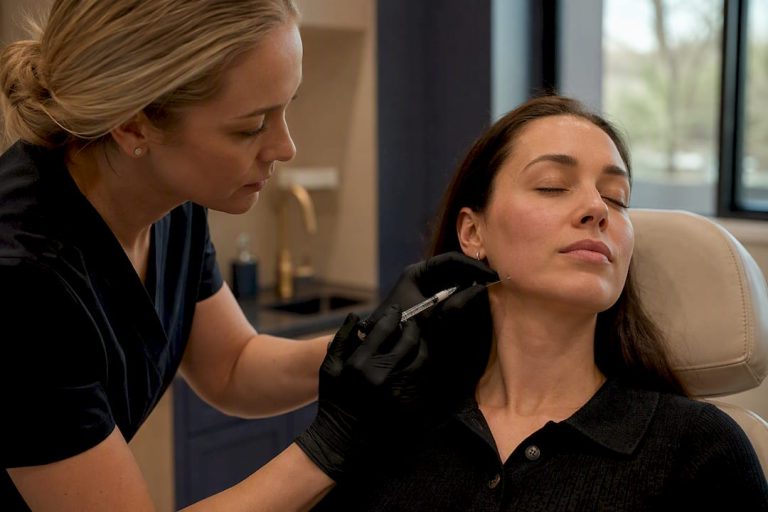
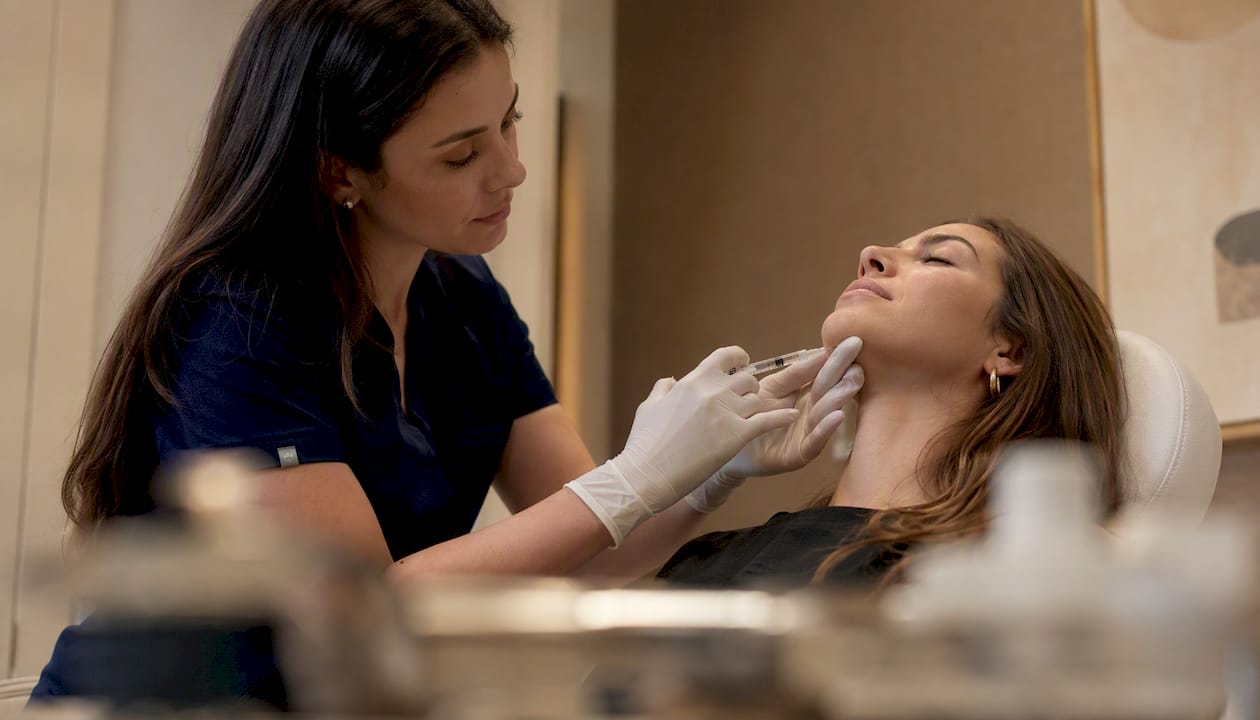
Chin filler can improve and balance the side profile for many adults when it is correctly indicated and placed by an experienced injector. A small amount of hyaluronic acid or calcium hydroxylapatite filler added to the chin apex, mental crease, or prejowl area can increase forward projection, refine the mentolabial angle, and bring the lower third of the face into better proportion with the nose and forehead. The change is often subtle, but on a side profile photograph it can be striking.
Before you book anything, three steps matter most:
- Book a consultation with a qualified injector who can assess your anatomy, take profile photographs, and measure your chin projection against clinical reference points.
- Bring photographs of your profile from multiple angles, including any reference images that reflect your aesthetic goals.
- List your full medical history, including current medications, prior facial procedures, and any history of cold sores, autoimmune conditions, or bleeding disorders.
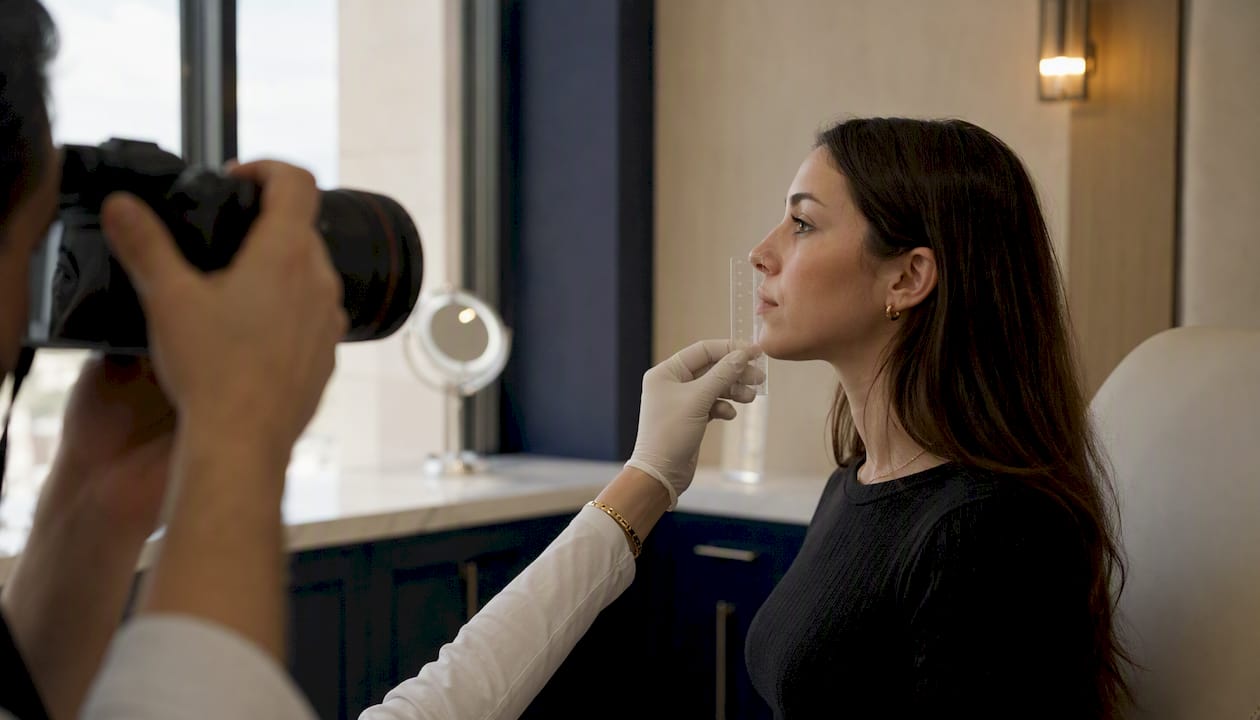
Pro Tip: Ask your injector to take a standardised side-profile photograph before treatment and again at your two-week follow-up. Comparing the two images side by side is the clearest way to see what has actually changed.
Key takeaways
Chin filler is a clinically supported, reversible option for improving facial profile balance in adults with mild to moderate chin retrusion, when performed by a trained injector using appropriate technique and conservative volumes.
| Point | Details |
|---|---|
| HA filler is the first-line choice | Reversible with hyaluronidase; an 18-month study reported 95.0% patient satisfaction and 77.8% chin improvement. |
| Results last 6–18 months for HA | CaHA (Radiesse) lasts longer and stimulates collagen; neither replaces surgery for severe deficiency. |
| Consultation takes longer than the injection | Medical history, measurements, and goal-setting are the most critical part of the process. |
| Vascular occlusion requires immediate response | Blanching or severe pain after injection is an emergency; confirm your clinic has hyaluronidase on-site. |
| Beautyshotmedicalclinic offers measurement-led planning | Irene Soni, R.N., BScN uses Ricketts’ E-line assessment and conservative volumes for natural, personalised results in Woodbridge, Vaughan. |
What are chin fillers and which products are used in Canada?
Chin filler is a category of dermal filler injection sometimes called a liquid genioplasty, a term that distinguishes it from surgical genioplasty (bone repositioning). The goal is to reshape the chin using an injectable material rather than an implant or osteotomy. Two material categories dominate clinical practice in Canada: hyaluronic acid (HA) and calcium hydroxylapatite (CaHA).
Hyaluronic acid (HA) fillers
HA occurs naturally in connective tissue and binds water, which gives it structural stability and a smooth, tissue-like feel. It is the most commonly used soft-tissue filler for chin and jawline work, and its single most important clinical advantage is reversibility: an enzyme called hyaluronidase can dissolve it if the result is unsatisfactory or if a complication arises. Research published in PMC reports that an 18-month open study of an HA filler found at least a one-grade improvement in chin volume in 77.8% of patients and 95.0% patient satisfaction at final follow-up. In clinical practice, noticeable results typically persist for roughly 6–18 months depending on the product, the volume used, and individual metabolism.
Widely used HA brands available in Canada include Juvéderm (Allergan) and Restylane (Galderma). Both product lines offer formulations with varying degrees of cross-linking and lift capacity, and an experienced injector will select the specific product based on the depth of placement and the degree of projection needed.
Calcium hydroxylapatite (CaHA)
CaHA, sold under the brand name Radiesse, is a thicker, more viscous material that also stimulates collagen production over time. It tends to provide firmer lift and is often chosen when more structural support is needed or when a longer duration is desirable. Because it cannot be dissolved with hyaluronidase, it is generally reserved for patients who have already had HA treatment and know their anatomy responds well to chin augmentation.
- HA fillers: reversible, moderate viscosity, 6–18 months typical duration, suitable for first-time patients.
- CaHA (Radiesse): non-reversible, higher viscosity, collagen-stimulating, longer duration, better suited to experienced patients with established anatomy.
Pro Tip: If this is your first chin filler treatment, an HA product is almost always the right starting point. Reversibility is a genuine safety net, not just a marketing claim.
Why the chin shapes your side profile more than you might expect
The face is divided into three roughly equal horizontal thirds: the forehead to the brow, the brow to the base of the nose, and the nose base to the chin. When the lower third is short or the chin sits behind the vertical plane of the lips, the entire profile can look unbalanced, regardless of how well-proportioned the upper two-thirds are. A chin that projects adequately also creates a cleaner separation between the jawline and the neck, which affects how the face reads in photographs and in person.
Clinicians use several reference points to evaluate chin projection. The most widely cited is Ricketts’ E-line: a straight line drawn from the tip of the nose to the tip of the chin. For a balanced Caucasian profile, the upper lip sits approximately 4 mm behind this line and the lower lip approximately 2 mm behind it. A chin that falls significantly short of the E-line suggests retrusion that may respond well to augmentation.
A simple home assessment: Stand in front of a mirror and hold a pencil vertically against the tip of your nose, pointing straight down. If the pencil touches your chin, your projection is roughly balanced. If there is a visible gap between the pencil and your chin, that gap is what filler can address.
A few important caveats apply to any single measurement rule:
- Ricketts’ E-line was developed primarily on Caucasian populations; norms differ across ethnic groups, and a skilled injector will adjust reference points accordingly.
- Bone structure sets the ceiling for what filler can achieve; filler adds soft-tissue volume, not skeletal projection.
- Individual preference matters as much as any measurement. Some patients prefer a softer, less projected chin, and that is a valid aesthetic goal.
How chin filler actually changes your side profile
The mechanics are straightforward. Filler is deposited in specific anatomical zones, and the added volume pushes the overlying soft tissue forward, downward, or both, depending on placement depth and location.
Where volume is added and what it does
- Chin apex (the tip): Increases forward projection and elongates the lower third. This is the most common injection site for profile improvement.
- Mental crease (the horizontal groove above the chin): Softening this crease creates a smoother transition between the lower lip and chin, which reads as a more refined profile.
- Prejowl sulcus (the hollows on either side of the chin): Filling here improves jawline continuity and reduces the appearance of early jowling.
Common aesthetic goals and what to expect
Most patients seeking chin filler for facial profile improvement have one or more of these goals:
- Increase forward projection to bring the chin into better balance with the nose and lips.
- Elongate a short lower third that makes the face appear bottom-heavy or compressed.
- Sharpen the jawline by filling the prejowl area and improving the chin-to-jaw transition.
- Soften a cleft or dimpled chin that creates an uneven surface in photographs.
- Balance the profile after rhinoplasty, where a nose that has been reduced can make a previously adequate chin appear relatively weak.
Liquid genioplasty research confirms that non-surgical chin augmentation using HA and related techniques produces high patient satisfaction and maintains a measurable effect for months, with results commonly well-maintained at the 3–6 month mark and variable persistence beyond that point.
What filler cannot do is equally worth knowing. It will not reposition bone, correct a severe skeletal discrepancy, or tighten loose skin. Patients with significant skin laxity along the jawline may see less definition from filler alone than they expect. For a visual sense of directional changes, the before and after gallery at Beautyshotmedicalclinic shows real patient outcomes from the clinic.
Are you a good candidate for chin filler?
Most adults with mild to moderate chin retrusion, age-related volume loss, or subtle asymmetry are reasonable candidates. Realistic expectations are the single most important factor: filler creates a refined, natural improvement, not a structural transformation.
Good candidate indicators
- Mild to moderate chin retrusion visible on a side-profile photograph.
- Loss of lower-face projection associated with age-related bone resorption or soft-tissue descent.
- Desire to balance the chin with the nose or lips without surgery.
- Willingness to maintain results with periodic touch-ups.
Consultation checklist
A thorough consultation covers more ground than the injection itself and often takes longer. Come prepared with:
- Full medical history, including autoimmune conditions, bleeding disorders, and history of cold sores or facial infections.
- Current medications, particularly anticoagulants (warfarin, aspirin, NSAIDs), isotretinoin (Accutane), and immunosuppressants.
- A list of prior facial procedures, including any previous filler, implants, or surgical work.
- Profile photographs from multiple angles, ideally taken in natural light without makeup.
- Your aesthetic goals stated clearly, including reference images if you have them.
Red flags that may point toward surgery or specialist referral
- Severe horizontal chin deficiency that filler volume cannot adequately correct.
- Significant skin laxity where added volume may worsen jowling rather than improve it.
- History of prior infection or granuloma at the injection site.
- Unrealistic expectations about the degree of change achievable without surgery.
Pro Tip: Read the preparation guide for filler appointments before your consultation. Knowing what to stop (blood thinners, alcohol, certain supplements) in the days before treatment can meaningfully reduce bruising.
What happens during a chin filler appointment, step by step
A well-run chin filler appointment follows a consistent sequence. Knowing what to expect at each stage helps you feel calm and ask the right questions in the moment.
- Consultation review: Your injector reviews your medical history, photographs, and goals. Facial measurements are taken or confirmed, and the treatment plan is discussed, including product choice, estimated volume, and injection sites.
- Informed consent: You review and sign a consent form that outlines the procedure, expected outcomes, risks, and aftercare requirements.
- Facial marking: The injector marks the injection points on your skin using a white pencil or similar tool, often while you are seated upright so gravity reflects your natural anatomy.
- Anaesthesia: A topical numbing cream is applied for 15–20 minutes. Most HA products also contain lidocaine, which further reduces discomfort during injection.
- Injection sequence: Filler is placed in small aliquots at the planned sites. The injector may use a fine needle for precise bolus placement at the chin apex or a blunt cannula for broader distribution in the prejowl area, depending on the technique and anatomy.
- Immediate assessment: You are asked to sit upright and the result is assessed from multiple angles. Minor adjustments may be made at this stage.
- Post-treatment photographs: Standardised photographs are taken for your clinical record and for comparison at follow-up.
Typical volumes and placement by indication
Volume ranges reflect commonly cited clinical practice; your injector will determine the appropriate amount based on your anatomy and goals.
Safety measures during injection
- Aspiration before injection in high-risk areas, combined with slow, low-pressure delivery.
- Small aliquots rather than large boluses to reduce vascular risk.
- Knowledge of the facial vascular anatomy, particularly the mental artery and its branches.
- Immediate availability of hyaluronidase in the clinic for emergency reversal of HA filler.
- A documented emergency protocol, including contact information for a supervising physician.
Pro Tip: Before your appointment, ask your injector directly: “Do you have hyaluronidase on-site, and do you have an emergency protocol for vascular occlusion?” A confident, specific answer is a good sign. Hesitation is a red flag.
How long do results last and can they be reversed?
Results are visible immediately after treatment, though some swelling in the first 24–72 hours can make the chin appear slightly larger than the final outcome. Most patients see the settled result by the end of the second week.
Typical timeline
- Day 0–3: Immediate result visible, with swelling and possible bruising. The chin may feel firm.
- Days 3–14: Swelling resolves, filler integrates with surrounding tissue, and the final shape becomes clearer.
- Weeks 2–4: Final settled result. This is the best time for a follow-up photograph comparison.
- Months 3–6: HA results are typically well-maintained at this stage; a good point to assess whether a touch-up is needed.
- Months 6–18: Gradual, natural metabolism of HA filler. Most patients notice a slow return toward baseline rather than an abrupt change.
Longevity by filler type
A systematic review of HA chin augmentation found high patient satisfaction across included studies and a low rate of severe complications, supporting HA as a reliable option for mild-to-moderate retrusion. HA fillers commonly maintain a noticeable effect for 6–18 months, with variation based on product cross-linking, volume used, and individual metabolism. CaHA (Radiesse) tends to last longer and also stimulates collagen production, which can extend the visible benefit beyond the filler’s own lifespan.
Reversibility
Hyaluronidase dissolves HA filler by breaking down the hyaluronic acid chains. It works quickly, often within 24–48 hours, and is used both for elective reversal (patient dissatisfied with the result) and for emergency management of vascular occlusion. CaHA and other non-HA materials cannot be dissolved enzymatically, which is one reason HA is preferred for first-time patients.
Maintenance planning: Schedule a follow-up at 2 weeks to assess the settled result, and plan a review at 6 months to decide whether a touch-up is appropriate. Keeping a consistent photographic record makes these decisions much easier.
What are the risks and how are serious complications prevented?
Chin filler has a well-established safety profile when performed by a trained injector, but no injectable procedure is without risk. Understanding what is common, what is uncommon, and what is rare helps you make an informed decision.
Common, expected effects (usually resolve within days)
- Swelling and firmness at the injection site.
- Bruising, particularly if small vessels are nicked during injection.
- Tenderness or mild discomfort for 24–72 hours.
- Temporary asymmetry as swelling resolves unevenly.
Less common complications
- Delayed nodules or lumps, which may form weeks to months after treatment and often respond to massage or hyaluronidase.
- Infection, which presents as increasing redness, warmth, and pain beyond the first 48 hours and requires prompt medical attention.
- Granuloma formation, a chronic inflammatory reaction that is uncommon but may require specialist management.
Rare but serious: vascular occlusion
The most serious complication of any facial filler is accidental injection into or compression of a blood vessel. In the chin area, the mental artery and its branches are the primary concern. Vascular occlusion presents as blanching (white discolouration) of the skin, followed by a dusky or mottled appearance. Without prompt treatment, it can progress to tissue necrosis. This is why immediate access to hyaluronidase and a clear emergency protocol are non-negotiable requirements for any clinic offering HA filler.
Anatomy-based prevention strategies
- Mapping vascular landmarks before injection and adjusting technique accordingly.
- Using a blunt cannula in areas where vessel proximity is a concern, as it is less likely to penetrate vessel walls than a sharp needle.
- Injecting in small aliquots at low pressure.
- Aspirating before injecting in high-risk anatomical zones.
- Maintaining conservative volumes, particularly on first treatment.
Signs that require urgent attention after treatment
- Sudden, severe pain during or immediately after injection.
- White or grey discolouration of the skin that does not resolve within seconds.
- Vision changes, including blurring or loss of vision in one eye.
- Increasing redness, swelling, or warmth after 48 hours (possible infection).
Pro Tip: Save your clinic’s after-hours contact number in your phone before you leave your appointment. If you notice blanching or severe pain in the hours after treatment, call immediately rather than waiting to see if it resolves.
When is surgery a better option than filler?
Filler is a temporary, adjustable, lower-downtime option for mild to moderate chin concerns. Surgery offers permanent structural correction for more significant deficiencies. Neither is universally better; the right choice depends on the degree of change needed, the patient’s age and skin quality, and their tolerance for downtime and permanence.
Clinical indicators that favour surgery
- Severe horizontal chin deficiency where the required volume of filler would exceed what soft tissue can safely accommodate.
- Major skeletal asymmetry that requires bone repositioning rather than soft-tissue augmentation.
- A desire for permanent correction without the commitment to periodic maintenance.
- Significant skin laxity where added filler volume may not produce the desired definition.
Decision guidance
- Mild retrusion, good skin quality, open to maintenance: Non-surgical filler is a reasonable first approach.
- Moderate retrusion, realistic about temporary results: Filler can produce meaningful improvement; discuss volume expectations carefully.
- Severe retrusion or major asymmetry: Surgical consultation (chin implant or genioplasty) is the more appropriate route.
- Younger patient with good bone structure, wants subtle refinement: Filler is well-suited.
- Patient with prior filler complications or unrealistic expectations: Careful screening and possibly surgical referral.
Non-surgical vs. surgical chin augmentation
| Feature | Non-surgical (filler) | Surgical (implant or genioplasty) |
|---|---|---|
| Duration of results | Temporary (6–18+ months) | Permanent |
| Degree of structural change | Mild to moderate | Moderate to severe |
| Downtime | Minimal (1–3 days) | 1–2 weeks or more |
| Reversibility | Yes (HA with hyaluronidase) | No |
| Anaesthesia | Topical / local | General or sedation |
| Ongoing maintenance | Required | Not required |
For patients exploring non-surgical approaches to the lower face more broadly, jawline filler techniques can complement chin augmentation by improving the angle and continuity of the jaw from chin to ear.
Aftercare, recovery timeline, and cost in Canada
Recovery from chin filler is minimal compared to surgery, but the first 48 hours do require some care to protect the result and reduce side effects.
Aftercare checklist
- Apply a cold pack (wrapped in a cloth, never directly on skin) for 10–15 minutes at a time during the first 24 hours to reduce swelling.
- Sleep with your head slightly elevated for the first night.
- Avoid strenuous exercise, alcohol, and heat exposure (saunas, hot yoga) for 24–48 hours.
- Do not massage or apply pressure to the treated area for at least one week unless instructed by your injector.
- Avoid dental procedures for 2–4 weeks after treatment, as the pressure and positioning involved can displace filler.
- Stay well-hydrated; HA fillers bind water and hydration supports the settling process.
Recovery timeline
- Hours 0–48: Swelling, firmness, and possible bruising are normal. The chin may appear slightly larger than the intended final result.
- Days 3–7: Most bruising fades; swelling reduces significantly.
- Weeks 1–2: Filler integrates and the final shape becomes visible.
- Weeks 2–4: Full settling complete; this is the right time for a follow-up assessment.
Cost considerations in Canada
Chin filler pricing in Canada varies based on the injector’s experience and credentials, the product brand and formulation used, the volume required, and the clinic’s location. As a general guide, treatment at a medically supervised clinic in the Greater Toronto Area tends to reflect the cost of the product itself plus the injector’s professional fee. Cosmetic injectables are not covered by provincial health insurance plans and are paid out-of-pocket. Request a personalised quote at your consultation, as the volume needed varies considerably from patient to patient.
For a broader look at non-surgical options for the chin and submental area, Evolved Dentistry Dallas offers a useful overview of non-surgical approaches to the chin and submental region, including context on how different treatment categories compare.
How clinicians plan chin filler: measurements, imaging, and evidence
The difference between a natural-looking result and an overdone one often comes down to what happens before the first injection. Measurement-based planning is what separates a clinical approach from a purely aesthetic one.
Ricketts’ E-line and related measurements
Ricketts’ E-line is drawn from the nasal tip to the chin tip on a lateral (side) photograph. For a balanced Caucasian profile, the upper lip sits approximately 4 mm behind this line and the lower lip approximately 2 mm behind it. A chin that falls well short of the E-line suggests retrusion; one that projects beyond it may not benefit from augmentation. The mentocervical angle (the angle between the chin and the neck) is a secondary reference point: a sharper, more defined angle generally reads as more youthful and defined.
Common clinical measurements used in chin planning
| Measurement | Reference standard | Clinical use |
|---|---|---|
| Ricketts’ E-line | Upper lip 4 mm behind, lower lip 2 mm behind (Caucasian norm) | Assess chin projection relative to lips and nose |
| Mentocervical angle | considered an aesthetic angle | Evaluate chin-to-neck definition |
| Lower facial third | Should approximate upper and middle thirds | Assess vertical proportion |
| Chin-to-lip distance | Varies by individual; assessed relative to philtrum | Guide vertical placement of filler |
These are clinical reference points, not absolute rules. Ethnic background, individual anatomy, and patient preference all modify the target.
What the evidence says
A systematic review of nonsurgical HA chin augmentation found the technique effective for correcting chin retrusion with high patient satisfaction and a low rate of severe complications across included studies. Liquid genioplasty research further supports that HA-based approaches maintain a measurable effect for months, with results commonly well-preserved at the 3–6 month mark.
Pro Tip: Ask your injector to show you the E-line measurement on your own profile photograph during the consultation. Seeing the gap between your chin and the reference line makes the treatment rationale concrete and helps you agree on a realistic volume target together.
A nurse injector’s perspective on subtle chin augmentation
When I assess a patient for chin filler, the first thing I do is look at the whole face, not just the chin. A chin that appears weak in isolation often looks perfectly appropriate once I consider the nose, the lips, and the overall lower-face structure. My goal is never to create a chin that draws attention to itself. It is to create a profile that looks balanced and natural, so that when someone sees you, they notice how good you look, not that you have had something done.
At Beautyshotmedicalclinic, every chin filler consultation begins with standardised photographs and a measurement review before we discuss any product or volume. I use Ricketts’ E-line and the mentocervical angle as starting points, then adjust based on the patient’s ethnicity, age, skin quality, and personal goals. Conservative volumes are the default. It is always easier to add a little more at a follow-up than to manage an overcorrection. Safety protocols, including on-site hyaluronidase and a documented emergency plan, are part of every appointment, not an afterthought.
Chin filler at Beautyshotmedicalclinic: what to expect
Beautyshotmedicalclinic, located in Woodbridge, Vaughan, is run by Irene Soni, R.N., BScN, an advanced cosmetic nurse injector with over nine years of experience and a background in Medical/ICU nursing at Sunnybrook Hospital. Her training includes MD Codes, Allergan techniques, Teoxane Academy, Clarion Medical, and advanced programmes with Dr. Mauricio and Dr. Martins Training Center Canada.
When you book a chin filler consultation at Beautyshotmedicalclinic, you receive a personalised assessment that includes profile photography, facial measurements, a review of your medical history, and a clear explanation of the product, volume, and technique planned for your anatomy. There are no cookie-cutter treatment plans here. Every patient leaves with a result that looks like a better version of themselves, not a different person.
For patients who want to understand the full range of injectable options before booking, the dermal fillers service page covers what to expect from treatment at the clinic. You can also read the nurse injector’s guide to subtle injectables for a broader sense of the clinic’s treatment philosophy. When you are ready, book your consultation directly through the clinic to take the first step toward a more balanced profile.
Sources
The following resources were used in preparing this article. Clinical reviews and peer-reviewed papers provide the strongest evidence base; patient-facing clinic resources offer practical context.
- Using injectable fillers for chin and jawline rejuvenation – PMC
- The Liquid Genioplasty: Different Techniques Compared | Aesthetic Plastic Surgery | Springer Nature Link
- How to balance your looks with a chin filler | Galderma Aesthetics
Clinical literature provides the strongest evidence for safety and efficacy claims. Clinic-facing resources are useful for understanding treatment context and patient experience, but always discuss your individual situation with a qualified injector rather than relying on general guides alone.
This article is general information, not a substitute for advice from a qualified doctor. Consult a qualified healthcare professional about your own circumstances before acting on anything here.
FAQ
Does chin filler actually improve the side profile?
Yes, for adults with mild to moderate chin retrusion, filler placed at the chin apex can meaningfully increase forward projection and improve the balance between the chin, lips, and nose on a side-profile view. Research on liquid genioplasty confirms a measurable, sustained effect for months following treatment.
What are the downsides of chin filler?
Results are temporary and require maintenance every 6–18 months for HA products; rare but serious risks include vascular occlusion, infection, and delayed nodule formation. Filler cannot correct severe skeletal deficiency or significant skin laxity, and overcorrection is possible if conservative volumes are not used.
How long does chin filler last?
HA chin fillers typically maintain a noticeable result for 6–18 months depending on the product, volume, and individual metabolism; an 18-month open study reported results persisting to final follow-up in the majority of patients. CaHA (Radiesse) generally lasts longer and also stimulates collagen, extending the visible benefit.
Does chin filler make you look better overall?
When correctly indicated and conservatively placed, chin filler tends to improve overall facial harmony by bringing the lower third into better proportion with the rest of the face. The effect is most noticeable on a side profile, but it can also improve the appearance of the jawline and neck definition from the front.
How do I choose a qualified chin filler injector in Canada?
Look for a Registered Nurse, nurse practitioner, or physician with specific training in facial anatomy and injectable techniques, not just general aesthetic training. Confirm the clinic has hyaluronidase on-site, ask to see before-and-after photographs of chin cases specifically, and verify that a comprehensive consultation is part of the process. Beautyshotmedicalclinic in Woodbridge, Vaughan offers chin filler consultations with Irene Soni, R.N., BScN, whose credentials include advanced training in MD Codes, Allergan techniques, and multiple specialist programmes.
Recommended
- How filler restores facial harmony: a 2026 guide
- Choosing injectables for your face shape: a complete guide
- How Do Jawline Fillers Create a More Defined and Chiseled Appearance? – Beauty Shot | Botox Fillers Woodbridge Vaughan
- Are jaw fillers the secret to a perfectly sculpted jawline? – Beauty Shot | Botox Fillers Woodbridge Vaughan