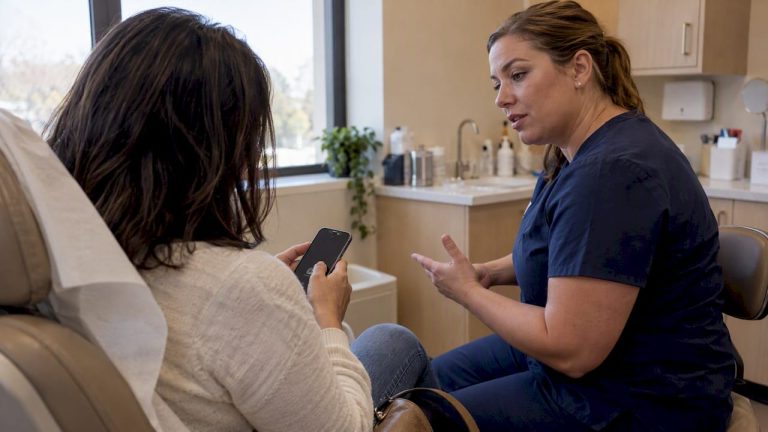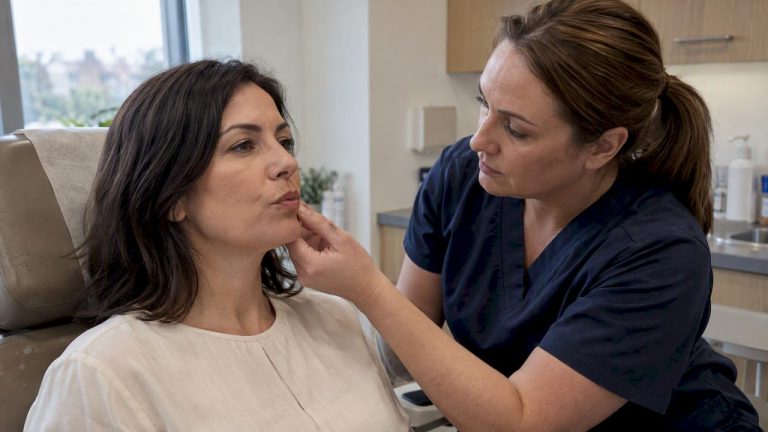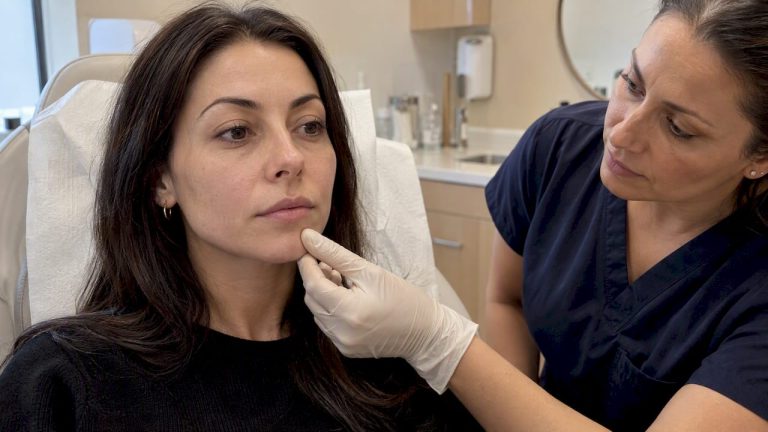

For most people, the right answer is no: do not massage your filler unless your nurse injector has told you to, shown you how, and given you a time frame. Early pressing can move product away from where it was placed, and the one situation where massage is urgent, a blocked blood vessel, is a job for a clinician, not for your fingertips. This guide covers lips, cheeks and the rest of the face: what to do in the first days, what a lump means, and when to call us.
TL;DR
- Do not massage, press or “smooth” your filler for at least 24 to 48 hours, and after that only if your injector has instructed you to. Canada.ca is the starting point for general guidance on cosmetic injections.
- Mild swelling, tenderness and small bumps in the first week are common and usually settle on their own. Waiting is usually the treatment.
- If a lump is still there after the swelling has gone, or it is firm or painful, book a review instead of working on it at home.
- Severe or one-sided pain, skin turning pale, white, grey or mottled: call your clinic immediately. Never try to massage these signs away.
- Guided massage does exist. It is shown to you by your injector, for a specific spot, for a limited time.
Why the answer is usually “leave it alone”
Filler is placed deliberately. Your injector chooses the depth, the plane and the amount for your anatomy, whether that is a lip border, a cheek, a chin or the under-eye hollow. In the first hours the product is still settling into the tissue, and the area is swollen and tender, so it is hard to tell what you are feeling with your fingers.
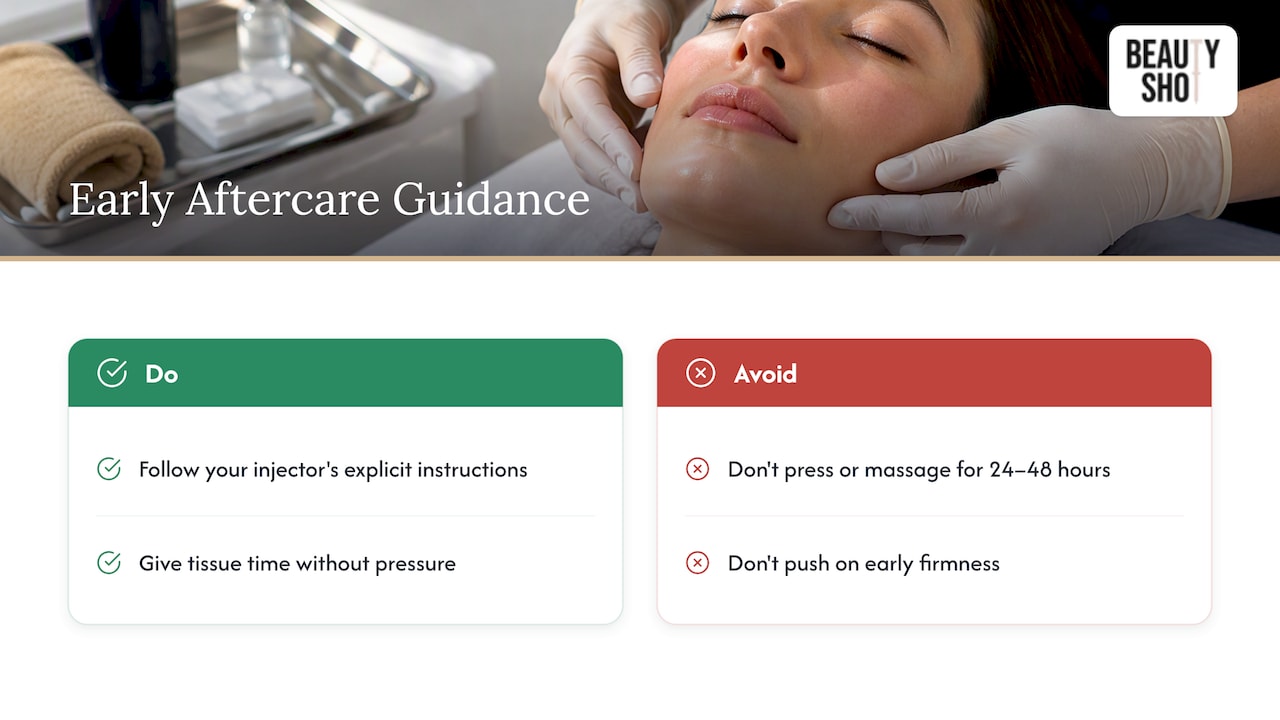
Standard post-procedure guidance in Canada is to avoid massaging or pressing on the treated area for at least 24 to 48 hours unless your nurse injector explicitly tells you otherwise. Touching the site early risks displacing the filler from where it was intended, which can mean asymmetry or swelling that lingers longer than it should. Health Canada’s page on cosmetic injections also stresses that anyone considering an injectable procedure should see a medical professional with experience in these treatments and understand the risks and benefits beforehand.
Hyaluronic acid, the base of most fillers, is a molecule that attracts and holds water. If you want a plain-language overview, there is a good explainer on hyaluronic acid and how it is used. That water-holding quality is part of why a treated area looks fuller and a little puffy at first, and why it needs time rather than pressure.
There is also a practical reason. Many patients massage because they feel something firm and assume it is a problem. In the first days, firmness is more often swelling and product that has not yet integrated with the tissue. Pushing on it does not speed that up. It irritates tissue that is already inflamed.
What the first two weeks usually look like
Every face heals differently, and I will not promise you a schedule. But the general pattern is useful, because it tells you what you can ignore and what you cannot.
| Time after treatment | What is common | What to do |
|---|---|---|
| First 24 to 48 hours | Swelling, tenderness, possible bruising, a slightly uneven feel | Do not massage or press. Keep your hands off the area. |
| Days 3 to 7 | Swelling easing, small bumps or firmness you can feel more than see | Wait. Note anything that is getting worse rather than better. |
| Around two weeks | Results settling and integrating | Attend your follow-up so your injector can assess and adjust if needed. |
The research we work from notes that most filler swelling typically resolves within 48 to 72 hours, with final integration and results settling over about two weeks. That is why the two-week mark matters: it is the point where your injector can judge the result fairly, not the point where you should start adjusting it yourself. A Canadian review of soft tissue filler therapy and informed consent describes follow-up and open communication with your injector as part of proper aftercare.
If you are specifically healing from lips, our guides on what to expect one week after lip fillers and the step-by-step lip filler aftercare plan walk through the days in more detail.
Massaging lip filler: the question we hear most
Lips are the area people most want to touch. They are sensitive, you feel every change, and you see them in the mirror all day. That makes it tempting to press, roll or “even out” a bump.
Here is what we tell patients:
- The first 24 to 48 hours: no massage, no pressing, no pinching, no checking by rolling the lip between your fingers.
- Day to day after that: keep touching to a minimum. Cleaning your face and applying a lip balm gently is fine. Kneading is not.
- If you feel a lump: do not work on it. Take a clear photo in good light, note when you first noticed it, and wait through the first one to two weeks unless it is painful or the colour changes.
- If we ask you to massage: we will show you where to press, how firmly, and for how long. Follow that exactly, and stop if it hurts.
Our separate page, Should you massage your lips after fillers? Do’s and don’ts, goes deeper on lips alone. If a bump is what brought you here, read lip filler lumps and why waiting one to two weeks usually helps as well.
A note on lip flip with Botox or Dysport: this is a different treatment. It relaxes a muscle rather than adding volume, so there is no filler to move. Even so, we ask you to avoid pressing on the area early on, and your injector will give you instructions specific to your treatment.
Cheeks, chin, jawline, temples and under the eye
The same principle applies across the face, with a few area-specific points.
Cheeks, temples and jawline. These areas often involve larger structural placement. Pressing, resting your face on your hand, or sleeping hard on that side in the first days can put pressure on product that is still settling. Sleep on your back, with your head slightly raised, if you can.
Chin and nasolabial folds or marionette lines. These move constantly when you talk and eat. You do not need to freeze your face, but avoid rubbing, and avoid facials or devices that press on the area until your injector clears you.
Under-eye hollows. The skin here is thin and any swelling or unevenness is more noticeable. Do not rub or massage the area, even if it feels puffy. If you see a persistent bluish tone or lumpiness after the first couple of weeks, that is a reason to call us rather than to experiment.
If you are planning your first treatment, our guide to first filler treatment expectations and the page on preparing your skin before your first filler session will help you know what comes next.
Lumps and bumps: normal, or a reason to call?
Not all lumps are equal. This is the part of aftercare patients most want clarity on, so here is how we think about it.
Usually part of normal healing:
- Slight firmness or a tiny bump during the first week.
- Lumpiness that is soft, not painful, and gradually becoming less noticeable.
- Mild asymmetry while one side is more swollen than the other.
Worth a professional look:
- A firm or painful nodule that persists after the initial swelling has faded.
- A lump that appears weeks later, long after the area had settled.
- Redness, warmth or tenderness that is increasing rather than decreasing.
- A lump that is getting bigger.
The Canadian informed-consent review linked above makes the same distinction: persistent or late-appearing firm or painful nodules need evaluation by a professional. That evaluation is where we decide on the right approach. Sometimes the answer is to wait. Sometimes it is a guided massage technique for a specific lump. And sometimes, for hyaluronic acid fillers, it is dissolving a small amount of product with hyaluronidase. What we will not do is guess, and we would rather you did not guess at home either.
When a clinician does use massage
There is a legitimate role for massage in aftercare, and it is worth understanding why it is not something to try yourself.
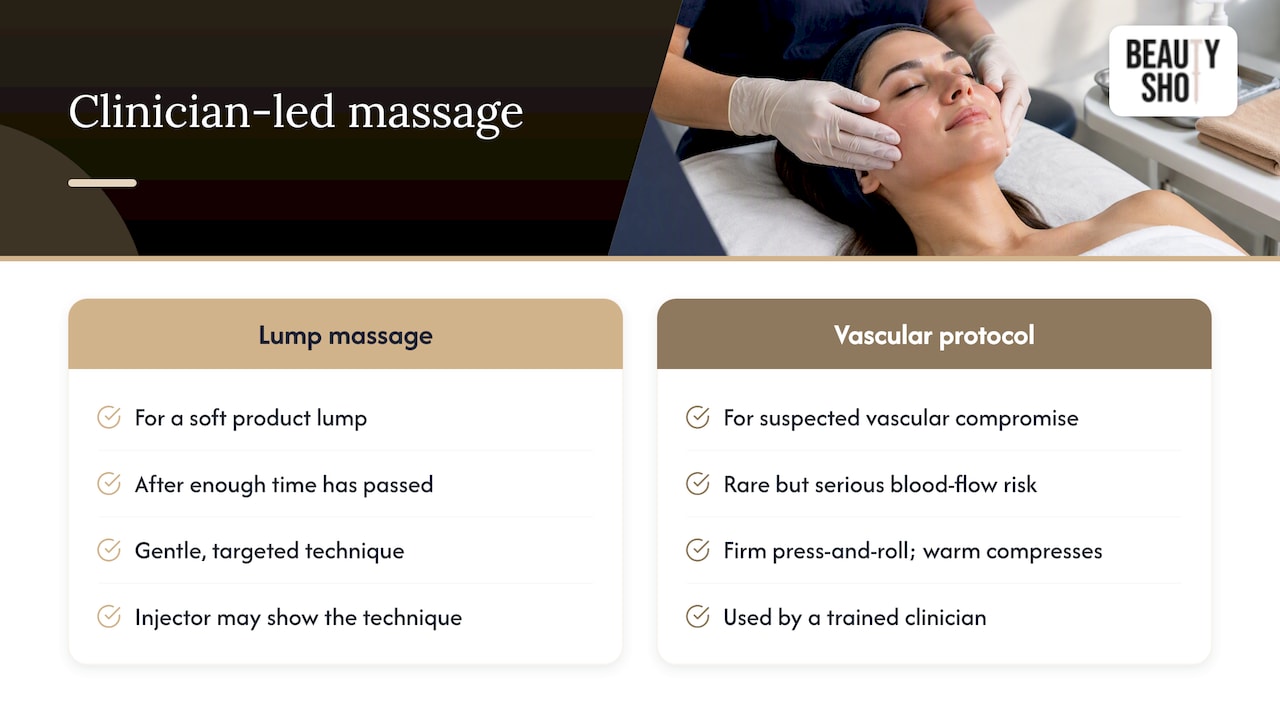
Guided massage for a lump. Occasionally, when a lump is soft enough to be product rather than inflammation, and enough time has passed, your injector may show you a gentle technique. It is specific: one area, light pressure, a set number of days. It is not a general instruction to rub your face.
Emergency massage for vascular compromise. This is a different thing entirely. Vascular occlusion is rare but serious: filler blocks or compresses a blood vessel and reduces blood flow to the skin. In that situation a trained clinician may use a firm press-and-roll massage along with warm compresses, to encourage the vessel to open and move the material. The published literature on vascular compromise from soft tissue augmentation covers these approaches, and a review on managing vascular occlusion after cosmetic injections describes treatment in more detail. This is a medical protocol. It depends on a clinician who can recognise what is happening, watch how the tissue responds, and treat with hyaluronidase when appropriate.
It is not a beauty technique, and it is not something to do at home on the strength of an internet video.
Warning signs: call right away
This is the part of the article to remember if you remember nothing else.
Contact your clinic immediately if you notice any of the following after treatment:
- Severe pain, or pain that is on one side and getting worse.
- Skin that turns pale, white or greyish in or around the treated area.
- Dusky, bluish or mottled, net-like discolouration.
- Any change in vision, or pain around the eye, after treatment near the face’s upper areas. Go to emergency care.
In the medical literature, the first sign of vascular damage after filler is often painless blanching, which can be subtle and easy to miss. Over the next couple of days it may progress to a painful, purplish, net-like patch, as described in the vascular compromise review. Signs can appear straight away or evolve over the first few hours, and some changes take a day or two to show. So check your skin in a mirror, in good light, the evening of your treatment and again the next morning.
Do not wait to see if it improves, and do not try to massage it away. If you cannot reach your clinic and the symptoms are severe, go to the nearest emergency department and tell them you had filler.
Choosing an injector who is prepared for complications
Complications are uncommon, but they are time-sensitive. That is why the practitioner matters as much as the product. Before you book anywhere, ask:
- Who will actually perform the injection, and what is their licence and training?
- Do you have a plan for complications, and immediate access to hyaluronidase?
- What aftercare instructions will I receive in writing?
- Will there be a follow-up, and how do I reach you if something looks wrong?
This lines up with the guidance on cosmetic injections from Health Canada to see an experienced medical professional. Our guide to cosmetic nurse versus doctor injectables explains what to look at beyond the title, and our page on whether dermal fillers are safe and what side effects to expect covers risks in plain terms.
Our perspective on massage and aftercare
We are an injectables clinic in Woodbridge, and every injectable treatment here is performed by an advanced cosmetic Registered Nurse with more than nine years of injection experience, who also has a hospital Medical/ICU nursing background. That shapes how we think about aftercare: we want you to feel informed and calm, not anxious, and we want you to know exactly when to wait and when to call.
Our view on massage is simple. Filler placement is a plan, and your healing is part of that plan. Most of the time, the kindest thing you can do for your result is to leave it alone, protect it from pressure, and let it settle. We would much rather see you at a follow-up and make a small, precise adjustment than see a result that has been pushed around by well-meaning fingers.
We also believe in telling you what we see. If something looks like normal swelling, we will say so. If a lump needs attention, we will say that too, and explain what we recommend and why. Our goal is a refreshed, balanced look that still looks like you, and good aftercare is how you get there. If you ever feel unsure, a short message or call is always better than waiting and worrying.
— Felix
Book your filler or follow-up in Woodbridge
If you are considering filler, or you have had treatment elsewhere and want a second opinion on how it has settled, we are happy to see you. We offer dermal fillers for cheeks, temples, chin, jawline, lips, nasolabial folds, marionette lines and under-eye hollows, along with Botox and Dysport. You can see the full range on our services page. Treatment is personalised, and you leave with clear written aftercare so you know what to do and what to avoid.
Frequently asked questions
Should I massage my fillers?
Not unless your injector has told you to. Massaging too early can move the product and cause swelling or asymmetry. If your injector wants you to massage, they will show you the technique, the area and the duration.
How do you massage your lips after fillers?
Only follow a method your own injector has shown you, since it depends on where the product sits and how long it has been. In general, it means very light pressure on one specific spot for a short period, and never in the first 24 to 48 hours. If a lump is bothering you, book a review rather than trying techniques from videos.
What if I already massaged my filler?
Stop, and do not keep checking. Many people press out of worry and nothing goes wrong, but let your injector know, particularly if you notice new swelling, unevenness or pain. Mention it at your follow-up or sooner if anything looks different.
Can I massage a lump away after a week?
Do not decide this on your own. A small bump in the first week is often normal swelling that settles with time. If it is still there after the swelling has gone, or it is firm or painful, have it assessed, because the right fix depends on what is causing it.
Is massage ever an emergency treatment?
Yes, in one situation: suspected vascular occlusion, where a clinician may use a specific press-and-roll massage with warm compresses and may treat with hyaluronidase. It is rare and urgent. If you see severe or one-sided pain, or pale, white or mottled skin, call your clinic right away.
Sources
- Cosmetic injections, Health Canada
- Vascular Compromise from Soft Tissue Augmentation, PMC
- Soft Tissue Filler Therapy and Informed Consent: A Canadian Review, PMC
- Management of a Vascular Occlusion Associated with Cosmetic Injections, PMC
- Hyaluronic acid: science, benefits and skincare uses