
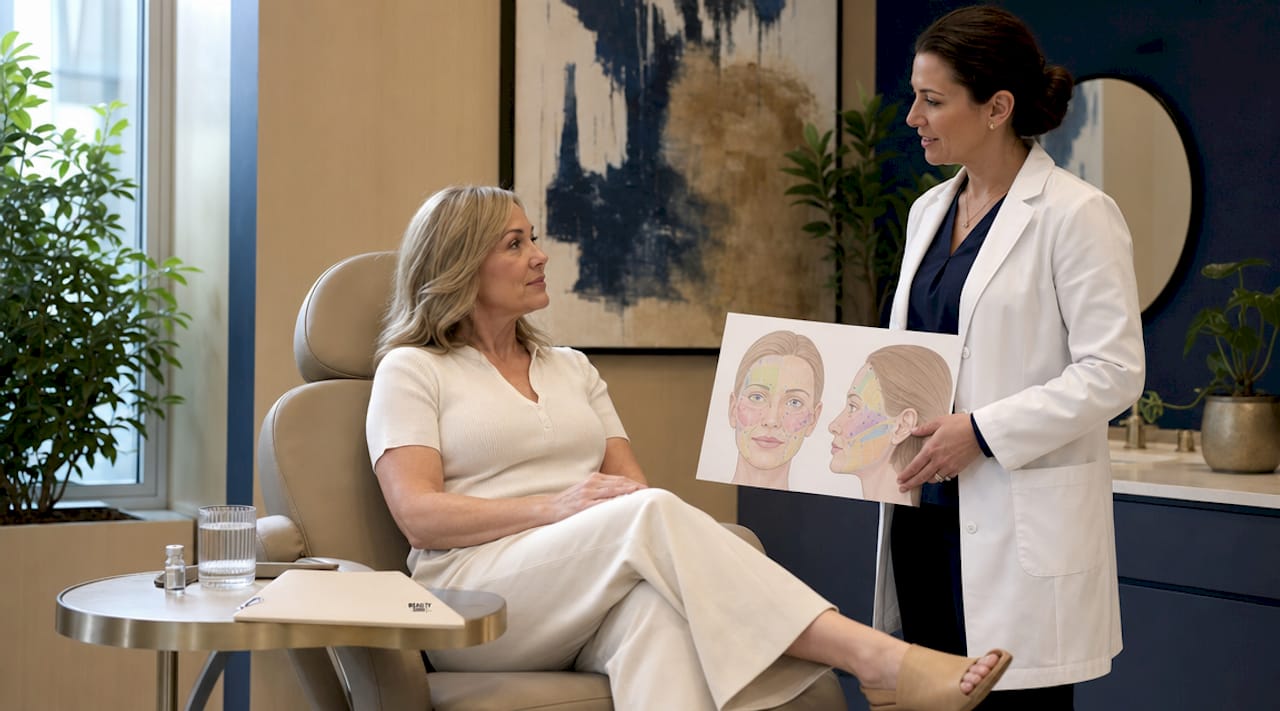
Botox and dermal fillers are both injectable cosmetic treatments, but they address completely different aspects of facial ageing. The core difference between fillers and Botox is this: fillers restore lost volume and structure beneath the skin, while Botox relaxes the muscles responsible for expression lines. Understanding this distinction helps you make a confident, informed decision about which treatment suits your face and your goals. Both are non-surgical, performed in-clinic, and deliver natural-looking results when administered by a skilled injector. This guide walks you through how each works, what concerns each addresses, and what to realistically expect.
How do Botox and fillers work differently in the face?
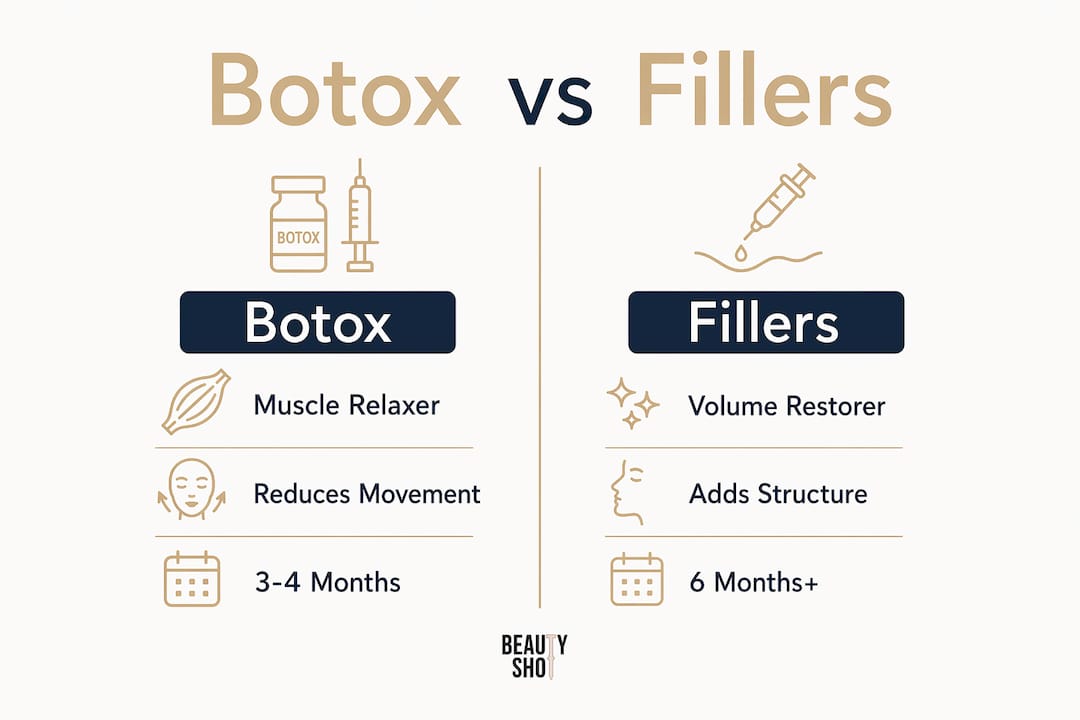
Botox uses botulinum toxin type A to temporarily block nerve signals to targeted facial muscles. When those muscles can no longer contract fully, the overlying skin smooths out. This is why Botox works so well on forehead lines, the “11s” between the brows, and crow’s feet. These are called dynamic wrinkles because they form through repeated movement. Botox does not add any volume to the face.
Dermal fillers work through an entirely different mechanism. Most fillers are made of hyaluronic acid, a substance naturally found in the body that attracts and retains moisture. When injected beneath the skin, fillers physically add volume, support skin structure, and restore contours that have flattened or hollowed with age. Brands like Juvederm and Restylane are among the most widely used hyaluronic acid fillers in Canada.
The onset of results also differs between the two. Filler results are visible almost immediately after treatment, though some initial swelling is normal. Botox takes a few days to begin working, with full results typically visible within 10 to 14 days. This is worth knowing so you plan treatments ahead of any important events.
Here is a quick comparison of the core mechanisms:
- Botox: Relaxes muscles, reduces dynamic wrinkles, no volume added
- Fillers: Adds volume, restores contours, hydrates skin from within
- Botox onset: Results visible within 2 to 14 days
- Filler onset: Results visible immediately, with final results after swelling settles
- Botox target: Muscle activity and expression lines
- Filler target: Volume loss, hollowing, and structural support
Pro Tip: If you are unsure which treatment you need, look at your face at rest versus when you are making expressions. Lines that appear only when you move are dynamic wrinkles suited for Botox. Lines and hollows visible even at rest are better addressed with fillers.
Which concerns are best treated with fillers vs. Botox?
Botox is the right choice when the concern is caused by muscle movement. Forehead lines, frown lines between the brows, crow’s feet around the eyes, and bunny lines on the nose are all driven by repeated muscle contractions. Botox is also used preventatively in younger patients in their mid-to-late 20s and 30s to slow the deepening of these lines before they become etched into the skin at rest.
Fillers address concerns rooted in volume loss and structural change. As we age, the fat pads in our face shift and diminish, collagen breaks down, and bone resorbs. This leads to hollowed cheeks, sunken under-eyes, flattened lips, deepened nasolabial folds, and a less defined jawline. Fillers restore youthful contours by replacing that lost volume precisely where it is needed.
Many patients benefit from both treatments together. A combination approach can address muscle-driven lines and volume loss simultaneously, producing a more balanced, refreshed result than either treatment alone.
| Concern | Best treatment |
|---|---|
| Forehead lines and frown lines | Botox |
| Crow’s feet and bunny lines | Botox |
| Hollow cheeks and temples | Dermal fillers |
| Lip volume and definition | Lip filler |
| Nasolabial folds and marionette lines | Dermal fillers |
| Jawline definition | Dermal fillers |
| Under-eye hollowing (tear trough) | Dermal fillers |
The areas listed above are not rigid rules. Every face is different, and a thorough consultation with an experienced injector is the only way to determine the right treatment plan for your specific anatomy and goals.
What to expect: treatment process, results, and maintenance
Knowing what happens during and after each treatment removes a great deal of uncertainty. Here is what a typical experience looks like for each.
-
Botox appointment: A Botox session takes approximately 10 to 15 minutes. Your injector will assess your facial muscles, mark the injection sites, and administer small amounts of botulinum toxin using a fine needle. There is minimal discomfort. You can return to your day immediately after.
-
Filler appointment: Filler treatments last 15 to 45 minutes depending on how many areas are treated. A topical numbing cream is often applied beforehand. Most fillers also contain lidocaine, which makes the injection more comfortable as treatment progresses.
-
Results and longevity: Botox results last approximately 3 to 4 months, after which muscle activity gradually returns. Fillers vary considerably. Lip filler may last 6 to 9 months, while cheek or jawline filler can last 12 to 24 months or longer depending on the product used.
-
Why location matters for fillers: Fillers in highly mobile areas like the lips break down faster than those placed in less mobile areas such as the cheeks or jawline. Mechanical movement accelerates the breakdown of hyaluronic acid, which is why lip filler requires more frequent touch-ups than cheek filler.
-
Long-term maintenance: Consistency pays off with both treatments. Regular Botox appointments can train muscles to contract less forcefully over time, meaning some patients need slightly less product as years go on. Similarly, repeated filler treatments may require less volume over time as the skin becomes better supported, making maintenance more cost-effective in the long run.
| Treatment | Session length | Onset | Duration |
|---|---|---|---|
| Botox | 10 to 15 minutes | 2 to 14 days | 3 to 4 months |
| Dermal fillers | 15 to 45 minutes | Immediate | 6 months to 2+ years |
Pro Tip: Book your Botox appointment at least two weeks before a significant event. This gives results time to fully settle and allows for a follow-up touch-up if needed.
Are Botox and fillers safe? Side effects and common myths
Both treatments are considered safe when performed by a qualified, experienced injector in a clinical setting. That said, understanding the risks and separating fact from fiction helps you approach treatment with realistic expectations.
Common side effects for both Botox and fillers include temporary redness, bruising, and swelling at the injection site. These typically resolve within a few days. More specific risks include:
- Botox: Temporary muscle weakness or drooping in adjacent areas if product migrates. This is rare and resolves as the Botox wears off.
- Fillers: Lumpiness or uneven texture if product is placed incorrectly. In rare cases, vascular occlusion can occur if filler is inadvertently injected near a blood vessel. This is a serious complication that underscores why injector skill and anatomical knowledge are non-negotiable.
The most persistent myth about Botox is the “frozen face” fear. Botox administered at appropriate doses by a skilled injector does not eliminate expression. It softens lines while preserving natural movement. The frozen look comes from overuse or poor technique, not from the treatment itself.
A similar myth surrounds fillers: that they always look obvious or “puffy.” Well-placed filler follows the natural architecture of the face. The goal is never to change how you look, but to restore what time has taken. You can read more about Botox safety research to better understand the clinical evidence behind these treatments.
“The best injectable result is one that nobody notices except you. When someone looks at you and thinks you look well-rested and refreshed, that is the outcome we are working toward.”
Choosing a Registered Nurse or physician with specific training in facial anatomy and cosmetic injectables is the single most important safety decision you can make.
Key takeaways
Botox relaxes muscles to address movement-driven wrinkles, while dermal fillers restore volume and structure. Choosing between them depends on your specific facial concerns, not a one-size-fits-all approach.
| Point | Details |
|---|---|
| Different mechanisms | Botox blocks nerve signals to muscles; fillers add physical volume beneath the skin. |
| Different target concerns | Use Botox for dynamic wrinkles; use fillers for volume loss, hollowing, and contour. |
| Duration varies by treatment and location | Botox lasts 3 to 4 months; fillers last 6 months to 2+ years depending on area treated. |
| Combining both is common | Many patients benefit from Botox and fillers together for a balanced, refreshed result. |
| Injector skill is the safety factor | Choosing a qualified, anatomy-trained injector reduces risk and improves outcomes significantly. |
What I have learned after years of treating real faces
I have been injecting Botox and fillers for over nine years, and the question I hear most often is some version of: “Which one do I need?” My honest answer is always the same. I need to look at your face first.
What surprises many patients is how rarely the answer is one or the other. Most people in their 30s and 40s have both dynamic wrinkles and early volume loss happening at the same time. Treating only one without addressing the other often produces a result that feels slightly off, even if the patient cannot articulate why.
The other thing I have learned is that less is almost always more, especially for first-time patients. I would rather treat conservatively and have you return for a touch-up than overdo it and have you feel self-conscious. The goal is for you to look like yourself on a very good day, not like a different person.
I also want to be direct about something: the quality of your result depends far more on who injects you than on which product is used. Juvederm and Restylane are both excellent fillers. Botox and Dysport both work well. What matters is the injector’s understanding of facial anatomy, their aesthetic eye, and their willingness to listen to what you actually want. Do your research, ask questions, and never let price be your primary deciding factor when it comes to your face.
You can explore more about choosing between Botox and fillers based on your individual goals and facial structure.
— Felix
Ready to find the right treatment for your face?
At Beautyshotmedicalclinic in Woodbridge, Vaughan, all injectable treatments are performed by Irene Soni, R.N., BScN, an advanced cosmetic nurse injector with over nine years of clinical experience. Whether you are exploring Botox for the first time, considering lip filler, or looking for a full facial balancing plan, every treatment begins with a thorough consultation focused on your anatomy and your goals. Irene’s approach prioritises natural, age-appropriate results that leave you looking refreshed and confident, never overdone. Visit Beauty Shot Medical Clinic to book your consultation and take the first step toward results you will genuinely love.
FAQ
What is the main difference between fillers and Botox?
Botox relaxes facial muscles to reduce dynamic wrinkles caused by movement, while dermal fillers add volume beneath the skin to restore lost contours and smooth static lines. They treat different concerns and are often used together for a complete result.
How long do Botox and filler results last?
Botox results typically last 3 to 4 months. Filler longevity ranges from 6 months for lip filler to 2 or more years for cheek or jawline filler, depending on the product and the mobility of the treated area.
Can you get Botox and fillers at the same appointment?
Yes. Many patients receive both treatments in a single session. Combining Botox and fillers allows your injector to address muscle-driven lines and volume loss at the same time, producing a more balanced outcome.
Is Botox or filler better for under-eye hollows?
Dermal fillers are the appropriate treatment for under-eye hollowing, also called the tear trough. This concern is caused by volume loss, not muscle movement, so Botox would not address it. Tear trough filler requires a highly skilled injector due to the delicate anatomy of the area.
At what age should you start Botox or fillers?
Botox is increasingly used preventatively in patients in their mid-to-late 20s and 30s to slow the deepening of expression lines. Fillers are typically introduced when visible volume loss begins, which varies by individual. A consultation with a qualified injector is the best way to determine the right timing for your face.
Recommended
- Botox vs. Fillers: Which One is Right for You? – Beauty Shot | Botox Fillers Woodbridge Vaughan
- What’s the Difference Between Lip Fillers & Botox for Lips? – Beauty Shot | Botox Fillers Woodbridge Vaughan
- Lip fillers vs. dermal fillers: What’s the difference and which is right for you? – Beauty Shot | Botox Fillers Woodbridge Vaughan
- Botox vs. Juvéderm: Which Treatment Is Better for You? – Beauty Shot | Botox Fillers Woodbridge Vaughan