Botox is defined clinically as an injectable neurotoxin, botulinum toxin type A, that works by gradually blocking nerve signals to targeted muscles rather than producing any immediate visible change. Understanding why botox takes time to work is one of the most common questions patients bring to their first consultation. The short answer: visible softening typically begins within 3–5 days, with full results peaking around day 10–14. That delay is not a sign that something went wrong. It is the biology working exactly as it should.
Why does botox take time to work at the cellular level?
Botox does not act the moment it enters your skin. The process is staged, and each stage takes time to complete. To understand the delay, you need to know what is actually happening at your nerve endings after injection.
Botulinum toxin type A works by cleaving SNAP-25 at the nerve terminal. SNAP-25 is a protein your nerve cells rely on to release acetylcholine, the chemical messenger that tells a muscle to contract. When SNAP-25 is cleaved, that signal is blocked. The muscle can no longer receive the instruction to tighten, and over days, it gradually relaxes.
The process unfolds in four distinct stages:
- Binding: The toxin attaches to the surface of the nerve terminal. This happens relatively quickly after injection, but binding alone produces no visible effect.
- Uptake: The toxin is absorbed into the nerve cell. This cellular uptake takes additional time and is not visible externally.
- Cleavage: Once inside, the toxin cleaves SNAP-25, disrupting the neurotransmitter release mechanism. This is the critical step that leads to muscle relaxation.
- Muscle relaxation: With acetylcholine blocked, the muscle gradually loses its ability to contract fully. This is when you begin to see softening in the skin above.
The reason muscle contractions do not stop immediately is straightforward. Your nerve terminals contain existing stores of acetylcholine that continue to function briefly even after SNAP-25 is cleaved. Those stores deplete over days, not hours. The neuromuscular junction changes that produce visible wrinkle reduction require this full depletion cycle to manifest on the surface of your skin. This is a natural biological process, not a treatment delay you can shortcut.
What is the botox effects timeline day by day?
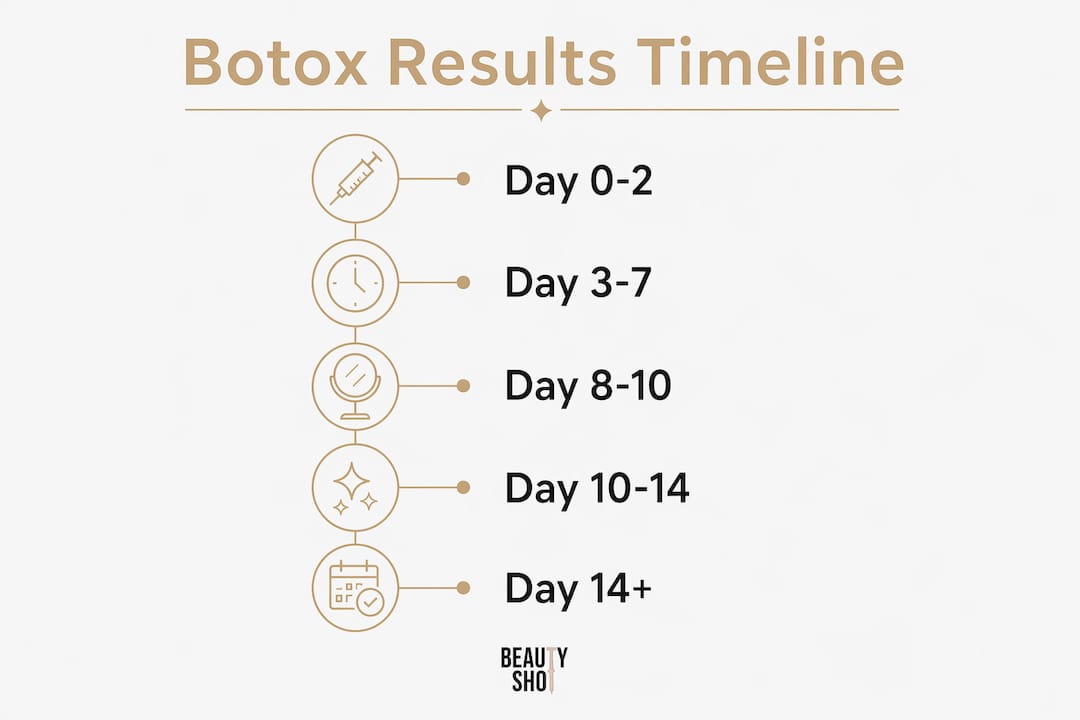
Knowing what to expect at each stage helps you stay calm and avoid second-guessing your results too early. The Botox effects timeline follows a predictable pattern for most patients, though individual variation is normal.

| Timeframe | What You May Notice |
|---|---|
| Day 0–2 | Mild redness, small bumps, or swelling at injection sites. These are trauma responses, not Botox effects. |
| Day 3–5 | First signs of muscle softening. Lines may appear slightly less defined during movement. |
| Day 5–7 | Continued relaxation. Some areas may look more relaxed than others at this stage. |
| Day 10–14 | Full results visible. Wrinkle reduction is at its peak and results can be fairly assessed. |
| Day 14+ | Stable results. This is the appropriate time to schedule a follow-up or touch-up if needed. |
The standard evaluation window is day 10–14 because this is when the neuromuscular blockade is complete. Mild unevenness during the first week is common and temporary. Different muscles in the same treatment area can respond at slightly different speeds, which is why one side of your forehead may look softer before the other. This is not asymmetry caused by technique. It is the biology catching up.
Temporary side effects during the onset period can include minor redness, small bruises, and light swelling. These resolve within 24–48 hours and have nothing to do with how well the Botox is working.
Pro Tip: Take a photo on the day of your treatment and another at day 14. Side-by-side comparison is far more reliable than daily observation, which can make subtle changes feel invisible.
What factors affect how quickly botox takes effect?
The Botox effects timeline is consistent in its general pattern, but the speed and visibility of onset vary between patients. Several biological and treatment variables influence how fast you see results.
- Muscle strength and size: Larger, stronger muscles have more acetylcholine receptors. More receptors means the toxin needs more time to achieve full binding coverage before visible relaxation occurs. First-time patients with strong facial muscles often notice a longer onset period than those who have had regular treatments.
- Prior Botox experience: Repeat patients sometimes see results slightly sooner. With consistent treatment, muscles gradually weaken over time, requiring less binding activity to produce visible relaxation.
- Metabolic rate: Your body’s metabolism affects how quickly the toxin is processed at the cellular level. Patients with faster metabolisms may notice both a quicker onset and a shorter duration of results.
- Age: Skin thickness and muscle tone change with age. Older patients with thinner skin may notice surface changes sooner, while deeper muscle relaxation still follows the same biological timeline.
- Dosage and injection technique: The number of units injected and the precision of placement directly affect how thoroughly the neuromuscular junction is blocked. This is why working with an experienced injector matters.
- Muscle group treated: Different muscles respond at different speeds. The forehead often shows earlier softening than the masseter or crow’s feet area. Your injector accounts for these differences when planning your treatment.
Faster onset is not always better. Rushing the process or adding units before the full effect has declared itself carries real risk. Premature touch-up injections can lead to over-correction because the initial dose has not yet reached its full neuromuscular impact. Patience here protects your results and your appearance.
Common misconceptions about botox timing
Many patients arrive expecting to see results within hours. When they do not, anxiety sets in. Understanding what early signs actually mean prevents unnecessary worry and premature decisions.
-
Redness and swelling mean Botox is working. This is false. Injection site redness reflects needle trauma to the tissue, not neurotoxin activity. These responses appear and resolve within hours to a day. They tell you nothing about how effectively the Botox is binding.
-
Early unevenness means the treatment failed. Muscles in the same area respond at different rates. Mild asymmetry during the first week is a normal part of the onset process, not an indicator of poor technique or failed treatment.
-
You can speed up Botox onset. There are no clinically proven methods to accelerate the biological process. The binding, uptake, and cleavage stages proceed at a fixed biological rate. Facial exercises, heat, and massage do not reliably change this timeline and may actually disperse the toxin to unintended areas.
-
If you do not see results by day 5, you need more units. Requesting a top-up before day 14 is premature. The full neuromuscular effect has not yet declared itself, and adding units at this stage risks over-correction and an unnatural appearance.
Pro Tip: Book your follow-up appointment at the time of your initial treatment, scheduling it for day 14. This removes the temptation to assess results too early and gives your injector a clear, accurate picture of your outcome.
The right approach is to follow your provider’s post-treatment guidance, attend your scheduled follow-up, and trust the process. If you have genuine concerns about your results after the two-week window, that is the appropriate time to consult your injector. You can also review Botox aftercare guidance to support your results during the onset period.
Key takeaways
Botox takes time to work because the neuromuscular blocking process unfolds in biological stages that cannot be shortened, with full results reliably visible only at day 10–14.
| Point | Details |
|---|---|
| Staged biological process | Botox binds, enters the nerve cell, cleaves SNAP-25, then relaxes the muscle over days. |
| Standard results window | Visible softening begins at day 3–5, with peak results at day 10–14 post-treatment. |
| Early signs are trauma, not results | Redness and swelling after injection reflect needle trauma, not neurotoxin activity. |
| Muscle variables affect timing | Stronger muscles, first-time treatments, and faster metabolisms all influence onset speed. |
| Premature touch-ups carry risk | Adding units before day 14 risks over-correction because the full effect has not yet appeared. |
What nine years of injecting has taught me about patience and results
The question I hear most often in the days after a treatment is some version of: “Is it working? I can’t really tell yet.” My honest answer is always the same. If it has been less than two weeks, you are not meant to be able to tell yet.
What I have observed over years of practice is that the patients who struggle most with the waiting period are often the ones who have done the most research beforehand. They arrive informed, which is wonderful, but they also arrive with a mental image of what day five should look like. When day five looks like day two, they worry. That worry is understandable. It is also almost always unnecessary.
The biology of Botox is not something you can hurry. I have seen patients request top-ups at day seven, convinced their treatment had not worked, only to return at day fourteen looking beautifully relaxed and concerned they had gone too far. That is the risk of acting before the full picture is visible. The science behind Botox is precise, and it rewards patience.
What I prioritise in every consultation is making sure patients leave with a clear, realistic picture of their timeline. Not because I want to manage expectations downward, but because understanding the process is what allows you to trust it. A patient who knows that mild unevenness at day six is normal does not panic. A patient who knows that day fourteen is the real benchmark does not book an unnecessary top-up. That knowledge protects both your results and your face.
The goal at Beautyshotmedicalclinic is never to produce the most dramatic change in the shortest time. It is to help you look refreshed, balanced, and still like yourself. That outcome requires the right dose, the right placement, and the right amount of time.
— Felix
Book your botox consultation at Beautyshotmedicalclinic
Understanding the timeline is the first step. Getting the right treatment plan is the next one. At Beautyshotmedicalclinic in Woodbridge, Vaughan, every Botox treatment is performed by Irene Soni, R.N., BScN, an advanced cosmetic nurse injector with over nine years of experience and training through Allergan, Teoxane Academy, and Clarion Medical. Irene assesses your muscle anatomy, discusses your goals, and explains exactly what to expect at each stage of your results. There are no surprises and no pressure. If you are ready to learn more about your options, start with our injectable cosmetics guide or visit our Botox and Dysport page to book a consultation.
FAQ
Does botox work immediately after injection?
Botox does not produce immediate visible results. The neuromuscular blocking process is staged, with first signs of muscle softening typically appearing between day 3 and day 5.
How long does botox take to reach full effect?
Full results from Botox peak at approximately day 10–14 post-treatment. This is the standard window used by clinicians to fairly assess outcomes and determine whether a touch-up is needed.
Why does botox take longer for some people than others?
Stronger muscles, first-time treatments, and faster individual metabolic rates all extend the onset period. Prior Botox experience and smaller muscle groups tend to show results slightly sooner.
Is early unevenness after botox a sign of a problem?
Mild asymmetry during the first week is normal. Different muscles respond at different speeds, and the full effect across all treated areas is not complete until day 10–14.
When is the right time to get a botox touch-up?
The appropriate time for a touch-up assessment is at or after day 14. Requesting additional units before this point risks over-correction because the initial dose has not yet reached its full neuromuscular effect.
Recommended
- How Soon Will I See Results After a Botox Treatment? – Beauty Shot | Botox Fillers Woodbridge Vaughan
- How Long Do Botox Results Last and When Should I Get a Touch-Up? – Beauty Shot | Botox Fillers Woodbridge Vaughan
- The Science Behind Botox: How Does It Work? – Beauty Shot | Botox Fillers Woodbridge Vaughan
- What to Expect: The Botox Procedure from Start to Finish – Beauty Shot | Botox Fillers Woodbridge Vaughan